
The superfast express train from Ahmedabad to Bhuj

THE EXPRESS TRAIN, Indian Railways number 22903 (the Bhuj AC Superfast Express), runs between Bombay and Bhuj (in the Kutch district of Gujarat). On its way, it stops at Ahmedabad Junction Station at 630 am. To catch the train, we arrived at Ahmedabad Junction at about 530 am – I always prefer being early at the departure point of a train, aeroplane, bus,  etc.


It was dark as our autorickshaw drove speedily along the empty streets of central Ahmedabad. The sun only rises after 7 am in the west of India.
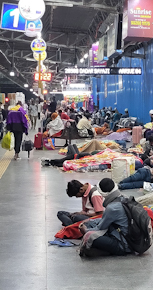
 

Ahmedabad Junction Station

The well-lit station platforms were covered with rows of people wrapped in blankets, sleeping on the floor. The sight of these sleepers reminded me of the images that Henry Moore made of people sleeping on the platforms in London’s deep Underground stations during WW2. Of course, the people sleeping in Ahmedabad’s Station were awaiting trains, not sheltering from bombs dropped by the German’s Luftwaffe.


These sleepers were not disturbed by the endless series of train announcements, each of them were made in three languages: Hindi, English,  and Gujarati. One of them that was repeated at regular intervals informed those who were listening that the Shalimar Superfast Express (it runs between Kolkata and Bombay) was running 12 hours and 50 minutes late. Fortunately, our train 22903, pulled into platform 3 almost exactly on time.


We had reserved places in the first class, air-conditioned carriage, and had a coupé (compartment) to ourselves. Although comfortable,  it was a rather spartan little cabin. I believe that first-class rail travel in India is aimed at those who wish to travel secluded from the ‘madding crowd’. Frankly, I prefer travelling in a carriage in which one can see and, sometimes,  interact with one’s fellow travellers and the endless stream of vendors, who move up and down the trains in India.


The six-hour journey from Ahmedabad to Bhuj is through terrain as flat as in the Netherlands,  but much dustier. All along the route we passed factories, both small and large, many with chimneys emitting smoke. For the first half of the journey,  we travelled past well-tended fields in which crops were growing. After crossing into Kutch, we passed numerous vast water features containg seawater that was being dried to produce salt. Every now and then, white, conical mounds of salt could be seen. The train runs for a long way parallel to a main highway in Kutch.  This connects Kutch and its important port Kandla with the rest of India. An endless stream of large trucks moves along this road.


At Gandidham in Kutch, the train’s engine was changed. We began moving in a different direction as we travelled along the stretch of rail track between Gandidham and Bhuj, where we disembarked.  Outside the station there was a sea of men offering to drive us in taxis, jeeps, and autorickshaws.


Eventually, our driver met us, and drove us through the hilly, almost arid hills between Bhuj and Kutch Mandvi, where we were going to stay with my wife’s cousins.


Even though train 22903 traverses terrain that few would regard as picturesque, I always enjoy long land (rather than air trips) journeys through  the countryside of India.

A slow journey in the west of India

OUR JOURNEY FROM Bhuj to Baroda (Vadodara), both in Gujarat, began yesterday at 650 am and ended at our hotel just after 8 pm. The distance we travelled was about 265 miles. There are direct trains between Bhuj and Baroda, but these were fully booked on the day we wanted to travel (i.e., 30th November 2023).

The first ‘leg’ of our journey was on a train that carried us from Bhuj to Sabarmati Junction – one of Ahmedabad’s several railway stations. The other passengers in our compartment were 4 young girls and a couple of young men returning to university after their Diwali break. We noted that the girls talked to each other. So, did the boys. But the girls and boys did not converse with each other and showed no interest in each other. The train rattled at high speed through the flat countryside and arrived at Sabarmati only about 8 minutes late. Unlike many Indian trains I have been on, the Bhuj to Sabarmati Superfast had no vendors wandering up and down the train.

It is a few miles between Sabarmati Junction and Ahmedabad’s centrally located main station. We hired an autorickshaw to take us between Sabarmati Jn and the Moti Mahal restaurant near the main station. Our driver tore through the heavy traffic narrowly missing numerous collisions. The eatery proved to be a scruffy but extremely popular place – noisy and lively. We enjoyed a good light lunch before walking to the station.

Although it was only about 200 yards between the restaurant and the station, it was necessary to cross an incredibly busy road with fast moving vehicles. We asked an autorickshaw driver if he would drive us there. He refused, but kindly offered to help us across the road, which resembled a disorderly road race. Using his arms like a traffic policeman he shepherded us across the thoroughfare. Even with his help it was a hair-raising experience.

We had to wait for our next train for about two hours on platform 6. The train we were about to catch was the Porbandar Shalimar Superfast. This train leaves Porbandar in Saurashtra (part of Gujarat) at 850 am on day 1 and arrives at Shalimar (a station in Calcutta) at 3.35 am on day 3 – having travelled a distance of 2544 km. Our journey on this train lasted just under two hours, arriving in Baroda about 20 minutes late.

She sells mats to passengers in the train

Unlike the train from Bhuj, the train to Shalimar was well populated by vendors. The seemingly endless procession of sales people were offering: bottled water; hot tea; snacks including biryani and bhel poori; bags of apples; and mobile phone chargers and cables. One lady in a colourful sari was selling attractive square mats at 10 Rupees each. Every now and then, a deformed invalid literally scuttled along the filthy floor of the corridor. He stopped at each compartment and banged his collecting pot ominously on the ground. Only a few passengers gave him coins.

The sun had set when our train pulled out of Ahmedabad. Through the open window, I saw many small villages, many of them with Hindu temples adorned with coloured lights – many of them flashing decorously. I could also see many brightly lit shops. Within the train, I had an excellent view of the door to one toilet. Even when it was closed it vibrated furiously as the train sped along. Many passengers peered inside the loo, but few dared to enter it.

The train seemed to travel even faster than the one from Bhuj, and it was a relief to disembark in Baroda’s lovely station. After another autorickshaw drive, we arrived at our comfortable hotel. Our reception there was a little reminiscent of an episode from “Fawlty Towers”. Once this was, over, things went smoothly and we enjoyed a good dinner in its dining room.