THE SERPENTINE GALLERY rarely puts on exhibitions that can be described as ‘mundane’. It is the most exciting and adventurous public art gallery in London. True to form, its current show (in the South gallery) is both weird and unexpected – actually, quite funky. Called “Emajendat” (i.e., ‘imagine that’), it is on until the 2nd of March 2025. The exhibition or art installations were created by Lauren Halsey, who was born in 1987 in Los Angeles (USA), where she lives and works.
Ms Halsey has created a series of fantasy landscapes that reflect the backyard culture of the part of Los Angeles – South Central – where was brought up and still lives. The exhibition’s leaflet explained that she:
“… has developed a distinct visual language deeply rooted in South Central Los Angeles where her family has lived for generations. Through objects and installations, Halsey archives and remixes the changing signs and symbols of her environment, gathering physical and graphic material from her neighbourhood. In her work Halsey merges past, present and future via her interest in iconography connected to the African diaspora, Black and queer icons and architecture. Halsey cites the collective sonic and visual layering associated with funk music as the blueprint for her approach to making, traversing time and drawing on a wide range of sources.”
The extraordinary environments she has created in the various spaces within the Serpentine have a humorous dreamlike quality, and at the same time contain her comments on the social culture of Los Angeles. These comments and her message as described in the gallery’s leaflet were lost on me, but I enjoyed the visual impact and creativity of what I saw. From a purely aesthetic point of view, this extraordinary exhibition is like the proverbial ‘breath of fresh air’.
I DOUBT THAT Auguste Rodin (1840-1917) would have ever imagined that a copy of his sculpture “The Kiss” (created 1901-1904) could have ended up being displayed bound up in one mile of string. Situated in the lower ground floor foyer of London’s Tate Britain gallery, that is what can be seen currently (August 2022). The British artist Cornelia Parker (born 1956) decided to wrap-up/tie-up a replica of “The Kiss” as described. You might wonder why. I cannot tell you, but make the observation that we all perceive things differently. And one of the skills that has united artists over the centuries is that they can express to other people the way they perceive and understand the world they observe. Rodin’s bound sculpture stands close to the entrance of an exhibition dedicated to works by Ms Parker, which runs until the 16th of October 2022.
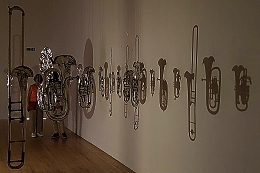
Part of “Perpetual Canon” by Cornelia Parker
The exhibition consists of artworks of varying sizes including visually dramatic installations, each large enough to fill a spacious room in the gallery. All the works are labelled. These labels explain how they were created and the concepts, some of them with political aspects, that the artist intended to express. When I look at works of art, I am primarily stimulated by their appearance and the visceral emotions they evoke in me. I am less interested in the concepts being portrayed and the artist’s explanations. Therefore, amongst the exhibits in the Parker exhibition, it was the installations that both interested me and excited me most.
The installation “Thirty Pieces of Silver” consists of domestic silver plate items that were squashed beneath a steam roller. Each piece is suspended above the ground by fine threads attached to the ceiling. They are arranged in thirty separate groups and lit from above. The shadows of the silver objects are projected on the floor below them. This delicate-looking installation’s name is taken from the 30 pieces of silver, which Judas received for betraying Jesus.
A spectacular installation, “Cold Dark Matter: An Exploded View”, is housed in another room. Parker arranged with the Army School of Ammunition to use Semtex (as used by terrorists) to blow-up her garden shed (filled with tools and other stored objects). Then, all the fragments were recovered, and one by one they were suspended from the ceiling of the gallery in such a way that the ensemble resembles a still from a film made whilst the shed was exploding. In the middle of all the suspended debris, there is a single light bulb shining. This throws the distorted shadows of the blackened fragments onto the gallery’s walls.
In another room, there was an installation, which also made effective use of reflections projected on to its walls. “Perpetual Canon” consists of a collection of silvered brass instruments, which have been flattened. Each of them is suspended from the ceiling by a fine thread, and they are arranged in a circle which surrounds a centrally located light. The light throws shadows of the instruments onto the four walls surrounding them. Like the two previously described works, this provides a very effective and intriguing visual experience.
Another installation, “The War Room”, impressed me least amongst this category of Parker’s works on display. One of the last rooms in the exhibition houses an installation called “Island”. This consists of a common design of garden greenhouse. Its floor consists of worn floor tiles that used to line the corridors of The House of Commons. The glass panes are covered with white dots made from cliff chalk. They are related to Parker’s reaction to Brexit. Contained within the glasshouse, there is a light whose brightness pulses like that of a lighthouse: increasing gradually, and the slowly diminishing. This causes the shadows of the dots and the frame of the greenhouse to be projected on to the walls of the room containing it. Like the light producing them, the intensity of the shadows pulsates gradually.
As already mentioned, the exhibits’ labels explain what Parker is trying to express. Interesting as that is, it was the visual impact of these installations that impressed me most. Parker, like all great artists, has interesting ideas expresses them most imaginatively and effectively.
The first time I saw a performance of Shakespeare’s A MIDSUMMER NIGHTS DREAM was in the 1960s in north London (Big Wood in Hampstead Garden Suburb). It was performed by an amateur dramatic group in a clearing in a small wood. There were barely any props. The actors appeared and disappeared in and out of the trees growing around the clearing. It might not have been the very best of renderings of the play, but I found it highly enjoyable and magical. Whenever I think of the Dream, I remember that show in the woods, so long ago, with much fondness.
Since that magical summer evening in the wood, I have seen several more performances of the play, but none of them managed to recapture for me the magical experience that was created for me by my first viewing of the work.
A few days ago, I watched yet another performance of the Dream. This time it was at the lovely new Bridge Theatre next to the southern end of London’s Tower Bridge. The staging and acting was brilliant. The Director, Nicholas Hytner, had ‘tweaked’ the play slightly but successfully to make it more accessble to contemporary audiences. I hope that Shakespeare would have approved of this latest version. I feel that he might well have done. The ‘show’ was livened up with acrobats, who were not only superbly skilful but also great actors with clear diction, and much music. Despite these additions, the Bard’s original words were not sacrificed or edited in any noticeable way. It was not merely a play, but a spectacular extravaganza.
There was one aspect of the performance that I did not like. The play was performed ‘in the round’ on an arena where there would normally be stalls seating. Many people had bought tickets to stand on the stage in order to take part in an immersive performance. The actors mingled with the crowd of spectators standing on the ‘stage’. Assistants and the actors themselves shifted the crowds around to make spaces for props and passages through which the actors could move. It was a case of, to use the Bard’s words, “All the world’s a stage…”. This seemed to be very popular with both the audience members immersed in the drama as well as the rest of us sitting in seats. I was not keen on watching a play where the actors are surrounded by swarms of spectators. I felt that the latter diluted the action and were a bit of a distraction. The immersive theatre technique disturbed me, but most of the rest of the audience approved of it.
My picture shows the actors and audience mingling together at the end of the play



 yamey
yamey 