IT IS EASY to understand the great popularity of paintings by David Hockney. They are colourful, often cheerful, and full of life. Until 23 August 2026, there is a delightful exhibition of his work at the Serpentine North gallery in London’s Hyde Park.
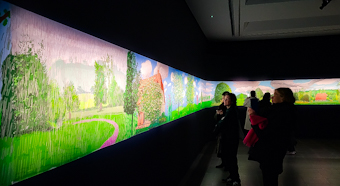
The highlight of the show is a series of prints of images that Hockney created on his iPad in France. They are joined together to form a huge, long picture depicting the seasons in the countryside of Normandy in France. Entitled “A Year in Normandie”, it was inspired by the famous Bayeux Tapestry. However, unlike the tapestry that portrays military activities, Hockney’s twenty-first century take on it contains only idyllic views of a peaceful countryside, changing in appearance as the year proceeds. The result is wonderful.
In addition to the Normandy scenes, there is a good selection of Hockney’s portraits on canvas. Painted mainly during the last year or two, many of them include objects such as tables painted so that perspective has been reversed. For example, the front of a table in a picture is painted narrower than the distant end of it.
All in all, this is a great exhibition. It shows that advancing age need not be an impediment to creative artistic productivity: Hockney is in his late eighties, soon to be 90.
THE CARTWRIGHT HALL Art Gallery in Bradford has a collection of paintings by David Hockney (born 1937), some of which he did when he was as young as 16. These early paintings, though not as adventurous as his later work, show that even as a teenager, he was a skilled artist. He studied art at Bradford College of Art. Then, between 1959 and 1962, he continued his studies at London’s Royal College of Art (‘RCA’). It was after his arrival in London that Hockney began experimenting with new ways of expression in painting. Apparently, he was not an ideal student in the eyes of the RCA. For example, he did not attend lectures and did not do the prescribed coursework. Yet, he created numerous paintings that are evidence of his skilful breaking away from conventional painting. Today, we caught the last day of an exhibition of the paintings he did between 1959 and 1963. It was held at Hazlitt Holland-Hibbert Gallery in Mayfair’s Bury Street.
Detail from the Diploma etching
The gallery’s website explained:
“Exhibited together for the first time, these early paintings embellished with love hearts, graphic text, suggestive shapes and depictions of friends and lovers reveal David Hockney’s precocious talent during the most formative chapter of his career.
In 1959, Hockney moved from Bradford to begin his studies at the Royal College of Art, London, where he was determined to experience the capital’s postwar bohemian culture as well as absorb the modern and contemporary art in its museums and galleries. The exhibition focuses on this period before Hockney relocated to the United States at the end of 1963 and reveals his discovery of an unmistakably personal style of painting that would establish him as the most important artist of his generation.”
It was exciting to view the images he created during this important period of his artistic development. However, for a while the RCA failed to appreciate him, and for a while threatened not to award him his degree. An article in Wikipedia revealed:
“When the RCA said it would not let him graduate if he did not complete an assignment of a life drawing of a live model in 1962, Hockney painted ‘Life Painting for a Diploma’ in protest. He had refused to write an essay required for the final examination and said that he should be assessed solely on his artworks. Recognising his talent and growing reputation, the RCA changed its regulations and awarded him a diploma.”
An etching in the exhibition, “The Diploma”, created in 1962, reflects Hockney’s protestation. Since graduating from the RCA, Hockney has been given awards by many prestigious institutions, and was made a Royal Academician.
Having seen his earliest known works in Bradford, the works done while at the RCA, and later creations, it is easy to understand why Hockney is now regarded as an artist of the highest calibre.
I VISITED BARCELONA in the late 1960s. One of the sights I saw was a museum dedicated to Pablo Picasso. Before entering that place, the artist’s works somewhat puzzled me. In the museum, there were some of Picasso’s earliest paintings. They were straightforward rather than abstract, and extremely well executed. The artist’s talents were immediately obvious. As I moved from room to room, the works on display became increasingly abstract. By seeing his progression from figurative to abstract, I began to appreciate his greatness as an artist, and I began to understand why he is regarded as a brilliant creator by many people. By the time I had finished looking around the museum, I had been converted from being sceptical about Picasso to becoming yet one more of his fans. More recently, I saw an exhibition showing the artistic development of Roy Lichtenstein from his earliest to his latest creations. No longer was he just a creator of entertaining pictures based on American comic strips, but I could see that he was an artist of great competence. Like the foregoing examples, a visit to the Cartwright Hall Museum in Bradford and seeing some of David Hockney’s earliest works also enhanced my appreciation of this highly prolific visual artist.
Bradford in Yorkshire is not far from the city of Wakefield, where Barbara Hepworth (1903-1975) was born. She was baptised in the city’s fine cathedral. Until today, I had mixed feelings about Hepworth’s works. There are some that I like very much, including a Mondrian-like crucifix at Salisbury Cathedral and a Naum Gabo inspired work attached to the eastern side of the John Lewis shop on London’s Oxford Street. Also, I have enjoyed visits to Hepworth’s studio and garden in Cornwall’s St Ives. However, as beautifully executed as her works are, I did not become terribly keen on her artistic output until today, the 18th of September 2021.
What converted me and increased my appreciation of Hepworth as an artist was today’s visit to the Hepworth Wakefield Museum. We arrived to discover that for the time being the whole museum is filled with works by Hepworth, beginning with her earliest and ending with her latest. The temporary exhibition, “Barbara Hepworth: Art & Life”, continues until the 27th of February 2022, and should not be missed.
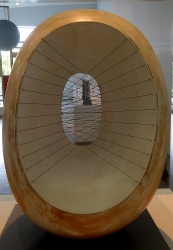
As with other abstract artists, such as Picasso, Hepworth began learning the basics of figurative representation. Her earliest carvings and drawings were created superbly competently but give no hint of which directions her creative output was soon to follow. Had she not developed any further, she would have been regarded as a skilled, if not too exciting, sculptor. However, Hepworth soon became involved artistically, and in one case maritally, with leading artists of the twentieth century. Contact with them and their ideas can be detected in some of the works she created as she moved from purely representational to highly abstract. It was particularly interesting to see a small carving with a hole in it, the first of her many works to have holes in them. The idea of the holes is to allow light to flow through her sculptures. It was not only other artists who inspired Hepworth’s creation but also the forces of nature, which unconsciously sculpt rocks, trees, and other natural features in the landscape.
It was interesting to see the life-size prototypes of some of Hepworth’s works I have admired in the past. It was wonderful, for example, to be able to get close to the full-size model sculpture which is now high up on the wall of John Lewis in Oxford Street.
Once again, seeing a collection of works illustrating the progression of an artist’s output from student days until the achievement of fame and beyond has helped me to increase my appreciation of an artist about whom I had some reservations. Today’s visit to the Hepworth Wakefield has moved Barbara Hepworth a long way up my ladder of great artists and removed any doubts I had about her works.
Finally, here is something that intrigues me. Hepworth, like Picasso and also my late mother, had what might be described as traditional basic artistic training, just like the European and western artists who created during the many centuries before the 20th, yet all three of them (and many others) moved from expressing themselves with figurative works to abstract creations. However, unlike the artists who flourished before the latter parts of the 19th century and never strayed into the world of artistic abstraction, those who created during after the late 19th century (including the Impressionists) strayed away from the purely figurative/representational. Why this happened is no doubt the subject matter of much art historical literature, which I have yet to read. As I wrote the previous sentence, it occurred to me that the move towards abstraction (and other forms of art that do not appear to give the viewer a straightforward recreation of nature) coincided with the advent of photography. The photograph can give the illusion of being a true image of the world, leaving the artist to explore other more imaginative representations of what he or she has seen.


 yamey
yamey 