HITCHIN IN HERTFORDSHIRE is the home of the North Hertfordshire Museum. Until 25 May 2025, it is holding an exhibition of the ceramic artworks of Abdo Nagi (1941-2001). He began life in Yemen, where during his early years he was a goatherd. When he was 12 years old, against his father’s wishes, he moved to Aden, where he worked for British ‘ex-pat’ families living there. In 1967, he moved to the UK with his then employer, and eventually settled in Letchworth (Hertfordshire). To earn a living, he worked in a Wimpy bar, then a hotel, and then an engineering firm.
After passing O’level and then A’ level examinations in art, Nagi was appointed Assistant art Technician at North Hertfordshire College. It was here that his creativity began to flower. He began creating ceramic artworks that were inspired by his Yemeni background, and made money by selling them. Then he took a degree in ceramics at Middlesex, graduating in 1988. From then on, his artistic career took off. His work was exhibited in important shows all over the country. The North Hertfordshire Museum bought three of them for their collection. Sadly, a heart attack killed him at the age of 60.
The works currently on show in Hitchin’s fine museum are well-displayed alongside pictures of Abdo at work and various portraits of him painted by local artists. I liked almost all of the works on display. Some of them are unusually shaped, possibly inspired by the crafts of his native land. There is nothing in the exhibition that I would not like to possess – and some of the works are on sale. If you happen to be passing anywhere near Hitchin (a lovely historic town), making a detour to see this show would be worthwhile.
HE WAS PASSIONATE about sketching and painting. However, his father, a wealthy Quaker brewer in Hitchin (Hertfordshire), insisted that his son should dedicate himself to working in the family business and use his spare time to create his art. The artist was Samuel Lucas (1805-1870). There is a wonderful exhibition of his creations at the beautifully laid out North Hertfordshire Museum in central Hitchin until the 12th of November 2023.
After schooling and an apprenticeship in London’s Wapping, Samuel worked in the family business in London before returning to work in Hitchin in 1834. As for his artistic ability, this appears to be self-taught. However, he was a keen visitor to the Royal Academy exhibitions in London. In 1837, he married Matilda Holmes, who had been a pupil of the artist John Bernay Crome (1794-1842). She was keen on sketching, but none of her works have survived. I speculate that it is not beyond possibility that Matilda, a water colourist, might have helped Samuel develop his superb water colour techniques.
Samuel’s sketches range from extremely detailed to impressionistic, resembling the work of JMW Turner to some considerable extent. The finished oil paintings, some of which were displayed at the Royal Academy, are beautifully composed, full of detail, and of great visual interest.
Two of the exhibits interested me more than the others. One of them is a pen and ink sketch depicting Thomas Whiting of Hitchin reading Harriet Beecher Stowe’s anti-slavery novel “Uncle Tom’s Cabin” (published 1852) to a gathering of people in a hall in Hitchin. Nearby, there was one of Samuel’s oil paintings. This shows seven men seated around a small table listening to a man standing with his left hand on the table. The standing man is Bishop Samuel Wilberforce (1805-1873). He is addressing members of the Oxford Mission amongst whom is the novelist Lord Lytton of Knebworth (Hertfordshire). The bishop was a son of the anti-slavery activist William Wilberforce. Bishop of Winchester from 1870 until 1873, he was both against slavery and Darwin’s Theory of Evolution. Samuel Lucas’s painting depicts him when he was Bishop of Oxford, which he became in 1845, and remained until he was shifted to Winchester. The Oxford Mission was an Anglican missionary organisation, which became important in Bengal in the late 19th century.
The two pictures described relate to Samuel Lucas’s involvement of the anti-slavery movement. In 1840, he was Hitchin’s delegate to the Anti-Slavery Convention held in London at Exeter Hall on the 12th to 23rd June 1840. During this period, he and his wife hosted some of the delegates who had come from the USA. The convention is portrayed in a painting by Benjamin Haydon (1786-1846), which is now in the National Portrait Gallery. The gallery’s website has a photograph of this painting, which has been displayed so that the viewer can identify each of the people in it. Samuel Lucas can be found near the back of the gathering near a pillar.
Lucas was against slavery, as were many of his fellow Quakers. In addition to this activity, his artistic creations, and his involvement in the family business, he was also an active contributor to the life and development of Hitchin. One of the largest of his paintings in the gallery, but not included in the exhibition, is a depiction of Hitchin’s Market Place. Each of the many people shown in the painting is a portrait of an actual person. The museum has an interactive guide to identify the people. One of them was Isaac Newton (1785-1861). This gentleman was not the famous scientist but the owner of a family firm of painters, plumbers, and glaziers. One of the many folks in the picture has a dark complexion. This is a portrait of Samuel ‘Gypsy’ Draper (1781-1870). He was a violinist, who played for dances and fairs in the area in and around Hitchin for about 20 years. Some of the local Quakers disapproved of him, but Samuel Lucas placed him at the front of the crowd in the centre of the painting. Had we not visited the North Hertfordshire Museum out of pure curiosity, I doubt that we would have ever come across the life and works of Hitchin’s Samuel Lucas. We spent most of our time looking at the superb exhibition about him, so that we had hardly any time left to see the rest of the museum. A fleeting glimpse of the other galleries in the lovely modern building was enough to persuade us that we need to return to see more.
HITCHIN IS A SMALL, attractive town in Hertfordshire. When we first visited it in 2020, despite an easing of the covid19 lockdown rules, we were unable to enter the town’s 14th to 15th century church of St Mary’s. On the 26th of August 2023, we spent a couple of hours in Hitchin and were able to enter the church. It contains many items of interest including a large painting created in the studio of Ruben’s.
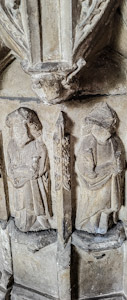
It was the 15th century carved stone font that particularly interested me. The column supporting the bowl, which contains water with which children are baptised, has twelve carved figures. These depict the 12 apostles. Looking at these closely, you will see that they are all mutilated. Their faces have been chipped away, leaving the figures faceless.
The very helpful and informative gentleman who was looking after the church was not sure whether the faces were obliterated by Thomas Cromwell during the Reformation of Henry VIII or during the time of that other iconoclast Oliver Cromwell.
Luckily the carved angels that adorn the ceiling of the Chapel of St Andrew and a finely carved 15th century wooden screen escaped the attention of the iconoclasts. In one or two Suffolk churches we have visited, angels such as these were destroyed as part of the attempts to ‘purify’ the English Church.
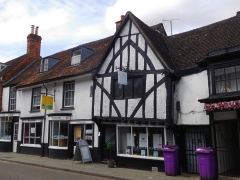
Apart from what I have described, there are plenty of other things that make a visit to Hitchin’s church worthwhile. And if you enjoy ‘Olde Worlde’ British buildings, the town centre is rich in them.
KEEN READERS OF NOVELS by Georgette Heyer (1902-1974) will have come across the name ‘Hitchin’ in several of her stories. For example, in “The Foundling”, Belinda sighs, and then says:
“She went to a place called Hitchin, but I don’t know where it is, and I only recall it because it sounds like kitchen, and I think that is very droll, don’t you, sir?”
She receives the reply:
“But Hitchin lies only a few miles from here! I daresay no more than six or seven, perhaps not as much! If you think you would like to visit this friend, I will take you there tomorrow! Do you know her direction?”
Later in the story, there are frequent mentions of Hitchin and a ‘Sun Inn’ in the town. There used to be an inn with that name on Sun Street, where currently, there is a Sun Hotel. In another novel, “The Reluctant Widow”, Hitchin is the name of the landlord of an inn, ‘The Bull’ in Wisborough Green, a village in West Sussex.
Old world in central Hitchin
It is only in recent years that I have begun to read the wonderfully crafted historical novels by Heyer, but I was aware of Hitchin even as a young child. In those now far-off days, when I lived near Golders Green in north London, I was a collector of bus and train maps and an enthusiastic observer of buses. One of the buses that passed through Golders Green and along Finchley Road was the Green Line route number 716 that travelled all the way from Chertsey in southwest London to … you have probably guessed … Hitchin, far north of London in Hertfordshire. It was only today (11th of May 2021) that I finally got to visit Hitchin. I had read that it has a picturesque historic town centre and what we found surpassed all expectations.
A 7th century document states that Hitchin was the centre of the Hicce people, ‘hicce’ being Old English for ‘the people of the horse’. By 1086, when the Domesday Book was compiled, Hitchin was described as a ‘Royal Manor’. The town’s name is also associated with the River Hiz (pronounced ‘hitch’ by some), a short stretch of which flows in front of the eastern end of the centrally located St Mary’s Church, which is mostly 15th century with an 11th century tower. Later, the town thrived because of the wool trade; vellum and parchment making; tanning; rope-making; malting; and its coaching inns, such as that mentioned in Heyer’s novel. Hitchin was a staging post for coaches travelling between London and what road signs in the south of England call ‘The North’. The town is not far from the current A1 trunk road. Many of the inns have long since closed, but their picturesque buildings, most of which look mediaeval, or at least pre-Georgian, still stand and can often be identified by the large archways leading from the street into yards behind them. Grain trading was another important activity in the town. Its former Corn Exchange still stands in the Market Square, but its use is no longer what it was built for.
Despite the 20th century improvements in transport links to London, making Hitchin into a convenient place for commuters, the historic town centre contains a remarkably high number of old buildings lining its mediaeval street lay-out. These old throughfares surround the lovely, large Market Square, which like many towns and cities in mainland Europe, was filled with tables and chairs for people to enjoy refreshments from the many eateries that surround it. A covered arcade leads off the square and provides a weather-proof place for refreshments. Nearby, there is a modern market area with stalls with conical roofs. We were fortunate to have arrived on a day, Tuesday, when this market is working.
Our first impression of Hitchin was extremely favourable, but because we had planned to do so much more sightseeing that day, we did not spend nearly enough time there. We hope to revisit this place again soon. I can strongly recommend the Hitchin to anyone who wants to get a flavour of ‘Ye Olde England’ without having to travel too far from London.



 yamey
yamey 