
In Holland Park
A heron stands looking pensively.
At what I ask?

In Holland Park
A heron stands looking pensively.
At what I ask?

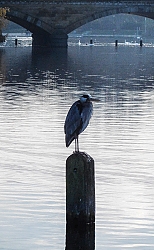
On a pole sits
A waterfowl watching keenly
A lonely heron

Standing, watching
Head turning slowly now and then:
A lonely heron

LONDON’S HOLLAND PARK contains a lovely area – the Kyoto Garden. It is a well-maintained Japanese-style garden. I visit it frequently. Each time, I see something different there.
The garden is planted around a small pond in which there are several rocks, which look like miniature islands. Today, I saw a heron perched on the summit of one of these rocks. It stood still, moving its head slowly every now and then. It showed little interest in the many fish that swim in the pond. My wife noticed that there was a nest containing eggs just below the bird’s feet. The creature stood like a sentinel, guarding its future offspring.
I could see four eggs in the nest – there might have been more. In general, so I learned from Wikipedia, the various species of heron are monogamous and lay between three and five eggs. I have no idea what species I saw in the Kyoto Garden, but it is the first time I have seen a heron’s nest with eggs anywhere in Holland Park.
Waiting silently
By the Serpentine lake
Stands a serene heron
KENSINGTON GARDENS CONTAINS numerous works of art, one of which is a large piece by Henry Moore (1898-1986), a sculptor who is highly regarded by many people. It is a large irregularly shaped arch made of travertine, which stands overlooking the Long Water, the part of the Serpentine lake within the confines of Kensington Gardens. Presented by the artist to the park in 1980, its shape is based on that of an animal bone. I am not wild about Moore’s works, but this piece looks wonderful in its setting on the eastern bank of the Long Water.

Today, 19th of May 2021, whilst walking in Kensington Gardens I saw a heron standing on the western bank of the Long Water almost framed by the Moore arch. After circumnavigating the lake, we reached the point on the eastern shore where the sculpture stands. Through the archway you can see the eastern façade of Kensington Palace. Along the line that connects the palace and the sculpture, you can see another sculpture, “Physical Energy” by George Frederick Watts (1817-1904). The three items on this axis form a kind of timeline: the 18th century palace, the 19th century sculpture by Watts, and the 20th century sculpture by Moore.
I have walked past the Moore sculpture too many times to count, but it was only today that I saw a heron perched on top of it. I have seen geese and pigeons perched on it in the past, but this was the first time I saw a heron using it as a doubtless superb vantage point to survey its surroundings. Apart from the fact that I find herons beautiful, its close association with the sculpture struck a certain curious chord in my mind. Maybe, it was something to do with the fact that the words ‘heron’ and ‘henry’ share so many letters in common (3 out of 5). Whatever the reason, it was pleasing to see nature and art intimately in touch with each other.

It stands on a fountain
A painting behind
Only a simple heron

You can never tell
What you might chance to see
When walking in the park
A heron in London’s Regents Park
 yamey
yamey 