AIRPORTS FIGURE IN many people’s lives these days. The artist Yin Xiuzhen (born 1963 in Beijing) studied art at Capital Normal University, then called Beijing Normal Academy, in Beijing from 1985 to 1989. Many of her works incorporate sewing, a skill that kept her amused as a child during Mao’s Cultural Revolution (1966-1976). “Heart to Heart” is an exhibition of her works at London’s Hayward Gallery that continues until 3 May 2026. The gallery’s website subtitles the name of her show with the words:
“See the familiar in new ways, as artworks made from unconventional materials and overlooked objects reveal personal and collective stories.”
And what one sees at the exhibition confirms those words. The website also noted:
“Yin Xiuzhen is renowned for her use of secondhand clothing, concrete, food and household ephemera in her immersive installations and sculptures. She creates multimedia artworks that negotiate the spaces between memories, individuals and the globalised societies that we live in today.”
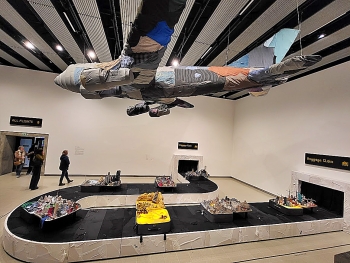
One of the immersive installations on display is “International Flight”, which incorporates examples of her “Portable City” series. The Portable Cities are open suitcases in which there are models of city centres, including those of many places in China and one of London. On entering the first gallery of the Hayward through a door marked “All flights”, one can see a model of a passenger jet plane made of cloth, suspended from the ceiling. Below it, at floor level, there is a life-size model of a baggage claim conveyor belt, on which several examples of Portable Cities are displayed. Near the conveyor belt, there are three seats of the kind usually found in the departure lounges of airports and a few baggage trolleys on whose handles are the words: “Press Down to Release the Brake”. The installation is not only visually fascinating and somewhat humorous, but also a creative portrayal of globalism.
The airport installation is only one of several highly original installations on display. The others are well-worth seeing, and if you are in London, this intriguingly original exhibition should not be missed.
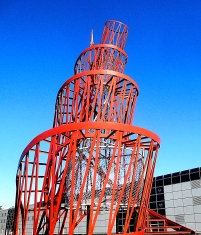
THE MARXIST SOCIETY of the University of East Anglia had just held a meeting around it, so we were told by someone working in the Sainsbury Centre for Visual Arts on the university campus in Norwich. The object around which the political gathering was held is a 35 feet high model of a structure that was never built full size. The Russian architect Vladimir Tatlin (1885-1953) had planned to build a futuristic tower in Petrograd (aka ‘Leningrad’ and ‘St Petersburgh’), an example of Constructivism. The tower, which was to have been 1300 feet high, was planned to celebrate and house The Comintern (3rd International). Hoping to rival Paris’s Eiffel Tower and to symbolise the modernity of Soviet Russia, the tower was never built.
Model of Tatlin’s tower with the Sainsbury Centre behind it
Sometime, back in the early 1970s, it was decided to construct a model of the Tatlin Tower near the Hayward Gallery on London’s South Bank. This was not a simple task because the structure is complex, and proper detailed blueprints were unavailable. To make a model of the Tatlin Tower that was faithful to the designer’s original idea, and which would not topple over, the services of a structural engineer were required. My uncle Sven, who worked for the firm of Felix Samuely and Partners, proved to be the man for the job. Working with the project’s director, Jeremy Dixon, my uncle had to unravel the plans of the structure using photographs of a 17-foot model of the tower that Tatlin had created in 1920 and a few existing images of plans that Tatlin had prepared. There were inconsistencies between Tatlin’s plans and the model produced in 1920. In 1971, Dixon:
“…built small models in balsawood to get it right, and he worked with Sven Rindl of consulting engineer Felix J Samuely & Partners, who generated detailed freehand drawings as they talked” (quoted from “Blueprint”, December 2011)
Dixon wrote about this in Sven’s obituary as follows:
“I particularly remember working with him on the reconstruction of the remarkable tower that Vladimir Tatlin produced as a monument to the Third International, the communist organisation founded in 1919, for the Art in Revolution exhibition at the Hayward Gallery in 1971. The project required us to go back to first principles to reinvent its extraordinary geometry and structure.
Sven would sit listening and commenting during our complex voyage of discovery, and at the same time he would be drawing. These drawings would be remarkable, elegant, three-dimensional sketches straight off the sketch pad, finished and complete. They were graphic works of art as well as documentation of engineering ideas.”
The model was built with timber inside the Hayward Gallery before being exhibited outside it in 1971 as part of an exhibition called “Art in Revolution: Soviet Art and Design since 1917”.
Forty years later in 2011, another model of the Tatlin Tower was produced, this time made of a more durable material, steel. Once again, the project was overseen by Jeremy Dixon. The completed model was first displayed in the courtyard of London’s Royal Academy. In an advance notice of the project (www.architectsjournal.co.uk/archive/ra-unveils-tatlins-tower), my uncle, who had died in 2007, was given a prominent mention:
“The 10.5m high steel structure in the Annenberg Courtyard was designed by architects Jeremy Dixon of Dixon Jones Architects, Christopher Cross, Christopher Woodward and engineer Sven Rindl. The tower will form part of the Royal Academy’s forthcoming exhibition, Building the Revolution: Soviet Art and Architecture 1915-1935 which opens on 29 October 2011.”
I remember going to view the model and then seeing a small exhibition about it and its construction. The exhibition, which was held inside the Royal Academy, included images of some of the beautifully drawn plans and diagrams created by my uncle.
The steel model of the Tatlin Tower, which was exhibited at the Royal Academy in 2011, has been lent to the Sainsbury Centre by the academy. Painted in red, this model of an experiment in futuristic architecture stands outside and close to the magnificent building that houses the Centre. The edifice, which is now over 40 years old, but looks like new, was designed by the architects Norman Foster and Wendy Cheesman.
We had no idea that there was a model of Tatlin’s tower next to the Sainsbury Centre when we visited it in September 2021. My wife and I were pleased to see this reminder of a much-missed relative whom we both loved dearly.

 yamey
yamey 