An unusual Victorian funicular still working by the sea

STEEP CLIFFS OVERLOOK Hastings Old Town and the beach immediately east of it. Although there are roads that lead from these parts of Hastings to the rest of the town on top of the cliffs, a more interesting way of travelling between the bottom and the top of the cliffs is by using either the East Hill Lift or the older West Hill Lift. Both are funiculars. We travelled up and down on the West Hill Lift, which travels between the west end of the Old Town and the ruins of Hastings Castle high above on the top of the cliff.

The West Hill Lift (‘WHL’) is 500 feet long and ascends a height of 170 feet, a gradient of 33% (1 in 3). It comprises two tracks, each 6 feet in gauge. It is powered by electricity. The two carriages, which can each hold up to 16 people are raided and lowered along the tracks by steel cables attached to them. They are equipped with a mechanism that automatically applies brakes to the wheels should the cable break. I did not know this when we made a trip up and down the cliff in the creaky old carriages, which are those that were supplied when the system was originally installed.

The construction of the WHL began in 1899 (the year that the Eiffel Tower was built). But it was only completed in 1891, when the cable winders were operated by a gas-powered engine. The funicular system was built by Messrs A H Holme & C W King of Liverpool, who later built the Snowdon Mountain Railway. In 1894, after the Hastings Lift Company went ‘bust’, the WHL was taken over by the Hastings Passenger Lift Company. This company ran it until 1947, when the Lift was bought by Hastings Borough Council. In 1924, the gas engine was replaced by a diesel engine, which was later replaced by an electric motor (in 1971).

Despite having been refurbished in 1991, the WLF still operates with its original 1890s carriages. Admission to these is via an old-fashioned metal turnstile operated by the ticket seller. Apart from looking archaic, a special feature of the WHL is that most of it travels in a brick-lined tunnel burrowed through the cliff. Its neighbour, the East Hill Lift, runs through an uncovered cleft cut in the cliffs. Apparently, few other funiculars in Britain were built, like the WHL, to run through tunnels, and those that were, are no longer in use.

Although Hastings is not nearly as elegant as other British seaside towns such as Eastbourne and Brighton, it is an intriguing place rich in places of historical and visual interest. The existence of the superb Hastings Contemporary art gallery and the two working funiculars adds to the fascination of the place. It is not a place to be ‘sniffed at’.

There is something fishy about Hastings

THE HASTINGS CONTEMPORARY art gallery is housed in an elegant modern structure. Some of its large windows and the terrace outside its café look out over the fishing vessels moored on the nearby shingle beach. Other windows give the visitor a view of tall wooden sheds covered with overlapping planks of timber painted black. And yet other windows look towards a couple of long-established purveyors of sea food. The timberwork on the outside of the Hastings Contemporary is  painted black to match its towering neighbours.

The tall wooden structures are ‘net shop’ sheds used for storing fishing nets and other gear when not in use. They are called ‘shops’ not because they sell something, but because ‘shop’ is an old-fashioned word for ‘workshop’. A newspaper article (www.hastingsindependentpress.co.uk/articles/culture/features/the-net-shops-part-one/ ) explained further:

“The Hastings net shops are unique: tall, thin wooden sheds, up to three stories high, painted black, standing side-by-side in clear-cut rows on a part of beach near the sea. Sheds of various shapes and sizes have been on this shingle in front of Hastings Old Town for many centuries, but it was a town planning decision in 1835 that created both the remarkable architectural design and the layout that together make this group of buildings unique. The shops are the traditional storage buildings of the Hastings fishing fleet. They were used in the past to stow gear made from natural materials – cotton nets, hemp ropes, canvas sails, etc – which would rot if left in the open, especially when wet. If possible, the items would be dried on the beach first, and then kept dry inside these weather-proof stores. “

The sheds, the fishing vessels, and the fish shops are all spread along Rock-a-Nore Road, which runs between the cliffs and the seashore, which in this part of Hastings is known as ‘The Stade’. The word ‘stade’ is derived from a Saxon word meaning ‘landing place’.

The two fish shops caught my attention. One of them is called The Net Shop – a jellied eel bar. It is appropriately named because it is right next to a net shop. Established in 1943, this place sells a variety of traditional English seaside seafood delicacies such as: jellied eels, cockles, mussels, oysters, whelks, winkles, dressed crab, prawns, baby octopus, shrimps, crayfish tails, lobster, ocean sticks, and so on. With the exception of the jellied eels, all of the seafood on display looked delicious to me.

The Net Shop jellied eel bar is separated from the Rock-a-Nore Fisheries by the already mentioned timber net shop. The Fisheries shop was started by a member of a family, who had been fishermen since the 19th century. Albert and Lilly set up the shop over 30 years ago. Today, the shop is run by their son Sonny and other members of his family. Sonny’s grandmother:

“… Polly Gannon, used to push a fish cart seven miles from Hastings to Bexhill and back again every day before his parents Albert & Lilly set up Rock-a-Nore Fisheries some 30 years ago.” (https://hastingsflyer.com/hastings-old-town-businesses/).

Sonny’s shop sells wide variety of fish and other seafood. In part of the shop there is an oak-chip fired smokery for smoking seafood. One of their products is smoked salmon. Albert, who worked as a chef in the renowned Brown’s Hotel in Mayfair, enjoyed experimenting with food. He invented a smoked salmon cure, which has been used in the shop for many years – its recipe is a well-guarded secret. Smoked sea salt is also on sale.

Had we been staying for a few days in Hastings in accommodation with cooking facilities, I am certain that we would have been regular customers at both the Net Shop and its near neighbour, Rock-a-Nore Fisheries. However, on our most recent visit, we were only in this charming fishing town for a few hours.

A working men’s club with an unusual name

HASTINGS IN EAST SUSSEX has long had a thriving fishing fleet. It is the largest beach-launched fleet in Europe. Unlike many other fishing ports where the boats are moored in harbours, those at Hastings are moored along the town’s shingle beach when they are at rest. This is part of the beach where in 1066, William the Conqueror famously set foot on English soil.

In 1900, a group of Hastings fishermen met in the (now non-existent) Prince Albert pub – a popular meeting place for these men. The members of the group discussed the idea of raising money to give the poor children of the borough a happy time at Christmas. At that time, regulars of another Hastings pub, the Royal Oak, formed a charitable organisation called the Acorn Club. A website (https://winkleclub.org/early-times/) revealed:

“Apparently at that time in another Hastings pub, the Royal Oak, an Acorn Club had been formed. All members had always to carry acorns, failure to do so involving a fine, all such money being devoted to charity. The fishermen decided to organise an effort on the same lines but one of them … said: `Why an acorn? This is the Old Town; can’t we have something to do with fishing?’ Just then, so the story goes, Providence took a hand. Somebody appeared with a pail of winkles collected from the rocks. Inspiration! Let’s make it the Hastings Winkle Club.”

Thus, the Winkle Club of Hastings was ‘born’.

Members of the Winkle Club must carry a winkle shell at all times. When challenged by a member with the words “Winkle up”, the challenged member must produce his winkle shell and show it to the challenger. For, if they are discovered without their winkle, they are fined. Originally, the fine was one (old) penny, now it is £1. If the person who discovered a member without a winkle did not report him, he would also be fined. All the fines are donated to raise money to achieve the club’s objectives.

In the past, the Winkle Club raised money for poor children as already mentioned. Now, the club raises money for local good causes. Over the years, the Club has included some famous members, who were not fishermen. These include Winston Churchill, the Duke of Windsor, and Lord Montgomery of Alamein.

Close to The Stade, the part of Hastings where the fishing boats are moored, there is a traffic island known as Winkle Island. It is used for various local festivals and is the symbolic meeting place for members of the Winkle Club. A huge sculpture of a winkle shell (see photograph above) stands on Winkle Island. It serves as a public collecting box for the charity. Seeing this marine sculpture is what aroused my interest in this thoroughly worthy charitable organisation.

Wild silk beside the East Sussex sea shore

THERE IS A NIGERIAN woven fabric called ‘sanyan’. Made mostly by the Yoruba people, its principal ingredient is a type of wild silk. The fabric is thick and resembles denim or canvas in texture. Strips of sanyan are sewn together to make garments and other items. During a recent visit to the Hastings Contemporary Art Gallery, which stands close to the seashore, we saw an exhibition of paintings made on sanyan cloths.

The creator of these images is Nigerian born Nengi Omuku who was born in Lagos (Nigeria) in 1987. It is there that this artist, who trained at the Slade School of Fine Art in London, now works. Before becoming an artist, Nengi worked in her mother’s florist shop, eventually coming into contact with art when she began making preparatory drawings for customers’ garden planning.

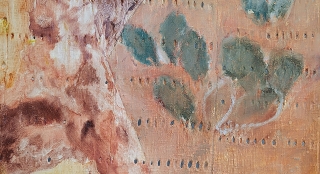
Nengi’s exhibition at Hastings is called “The Dance of People and the Natural World”and is on until the 3rd of March 2024. The artist took large sheets of sanyan fabric, consisting of strips of sanyan sewn tightly together, and then coated them with a gesso ground. When this was ready, she then used oil  paints to create images. Whether it was her painting technique or some property of the material upon which she applied the colours, the resulting images have a uniquely haunting, other-worldly quality that I have not seen in other artists’ works.  

The paintings are well displayed. They have been hung away from the walls so that one can look at their backs. By looking behind the paintings, you can see the stitching that holds the pieces of sanyan together as well as beads of the gesso ground that had oozed between the adjoining strips. By looking closely at the paintings, the joins between the constituent strips of sanyan can easily be detected (see photograph above). These create an interesting surface texture quite unlike the canvas usually used by painters.

I enjoyed the exhibition not only because the artwork was attractive but also because I became aware of an interesting fabric, which is in common use in Nigeria.