Was I an inventor of rewilding?

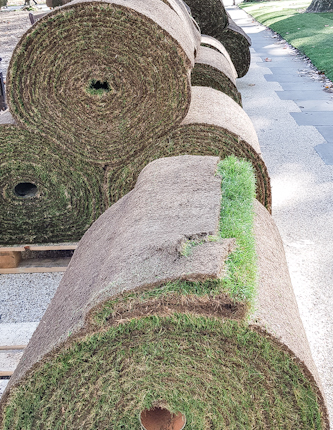
BETWEEN 1983 AND 1994, I owned a house in Gillingham, Kent. Number 148 Napier Road was a detached dwelling with a narrow garden that stretched 180 feet behind it. Most of this long stretch was covered with grass.  After I first moved into the house, I purchased an electric lawn mower, and regularly trimmed the lawn. All went well at first. However, after a few months and several mowing sessions, I found that when I was cutting the lawn my eyes streamed, and I sneezed uncontrollably. I tried wearing a facemask when mowing, but this did not relieve the symptoms. Eventually, I decided not to bother mowing the lawn.

The grass grew. So did the anger of my immediate neighbours, both of whom were elderly and believed in tidy gardens. One of them said that because my lawn was so unkempt, insects were travelling from it into her garden and destroying her plants. She was so upset by this thought that she did something extremely unwise. One summer evening, I returned home after nightfall, and because the weather was pleasant, I decided to spend a few minutes in my back garden. It was dark. I sniffed, and believed that I could smell burning. I saw no flames, and retired to bed. On the next day, I met my other neighbour – a very practical old gentleman who had built his own house. He told me that during the previous day, he had had to enter my rear garden to extinguish a fire which had been started by the lady, who believed that my garden was infecting hers with pests.

Meanwhile, the grass grew longer. It reached a point where it was so tall that if someone sat down, they became hidden by it. As autumn approached, the tall grass just fell over, and seemed to disappear gradually. It returned without fail every spring, and despite not being mowed, it grew healthily. However, the neighbours were unimpressed by my lawn, the untidiest in Napier Road. I decided that I would have to do something to give the impression that my wild garden was by design, rather than simply the result of neglect. So, what I did was to use the mower to create a sinuous, narrow mowed path that ran along the length of the lawn – I created what might be described as a landscaped lawn. I am not sure that this impressed my neighbours, but I felt that I had ‘done my bit’.

In addition to the lawn, I planted shrubs, which I allowed to grow ‘willy nilly’. My seemingly wild garden was a haven for butterflies. As I walked along the garden, following my sinuous path, clouds of butterflies used to shoot out of the shrubs and other plants.  Unwittingly, I had ‘wilded’ or ‘rewilded’ my garden, which in the 1980s and early 1990s was not something that was done. Had I invented what is now known as ‘wilding’, also known as ‘rewilding’?  Probably not, but it only began to be adopted as a strategy for reducing loss of biodiversity following work done in the mid-1980s (see https://en.wikipedia.org/wiki/Rewilding). I must confess that my pioneering rewilding in Gillingham did not result from a desire to save the natural world, nor from laziness, but to save myself from symptoms of allergy.

In the late 1990s, we put the house up for sale. The garden had become such a veritable jungle that our estate agent described it as being “… in a natural state.” Interestingly, the people who bought the house from me liked it because they were looking forward to taming the garden – there is no accounting for taste!
Just let it grow

BETWEEN 1983 AND 1994, I owned a house in Gillingham, Kent. It was not an exceptional building, but it had a long back garden – 180 feet in length and about 22 feet wide. Much of the garden was covered with a lawn bordered by plant beds. When I first moved in, I attended the garden keenly even though I had little idea about gardening. As soon as I unearthed weeds, they re-appeared. It was most disheartening.  I discovered that planting shrubs was the best way to hide the weeds, about which I soon stopped worrying.

As for the lawn, I acquired a mowing machine, and for some months, or maybe years, I trimmed the grass regularly. Then, I found that whenever I cut the lawn, my nose would start streaming and I would have fits of sneezing. I realised that I had a grass allergy. So, I decided to cease mowing the lawn. I let the grass grow higher and higher. When it reached its greatest height, people sitting in the garden would be hidden by it. At the end of the year, the grass collapsed and more or less disappeared – only to begin growing again the following spring. I let nature take its course, and ceased worrying about it until a deputation consisting of my immediate neighbours came to my house to complain about my unruly lawn and garden. One of them, an elderly lady, was convinced that all the weeds and insects in her garden had come from mine.

One summer evening, I came home after dark and as it was a pleasant evening, I stood in my back garden looking up at the stars. As I did so, I was aware of a slight smell of burning. The following day, one of my neighbours saw me in the street as I was setting off for work. He told me that the neighbour on the other side of the garden had set fire to mine, hoping that the flames would kill the weeds. Luckily, he had spotted the conflagration, and extinguished it before it did too much damage.

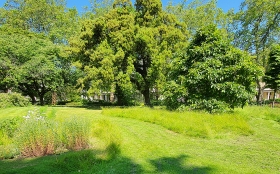
Following the neighbours’ complaints, I conceived an idea about how to deal with my lawn. I decided that I would let it grow without interference, but I would mow a narrow sinuous path along its length. The idea was that I could then explain to the neighbours that the wild grass was part of my garden design. Meanwhile, my shrubs increased in size steadily and the weeds flourished. In the warmer months of the year, whenever I strolled in my garden, clouds of butterflies used to billow from the luxuriant vegetation.

Today, in June 2023, whilst walking in Kensington Gardens, I noticed that much of the grass was growing wild – not being mowed. Here and there, the gardeners had trimmed small areas of grass with a lawnmower, much as I used to do back in Gillingham in the 1980s.

To be honest, I let my garden grow wild because I could not be bothered to spend hours of my life making it look neat and tidy. Today, what I was doing – letting the plants ‘do their own thing’ – is known as ‘wilding’. Maybe, unwittingly I was a pioneer of wilding.

Amazing maze or labyrinth

SIGNS IN SAFFRON WALDEN, a town in Essex, pointed to ‘The Turf Maze’. We followed these from the centre of the town’s attractive market square and across The Common, a large grassy expanse, to its eastern edge, where we came across the Turf Maze. I was expecting to see a maze with paths separated by hedges, but what we found is quite different, and might not be a maze at all.

The maze was cut unto the ground in the form of grooves separated from each other by low mounds of earth on which grass grows. A reliable website, https://historicengland.org.uk/listing/the-list/list-entry/1000741#:~:text=A%20turf%20maze%2C%20thought%20to,%2Dcut%20(Matthews%201922), describes it as follows:

“The maze … consists of a series of concentric circles cut into turf, surrounded by a low bank. It measures c 43m from corner to corner, the main areas of circular paths being c 29m in diameter. It is laid in a unicursal pattern formed of seventeen linked circles, and has four linked outer horseshoe-shaped bastions or ‘bellows’ which are, like the centre of the maze, raised slightly above the main circular paths. The narrow shallow grooves which form the paths are marked by bricks and begin on the north or south sides of the maze.”

The word ‘unicursal’ means that the pathway through the ‘maze’ forms a single route without branching, typical of a labyrinth. This is in contrast with a true maze in which the path is ‘multicursal’, meaning that the pathway has branches. An elderly lady whom we met walking on The Common told us that once she walked from the beginning of the ‘maze’ to its centre, following its path and confirmed to us that although the path is long and winding, it never branches.

The Turf Maze at Saffron Walden, which is really a labyrinth, was already in existence by 1699, but is believed to have first been created in mediaeval times. If it had a purpose, this has been long forgotten. Since then, it has been re-cut numerous times. When this was done in 1911, bricks were laid along the path of the labyrinth to help preserve its form. These have been replaced from time to time and more recently cemented together. In 2000, the so-called maze was put into the ownership of the Town Council of Saffron Walden.

Jeff Saward, writing in “The Saffron Walden Historical Journal” in Autumn 2012 (https://saffronwaldenhistoricalsociety.files.wordpress.com/2018/01/saffron-walden-turf-maze.pdf), notes that the labyrinth in Saffron Walden differs from other such labyrinths in the British Isles in that its path runs between the turf ridges and not along them as is the case in most others. He also discusses the age of the labyrinth, suggesting it may have been created later than the mediaeval era, possibly in the 16th century. It might have been designed from a labyrinth, almost identical to that in Saffron Walden, illustrated in “The Profitable Art of Gardening”, by Thomas Hill, published in about 1563. Hill’s design was not original as it can be found illustrated in “Le Théatre des bon engins, auquel sont contenuz cent Emblemes moraulx” by Guillaume de la Perrière, published in 1539. Whatever its date of construction, the labyrinth is a fine thing to see in the small Essex town.

Talking to some ladies who were feeding the ducks at a pond near one of the town’s car parks, we learned that Saffron Walden has three other mazes (or labyrinths) apart from the ill-named Turf Maze. We hope to explore these on a subsequent visit to the town. While trying to find the entrance to the car park of the local Waitrose supermarket, we discovered yet another maze, namely the one-way road system of Saffron Walden.