
A grand canyon in India

I HAVE VISITED the famous Grand Canyon in the USA, and seen it after a heavy snow fall. I have also seen a fabulous canyon in New York State, a few hours drive away from Buffalo. However, it was not until the first of February 2023, that I heard of, and then visited a grand canyon in Kutch, which is now part of the Indian State of Gujarat.

The canyon, named Kadiya (aka Kaliya) Dhro, is 73 Km north of the coastal city of Mandvi, and 33 Km northwest of Bhuj. Although the canyon is many, many thousands of years old and had been known to locals forever, its existence only became widely known in 2020. It was then that Varin Suchday, founder of the Kutch Travel Club stumbled across it. He had heard it discussed by local tribes people, whilst he was assisting them during the covid19 crisis, and with considerable difficulty, he managed to find it in the midst if the poorly mapped, arid semi-desert countryside.

We drove from Mandvi to a dusty parking area about 4 Km from the canyon. Several battered jeeps wait there to take visitors to the site. We boarded a well-worn Mahindra jeep, which was driven by a young fellow who looked to be about 15 years old; his voice had not yet broken. He drove us skilfully along sandy tracks strewn with rocks, precarious slopes, potholes, and other hazards. We held on to the Mahindra’s metal structural elements to avoid being thrown out of the constantly jolting and tilting vehicle, which had neither doors nor seatbelts. The tortuous track threads its way across dried up beds of streams; over boulders and sharp projecting stones; and past branching cacti and thorny bushes. Every now and then, other faster jeeps overtook us on this perilous, winding path. Other vehicles travelling in the opposite direction either waited for us to pass or vice-versa. After about thirty minutes of this exciting journey, we reached a parking area near the canyon.

The canyon is in the district of Ulat village, which we did not visit. A fast-flowing river, in which our driver spotted a crocodile, has over the millennia formed the canyon. Like the Grand Canyon, but far smaller, its walls are horizontally striated. The striations vary in colour. Here and there, you can see roundish rock formations that look like huge mushrooms. Their stalks are also striated. Parts of the riverbed that are not submerged are rocky platforms with patterns of grooves resembling crazy paving. The striations result from the alternate layers of shale and sandstone combined with the effects of sea air (for more detail, see: https://zeezest.com/travel/kaliya-dhrow-in-kutch-is-a-geological-wonder-to-behold-zee-zest-1054).
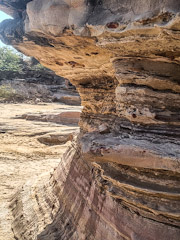
We visited the canyon on a Wednesday morning during the school term, so the place was not crowded. I have been told that on Weekends and during school holidays, large crowds of people come to view the interesting geological formations. We saw less than twenty other tourists, mostly Indian. Many were standing precariously on the rocks close to the water, posing for pictures probably destined to appear on Facebook and/or Instagram. I took many photographs of this lovely place.

I am extremely grateful that my wife’s cousin, who lives in Mandvi, arranged for us to visit the canyon, a geological jewel hidden deep in the Kutch desert. Although far off the ‘beaten track’, it is a highly worthwhile destination. A word of advice: the ride in the jeep is not a good idea for those with unhealthy backs!
Sun and snow in Arizona

BEFORE WE DEPARTED for the USA in January 1995, three months before the expected due date of the baby, who was in my wife’s womb, we consulted our obstetrician. We wanted to know whether it would be safe for my wife, Lopa, to travel at this point in the pregnancy. Our obstetrician saw no reason why we should not make the trip but warned us:

“Make sure you have good travel insurance because a premature birth in the States will bankrupt you.”

We spent much of January 1995 driving around California and neighbouring Arizona. What we had not expected was the weather. We had wanted to visit Death Valley but were advised against it, not because of the heat but because of the bad winter weather there. On arriving at Yosemite National Park, we were turned away in order to buy snow chains for the tires of our hired car. Returning with the chains we ventured into the snowy wilderness that Yosemite had become.

Later in the trip we crossed a so-called desert, probably the Mojave, the first I had ever seen. It rained nonstop and instead of sand there was plenty of green vegetation. I was disappointed as it did not match my preconceptions of desert appearances. We were travelling east towards Arizona, a state that until that trip I had associated with heat and deserts.

One of our destinations was the south side of the Grand Canyon. We were really glad that we had the snow chains with us because without them it would have been impossible to reach our rented cabin close to the edge of the canyon.

We were adequately dressed for the cold but Lopa was terrified that she might slip in the snow and fall, possibly risking the health of our unborn child. We found her a tall, stout branch and she walked in the snow, looking rather like  Mahatma Gandhi on a march as depicted in many statues in India, but dressed in padded clothing.

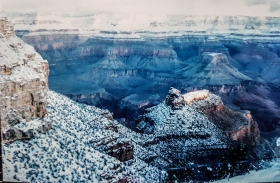
We arrived at the Canyon after nightfall. The next day, the sun was shining, and the sky was blue. The snow still lay thickly on the ground, on the trees, and in the canyon.

This was my first visit to the Grand Canyon and the snowfall enhanced my enjoyment of this spectacular place. The snow had fallen in such a way that it had only landed on the upward facing surfaces of the many strata that make up the walls of the canyon. This exaggerated their appearance in a positively aesthetic fashion. The Grand Canyon under snow made our visit memorable and exceeded all my expectations of the famous site.

From the Canyon, we drove south to Sedona, which is famous for its vortices that some people. including me, claim to be able to feel. Though not far south from the Canyon, the weather had improved considerably.

When we reached Phoenix, a city south of Sedona, winter had become summer. Whereas the temperature at the Canyon had been below freezing point, at Phoenix it was at least 80 degrees Fahrenheit.

From Phoenix, we drove west towards Yuma and San Diego in south California. On the way, we traversed a stretch of land that confirmed my preconceptions of what a desert should look like. It was neither soaked with rain nor lacking in sand dunes. On the contrary, it was hot, deserted, and sandy. And we saw occasional cacti. At last, at the age of almost 42 I had seen my first ‘real’ desert.  Since then, I have seen a few other sandy deserts including the vast wastes of Kutch in western India.

Although our obstetrician in London was unconcerned about our journey, everyone we met in the USA on that trip was horrified that we had undertaken it. Our holiday in the USA was a great success and our baby daughter arrived intact and healthy in early April. I cannot say for sure whether her in-utero journey across the Atlantic and around parts of California and Arizona is in any way responsible for her love of travelling, but there is a possibility that it was.

Route 66

MY MOTHER’S ANCESTORS included a Seligmann family, which can be traced back to the area around Ichenhausen Bavaria in Germany.

In January 1995, we visited Arizona in the USA and drove along a stretch of Route 66 on our way from Lake Havasu City and the Grand Canyon. On the way, we spotted a tiny settlement called Seligman . Even though its name differed to my ancestor’s family name by having only one ‘n’, we felt that we should make a small break there.

Seligman on the Santa Fe Railway is named after Jesse Seligman of JW Seligman & Co, who helped finance the railway and others in the area. The founder of the company was Jewish from Germany. Many German Jews who migrated to the USA with surnames ending with a pair of consonants, such as Seligmann and Wolff, dropped the final consonant on arrival in the States.

Seligman looked like a typical ‘boondocks’ place. It was just what I expected to find in the Wild West despite the dismal weather and the snow on the ground.

We came across a pen in the centre of the town. A weathered notice next to it said that the enclosure contained an ageing buffalo that was once displayed at Buffalo Bills Wildwest Show. My wife suggested, frivilously, that she should should into the pen to pose for a photograph next to the sign.

Despite being 7 months into pregnancy, she began climbing the fence around the pen, and stopped suddenly. What we thought was empty, was not. The pen housed an enormous, sleepy, aged buffalo. She had a lucky escape!

Later, we arrived at the Grand Canyon where the snow fall had been heavy. We were fortunate to see this spectacular geological area decorated with snow.