
Memories of Gujarat (India) at a park in north London’s Golders Green

GOLDERS HILL PARK lies halfway between Golders Green and Hampstead – both in north London. It occupies what used to be the extensive grounds of a former country house that was built in the 18th century and destroyed during WW2 (in 1940). Its fine landscaping was influenced by the great garden designer Humphry Repton (1752-1818). I have been visiting the park since my early childhood in the 1950s, when, if I remember correctly, my parents used to play tennis on the still existing tennis courts. The park has many attractions including a pond with an attractive stone bridge; a walled garden; many fine old trees; plenty of shrubs and flowers; a bandstand, which was certainly in use during my childhood; a good café-cum-restaurant; a wooded area; a stumpery; a deer enclosure; and a small zoo. The deer enclosure and the zoo were in existence when I was a young child. Today’s visitors can watch the deer and view animals such as wallabies; ring tailed lemurs; at least one kookaburra; donkeys; and a variety of exotic birds. The pond mentioned above is often visited by ducks.

Today (the 3rd of March 2024), we visited the park on a crisp, cold, sunny morning. The dew-covered lawns were full of blooming crocuses, and some of the bushes had burst into flower. Most of the trees, being deciduous, were devoid of leaves. By chance, I looked up at one of these leafless trees and saw a children’s kite caught up in its branches. Seeing this, my thoughts shifted 5000 miles from Golders Hill to Gujarat (in western India).

Wherever you go in Gujarat, you are likely to see kites caught up in the branches of trees. Unlike the kite I saw today, those in Gujarat are not the toys of small children, but part of a festival celebrated once a year, The Hindu festival, which celebrates the increase of day length a month after the winter solstice is known as ‘Uttarayan’ in Gujarat. The occasion is celebrated by kite flying. During this period of kite flying, riders of bicycles, motorcycles, and other two-wheelers face a real but, to the outsider, unusual hazard that could result in serious injury, if not death. I have described this festival and its hazards in some detail in my anthology of 101 vignettes of life and travel in India –“The Hitler Lock and Other Tales of India”.

Seeing the kite in Golders Hill Park reminded me of what I have seen in Gujarat during my several visits to that Indian state. However, although this year Uttarayan began on the 15th of January – not so long ago – I find it hard to believe that the kite I saw in the park was stranded in the tree during celebration of that festival.

[The book (& Kindle) is available from Amazon:
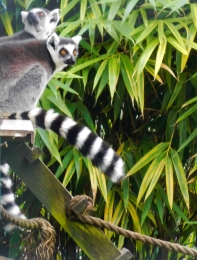
Seen in the park

Black and white stripes

Adorn their long furry tails

Two lemurs in a cage

These two lemurs live in a cage in Golders Hill Park in northwest London. You can discover more about Golders Green and its wonderful park in my new book: https://www.amazon.co.uk/gp/product/B0BHG873FB/

A small zoo in north London

EVERY VISIT TO GOLDERS Hill Park in northwest London gives me great pleasure. Now officially part of Hampstead Heath, it contains a lovely feature, its small zoo. This consists of a large paddock containing deer and sometimes a rhea. Close to this, is a series of cages, an aviary, containing exotic birdlife including a laughing kookaburra. These are located next to an enclosure that contains a small group of ring-tailed lemurs. The lemurs’ neighbours are several wallabies and a couple of donkeys, named Sienna and Calypso. The wallabies and the donkeys have a long rectangular sloping field in which to wander.

I have written about the park and the zoo before, and published it elsewhere (https://adam-yamey-writes.com/2020/11/19/walking-past-wallabies/). When I wrote that piece, I did not explore the small zoo’s history. It was certainly present well over 60 years ago, when I was less than ten years old. As a small boy, I remember seeing wallabies and flamingos. More recently, the flamingos have disappeared and have been replaced by ibis and various other exotic fowl. Before my time, the flamingos used to reside in the duck pond next to the park’s walled garden (https://londongardenstrust.org/conservation/inventory/site-record/?ID=BAR027).

The zoo’s history is difficult to ascertain. After searching the Google entries relating to the park and its history, I found only one reference that alludes to the presence of the zoo prior to WW2. This consists of a recording of an interview (https://sounds.bl.uk/Oral-history/Science/021M-C1379X0029XX-0001V0) with the scientist Sir Anthony Seymour Laughton (1927-2019), an oceanographer. Laughton was born in Golders Green, began his education in Hampstead at Heysham School, a ‘dame school’ (private elementary school) in Branch Hill, and moved to Gerrards Cross during WW2 (https://royalsocietypublishing.org/doi/10.1098/rsbm.2020.0021). As a young child, Laughton lived in one of the small roads that lead of North End Road and back on to Golders Hill Park. He and his brother were often taken to Golders Hill Park where he remembered that there was a small zoo with wallabies. This would have been before 1939, when he and his family moved out of London. So, we can conclude that the zoo was in existence before WW2.

According to Pam Fox, author of “The Jewish Community of Golders Green”, Golders Hill Park was popular with local Jewish families, who went:

“Golders Hill Park on Sundays to watch the peacocks strutting around the grounds of Golders Hill House.”

The House was destroyed in 1941. Laughton did not mention these in his interview and, sadly, there are none to be seen today.

To discover whether the little zoo existed before Laughton’s childhood, that is prior to 1927, I looked at a detailed map, surveyed in 1912. This was after the park was opened to the public by the London County Council in 1899, making it the first public park to have been opened in what was then the Borough of Hendon (now incorporated into the Borough of Barnet). I compared what was on that map with what is on modern maps and found that the park’s layout has not changed much since 1912. The bandstand that you can see today is where there was one back in 1912. Where there is the deer enclosure today, there was a similarly shaped and located fenced field in 1912. The same is the case for the long narrow field where you can see the wallabies and donkeys today. The 1912 map does not show any buildings where the aviary is located today, but apart from that the pattern of land enclosures in the part of the park where animals and birds are kept enclosed today is remarkably similar. The question is, and I cannot answer it, was what is now a deer enclosure, then a deer or other animal enclosure? Here is another as yet unanswerable question: did the long rectangular field where the wallabies live today enclose animals for viewing by the public as long ag as in 1912?

Prior to becoming a public park, Golders Hill Park was the gardens of the now long-since demolished Golders Hill House, built in the 1760s for the merchant Charles Dingley (1711-1769), who traded with Russia (www.leeandstort.co.uk/Stort%20History/Charles%20DINGLEY%20Biography.pdf). I have not found any references to any collections of birds and animals in Golders Hill Park prior to the childhood of Laughton, the oceanographer. It is possible that the merchant Charles Dingley or later owners of the property might have kept deer and even exotic creatures, but there is no evidence to confirm or deny this.

What is important, is that the little zoo, which I remember from the 1950s, is still thriving today and providing enjoyment for children of all ages. Whether the various creatures ‘enjoy’ being caged-up and gawped at is a question I cannot begin to answer.