Marilyn, Mao, and more at Milton Keynes

ONCE AGAIN, THE MK Gallery at Milton Keynes has put on a superb exhibition. Until 29 June 2025, there is a show of artworks by the artist and film maker Andy Warhol (1928-1987), who was born in the USA. Best known for his multiple portraits of figures such as Marilyn Monroe and Mao Tse Tung and Pop Art images, there is much more than this on display at the MK.

The first room of the show contains work that Warhol created in the 1950s and early 1960s. Like artists such as Picasso and Hockney, whose creative lives began with works that were not as experimental and novel as their later works, Warhol’s earlier, less revolutionary, images show that he was a competent draughtsman capable of producing highly acceptable ‘straightforward’ compositions. It was interesting to see his earlier works because they are rarely displayed in public galleries. And it is always nice to see how an artist who is best known for his or her more extraordinary creations began his or her creative output.

The exhibition includes many of Warhol’s Pop Art images including those of Marilyn and Mao, but also there are several of his portraits of other figures. These include the artist Basquiat, the politician Barry Goldwater, Marcel Duchamp, Joseph Beuys, Muhammad Ali, and Liz Taylor. What I found interesting was that amongst the portraits on display, there were a few of the British artistic couple Gilbert and George. As the exhibition booklet related:

“The British artistic duo Gilbert and George , like Warhol, explored the interplay between personal and public identity, often blurring the lines between performance and art.”

Warhol’s portraits of this couple reflect their own graphic artistic style.

Other images on display relate to the Cold War and to the electric chair. The images on display in the show include drawings, prints, posters, and photographs (often adjusted to create interesting artistic effects). There are also exhibits relating to Warhol’s prolific output of films. He made about 600 of them. It would have been interesting to have been able to see extracts from some of them.

In brief, this is an exhibition that is worth travelling to. Apart from being beautifully displayed alongside helpful information panels, it is worthy of a visit to be able to enjoy seeing this artist’s rarely seen early works.
Artists as artworks in London’s East End

BRICK LANE IN east London has been home to immigrants from various parts of the world. Currently, many of the people who live and work in the area are of Bangladeshi heritage. In the last few years, the area has attracted the ‘trendy’ set, whose interests are mainly in the attractions north of the former Truman Brewery. Some years ago, my friend David, visiting from Atlanta (Georgia), and I paid a visit to Brick Lane and were surprised to find a bit of ‘Ye Olde England’ almost hidden amongst the predominantly Asian businesses. It was the The Pride of Spitalfields London – a real old-fashioned ‘boozer’. Stepping into it, it was difficult to imagine you were not in a country pub, but in the heart of east London. It is on Heneage Street next door to what had once been part of a brewery.

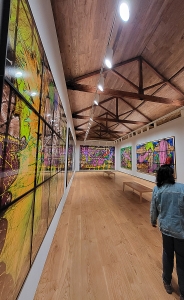
In 2015, the Trustees of the Gilbert & George Centre, a charity, acquired the building next door to the pub. On the 1st of April this year (2023), the converted buildings were opened to the public. They have been beautifully transformed by the SIRS Architects practice and they house artworks by the duo Gilbert and George (‘G&G’), who both trained at London’s St Martins School of Art. According to the G&G website (gilbertandgeorgecentre.org):

“The property was purchased with the idea to create a permanent home for works of the artist and to enrich London’s cultural offering thus further.”

G&G produce often very colourful works, all of which include the pair of creators within their images. As artists, they are also the subjects of their creations – they are almost always depicted in all their works. Their works deal imaginatively with a wide variety of things that we all face in our daily lives – some of them often considered too distasteful to be discussed or displayed. But G&G boldly bring them to our notice in a dramatic way.  As Michael Bracewell, a Trustee, wrote on the website:

“Gilbert & George maintain an ideological opposition to formalistic art theory and the reference of art to the history or theory of art. Asserting instead the power of emotion and actuality, their art addresses subjects that are culturally excluded, neglected or disowned. Their art questions social taboos and morality. By looking at difficult subjects the art and vision of Gilbert & George is intended to ‘de-shock’ rather than seeking to shock. Its aim is not the simple task of ‘shocking’ a viewer, but the difficult task of interrogating a subject and themselves … Unchanging, they have the appearance and countenance of modern sober-minded, anonymous citizens, who have embarked on the astral journey of their own Divine Comedy: purgatory, Heaven and Hell as they find it and perceive it in our world, in nature and in themselves.”

Whether or not you like the creations of G&G, the new Centre is well worth visiting, even if only to see the fine design of the buildings containing it. If the art is all too much for you, you can pop into the pub next door and seek liquid relief. And if you loved the place, which we did, you can visit the boozer to celebrate the arrival of this superb new addition to the London art scene.

Pioneers of making selfies?

THE LONDON-BASED ARTISTS Gilbert Prousch (born 1943) and George Passmore (born 1942) first met whilst they were studying sculpture at the St Martins School of Art, where, incidentally, my mother created sculptures in the 1950s and early 1960s. From the late 1960s onwards, most of their creations have portrayed themselves, usually together, in an incredible variety of poses and situations. One might say that they were pioneers of selfie-making.

On the 1st of April, Gilbert and George (‘G+G’) opened their new establishment, The Gilbert & George Centre, in London’s Heneage Street near Spitalfields and Brick Lane (see https://gilbertandgeorgecentre.org/). I have yet to visit this new gallery, and look forward to doings so soon. To coincide with this new venture, the White Cube Gallery in Mayfair’s Masons Yard is holding an exhibition of works by G+G until the 20th of May 2023.

Called “The Corpsing Pictures”, this exhibition at White Cube consists of G+G posing as corpses in a range of different settings. In each picture, the two artists are portrayed lying as if dead but fully dressed in their characteristic smart suits. In many pictures, images of bones have been included in the compositions. At first sight, these pictures, which look like stained glass windows, appear somewhat macabre, but soon the viewer becomes aware of the playful and often punning nature of the images. Each composition is compelling visually and together the collection is a stunningly beautiful sight.

I suspect that the crowds at the Heneage Street Centre will be great for the first few weeks after its opening. So, if you want to see some good examples of the works of G+G without being bothered by too many other viewers, I recommend that you head for the White Cube in Masons Yard.

Blood on the wall

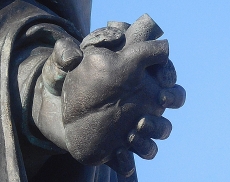
GRIPPING A HEART with the fingers of his left hand and his right hand on his chest, he stands in knee breeches, motionless on a plinth and staring out to sea. This bronze figure is a statue of the great scientist and first to give a scientific description of the way blood circulates through the heart and blood vessels, William Harvey (1578-1657), who was born in Folkestone, Kent, where his sculptural depiction stands. The commemorative artwork was created by the sculptor Albert Bruce-Joy (1842-1924) and made in 1881.

The heart in Harvey’s hand

Son of a Folkestone town official, William Harvey began his education in the town, where he learned Latin. Next, he attended The Kings School in nearby Canterbury before matriculating at Gonville and Caius College in Cambridge. After graduating in Cambridge in 1597, he enrolled at the University of Padua in northern Italy. There, he graduated as a Doctor of Medicine in 1602. Harvey became a physician at London’s St Bartholomew Hospital, and later (1615) became a lecturer in anatomy. In addition to his teaching activities, he became appointed Physician Extraordinary to King James I. It was in 1628 that he published his treatise, “De Motu Cordis”, on the circulation of the blood, work that remains unchallenged to this day. In 1632, he became Physician in Ordinary to the ill-fated King Charles I. In 1645, when Oxford, the Royalist capital during the Civil War, fell to the Parliamentarians, Harvey, by now Warden of Oxford’s Merton College, gradually retired from his public duties. He died at Roehampton near London and was buried in St. Andrew’s Church in Hempstead, Essex.

Folkestone, formerly a busy seaport, has restyled itself during the last few years. It has become a hub for the creative arts. Works by various contemporary artists, some quite well-known including, for example, Cornelia parker, Yoko Ono, and Antony Gormley, are dotted around the town and can be viewed throughout the year. Every three years, even more art can be found all over the town as part of The Creative Folkestone Triennial. This year, 2021, it runs from the 22nd of July until the 2nd of November. As one wanders around the town, one can spot artworks in both obvious locations and some less easily discoverable places. This year, the London based artistic couple Gilbert and George have exhibited several of their colourful and often thought-provoking images. And this brings me back to William Harvey.

High on a wall just a few yards behind the statue of Harvey, there are two images by Gilbert and George. Both were created in 1998. One is titled “Blood City” and the other “Blood Road”. Both relate to blood, its corpuscles, and its flow. It is extremely apt that they have been placed close to the image of the man who did so much to increase our understanding of blood and its circulation through the human body.