
The force of ambition standing in Kensington Gardens

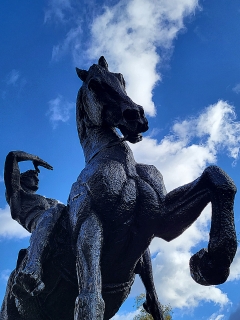
CAST IN BRONZE, he sits aside a rearing horse. He looks west towards Kensington Palace and uses his right hand to shield his eyes from the setting sun. I am describing a cast of a sculpture by George Frederic Watts (1817-1904), which bears the name “Physical Energy”. The sculptor was born on the birthday of the conductor George Frederic Handel – hence his two first names.

Watts began work on an equestrian sculpture in 1870, when it was commissioned by Hugh Lupus Grosvenor, who became 1st Duke of Westminster. It was to depict Hugh Lupus, 1st Earl of Chester. This was at Eaton Hall near Chester. In the early 1880s, Watts began working on “Physical Energy”, which was inspired by this sculpture. The first bronze casting of “Physical Energy” was made in 1902, and transported to southern Africa.   

Watts had been principally a painter until the 1870s, when his interests moved towards sculpture. “Physical Energy” was the high point of his efforts. A plaque next to the bronze horse and rider explained that this sculpture depicted:

“… a universal embodiment of the dynamic force of ambition …”

One man for whom these words might well be applied was the mining magnate and a Prime Minister of the South African Cape Colony, Cecil Rhodes (1853-1902), who ruthlessly let nothing get in the way of his ambitions. Therefore, it was particularly appropriate that one of the casts of Watts’s “Physical Energy” (that made in 1902) was placed at Groote Schuur (in Cape Town) as part of a memorial to Rhodes after Rhodes’s death. Unlike a bust of Rhodes placed nearby, which was vandalised recently, the equestrian statue has survived … so far.
An article published by Artnet News (https://news.artnet.com/art-world/watts-sculpture-royal-academy-ideological-baggage-1155971) made the following remarks:

“Watts, like Rhodes, believed in British imperial might to back its right to rule … the artist “plied” a leading politician with suggestions that military service should be introduced. (The colonial statesman Lord Grey was the man who suggested Watts turn the equestrian sculpture into a memorial to Rhodes after he died…)

… Watts’s imperialism was “liberal” and that the sculpture’s ideological meaning is open-ended. Socialists used the image, too. In fact, Watts had multicultural references in mind when he first conceived the statue: It was due to be dedicated to great empire builders including Mohammed, Attila the Hun, and Genghis Kahn. (Trowmans adds that May Watts, the artist’s second wife and a fellow artist, was much more sceptical of Rhodes.)”

The quotation mentions that Watts married twice. His first wife was the young actress Ellen Terry (1847-1928). They married when she was 16 years old. They separated after 10 months. During that brief period, she met, and was photographed by the Victorian pioneer of artistic photography, Julia Margaret Cameron (1815-1879). I have written about both Watts and his young bride in my book about Mrs Cameron (“BETWEEN TWO ISLANDS: JULIA MARGARET CAMERON AND HER CIRCLE”).

In addition to the cast in Cape Town, at least two others were made. One of them was produced in 1959. It now stands outside the National Archives in Harare (Zimbabwe). The cast which stands in Kensington Gardens was cast by AB Burton (a founder) in Thames Ditton in 1905, and was put in its present location in 1907. It stands on a line that runs between a Henry Moore sculpture on the bank of the Serpentine and Kensington Palace. Another cast was made in 2017 to commemorate the 200th anniversary of Watts’s birth. Briefly, it stood in the courtyard at the Royal Academy. Now, it stands at the Watts Gallery near Guildford.

We pass “Physical Energy” on our frequent strolls through Kensington Gardens. From it, there is a fine view of Henry Moore’s tall concrete sculpture across the Serpentine Lake. Watts was a contemporary of the French sculptor Auguste Rodin (1840-1917). However, sadly, neither Watts nor Moore produced works as fine as those of Rodin.

[My book about Julia Margaret Cameron is available from Amazon, e.g.,

https://www.amazon.co.uk/dp/B0BZFCVLX9/ ]

Julia Margaret Cameron at the National Portrait Gallery in London

RECENTLY I PUBLISHED a book about the highly innovative Victorian photographer Julia Margaret Cameron (‘JMC’; 1815-1879). She married a British colonial administrator and lived during the heyday of the British Empire.  In my book, I tried to portray her sympathetically, but I do hint briefly that she was a ‘child of her times’ as far as he attitudes towards the colonised was concerned. Today, the 11th of July 2023, I paid a visit to London’s National Portrait Gallery (‘NPG’) to see how JMC and her works are currently presented.

JMC was a friend of the painter George Frederic Watts. His portrait of her hangs in the NPG. Another portrait by Watts hanging in the gallery depicts the historian and social commentator Thomas Carlyle (1795-1881). Nearby in another room, you can see Carlyle as portrayed in a photograph taken by JMC. This photograph is close to JMC’s photograph (see photo above) of Edward John Eyre (1815-1901). As British Governor of Jamaica, this gentleman was responsible for the brutal suppression of a revolt against British rule on the island. Under his command, 1000 homes were burned and 439 people were killed. Although this outraged many in Britain, it was defended by people such as Carlyle. Eyre’s portrait, made whilst he was awaiting trial, was, according to the NPG’s label, crafted by JMC to make him seem as if he was vulnerable and not:

“… a ruthless murderer but a sensitive man of duty.”

Another caption, next to a photograph of JMC by an unknown photographer suggests that her:

“… photographs are admired for their beauty and artistry. They also reflect the values of the Victorian era. Her portrait of Governor Eyre indicates her support for him following his violent suppression of the Morant Bay uprising.”

From what I have just written, you might get the impression that someone who composes the labels in the NPG is disapproving of JMC. Much as I feel that JMC’s apparent support for Eyre (and Carlyle) is not to my 21st century taste, one must remember that Cameron was living in a time when any uprising in the colonies would have been regarded as a dangerous – even apocalyptic – threat to the privileged life that she and her contemporaries enjoyed.

In all fairness to the NPG, they also have on public display one of JMC’s photographs of a less controversial sitter – the scientist Sir John Herschel (1792-1871). JMC met him in South Africa whilst she was convalescing from an illness she caught in India where she was living in 1837. It was Herschel who sparked off JMC’s enduring fascination with photography, which really ‘took off’ when she received her first camera in late 1863. She was then living on the Isle of Wight next door to her friend the poet Alfred Lord Tennyson.

JMC did not confine herself to taking photographs of defenders of colonialism. She made wonderful photographs of anyone she could find – both famous and completely unknown. What distinguished her work from that of her contemporaries is that, by experimenting with techniques in the studio and also in the darkroom, she created photographs that were works of art rather than slavish attempts to record real life accurately. Like great portrait painters, her photographic portraits give the viewer a sense of the sitter’s inner personality as well as his or her physical appearance.

My book is “Between Two Islands: Julia Margaret Cameron and Her Circle”. It is available from Amazon: https://www.amazon.co.uk/dp/B0BZFCVLX9/

Self sacrifice remembered

GEORGE FREDERIC WATTS (1817-1904) was a sculptor and a painter. I first became acquainted with him and his work when I was writing my book about west London (“Beyond Marylebone and Mayfair: Exploring West London”). My interest in him increased when I was writing a book about the Victorian photographer Julia Margaret Cameron (1815-1879).  Between about 1850 and 1870, he lived with Thoby and Sara Prinsep’s family, about whom I have written in another book, in the now-demolished Little Holland House in Kensington. Not far from where he lived, there are two bronze statues by Watts: a portrait of Lord Holland in Holland Park, and the equestrian sculpture “Physical Energy” in Kensington Gardens.  While living with the Prinseps, Watts met Julia Cameron, who was Sara’s sister. Cameron lived at Freshwater on the Isle of Wight in a house that neighboured the property where the poet Alfred Lord Tennyson lived. Watts, who had helped the Prinseps rent Little Holland House, was a frequent visitor to Freshwater, where he met and socialised with both Tennyson and Cameron. Watts, who was briefly married to the actress Ellen Terry, painted Tennyson several times and was himself photographed by Cameron.  And Watts painted at least one portrait of Cameron – now in the National Portrait Gallery.

Apart from the numerous paintings and sculptures created by Watts, one of his most unusual works is neither a sculpture nor a painting – it is what one might describe as a precursor of Conceptual Art. Although attractive, the concept that it conveys – self-sacrifice – is more important than its appearance. Located in Postman’s Park, which extends from Aldersgate Street to King Edward Street, it is a memorial to ordinary people who lost their lives during peacetime whilst trying to save those of others. Created in 1898 but conceived by Watts in 1887, the work of art is called “Memorial to Heroic Self-Sacrifice”. It consists of a stretch of wall protected from the elements by a wooden loggia, which was designed by Ernest George who helped design the buildings at the Golders Green Crematorium. On the wall there are memorials to those who sacrificed their lives whilst rescuing others. Each memorial is made of ceramic tiles and records the name of the hero and a brief account of how he or she met their deaths. The first four memorials were designed and made by William de Morgan. Later, others were made by the Royal Doulton pottery. There is room for 120 memorials but by 1931, only 53 had been placed. In 2009, the Diocese of London permitted another memorial to be added.

Watts supervised this project. When he died, his widow, his second wife Mary, took over its supervision, but after a while she lost interest in it as she began concentrating on the management of the Watts Mortuary Chapel and the Watts Gallery – both near Compton in Surrey. The memorial is in Postman’s Park, which was formerly the graveyard of the nearby St Botolphs Aldersgate Church and is, I am guessing, maintained by the Church of England or a local authority.

The memorials are both fascinating and moving. Here are a few examples:

“Mary Rogers. Stewardess of the Stella. Mar 30 1899.Self sacrificed by giving up her life belt and voluntarily going down in the sinking ship.”

“Herbert Peter Cazaly. Stationer’s clerk. Who was drowned at Kew in endeavouring to save a man from drowning. April 21, 1889”

“Herbert Maconoghu. School boy from Wimbledon aged 13. His parents absent in India, lost his life in vainly trying to rescue his two school fellows who were drowned at Glovers Pool, Croyde, North Devon. August 28, 1882”

According to Wikipedia:

“Maconoghu was actually Herbert Moore McConaghey, the son of Matthew and Martha McConaghey, and he was born in Mynpoorie in India where Matthew was working as a settlement officer for the Imperial Civil Service,”

Standing amidst these memorials is a small sculpture depicting Watts. Its inscription reads:

“The Utmost for the Highest. In memoriam George Frederic Watts, who desiring to honour heroic self-sacrifice placed these records here.”

Luckily for us, Watts’s unusual creation has been kept in good condition. Since 1972, it has been a protected structure. Unlike most of the art made by Watts, the memorial in Postman’s Park was an idea created by him, rather than something he made with his own hands. I had seen the memorial several times in the past, but today, the 17th of May 2023, I took my wife to see it for the first time. A few weeks earlier, while visiting the Tate Britain, we had seen an art installation by Susan Hiller. It incorporated photographs of 41 of the memorials on Watts’s wall of memory in Postman’s Park. Having seen this, we wanted to see the original, and were not disappointed.

You can discover more about Julia Margaret Cameron, Tennyson, the Prinsep family, and Watts in my book “Between Two Islands: Julia Margaret Cameron and her Circle”, which is available from Amazon: