
Two artists and a critical view of the British empire

THE SINGH TWINS, Amrit Singh and her sister Rabindra Kaur Sing, were born in Richmond (Surrey), and brought up in Birkenhead (Cheshire). Between the mid-1980s and early ‘90s, they studied art at University College Chester, then at Manchester University. These highly creative women produce works that incorporate features of Indian traditional art, mediaeval illuminated manuscripts, contemporary western culture, and pop art, often all combined in one work.
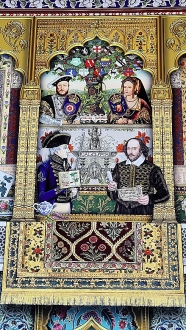
The exhibition at Kew Gardens, “THE SINGH TWINS: Botanical Tales and Seeds of Empire”, which is showing until 12 April 2026, is filled with great examples of their artwork. Their highly decorative, colourful works are rich in interesting details, rather in the way that Italian renaissance paintings were enriched with symbols and features that would have meant a great deal to those viewing them when they were first paintings, and to art historians many centuries later. The many details in the pictures at Kew evoke many thoughts in the minds of people seeing them today, and remind the audience of events that happened not too long ago when Britain had a vast empire and Britannia ruled the waves, and much of the world’s commercial activity.

Each of the pictures on display at Kew contains plenty of witty and often chilling reminders of what the British (and other Europeans) did to the lands they colonised and exploited. Though filled with imagery relating to Britain’s imperial past and its consequences both abroad and in modern Britain, the pictures are glorious to see. A video, with a commentary written in verse and narrated by the twins, accompanies the exhibition. If the pictures alone do not convey the artists’ messages to all viewers, watching the film is very helpful. In keeping with where they are being exhibited, this collection of the twin’s work focusses not only on colonial histories but also on the plants that helped the colonisers enrich themselves.

The exhibition can only be visited if you have paid for entry to Kew Gardens or if you are a member. After seeing the exhibition you can wander around the gardens and spot some of the many plants that were originally brought from different parts of the empire to grow in the botanical gardens.
Revealing some artists from India at Kew Gardens

ALMOST AS SOON as English people began visiting India, and later colonising it, they took an interest in the flora of the Indian Subcontinent. Their interest was both scientific and commercial: looking for plants that could be exploited to make a profit. Many of the early English explorers of India’s flora worked in an era before photography was invented, or in the early days before colour photography became possible. Instead of making photographs of botanical specimens, detailed drawings and paintings of plants were created. Until I visited an exhibition at Kew Gardens, which runs until 12 April 2026, I believed that all the intricately detailed botanical images had been created by English and other European people.

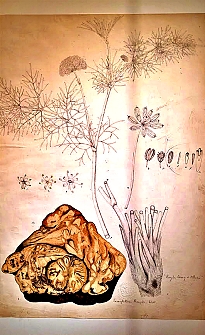
The exhibition, “The Singh Twins: Botanical Tales and Seeds of Empire”, is divided into two related but quite different sections. One section contains colourful, contemporary artworks by the Singh Twins. The other, subtitled “Flora Indica: Recovering the lost histories of Indian botanical art” contains 52 botanical illustrations by Indian artists commissioned by British botanists between 1790 and 1850. Each one of them is rich in detail, delicately drawn and/or painted, and a delight to behold. Not much is known about the Indian artists apart from their names, and where they were based. The artists were both Hindus and Muslims, and their pictures combine traditional Indian draughtsmanship with the kind of scientific realism required by the English botanists who commissioned them. Compared to other Indians employed by British botanists, they were well paid, receiving up to £500 per month in today’s money.

Most of the Indian artists, whose works were on display were based in Bengal: most in Berhampur, others in Calcutta and Darjeeling. Other artists were in Burma, Saharampur, and Nepal. All of them were male. Over 7500 drawings of flora in South Asia were commissioned by the East India Company, and were created entirely by Indian artists. Some of these images reached Kew in 1879 from the Company’s India Museum, established in London in 1801 and closed for good in 1879.

The exhibition is well-displayed with informative labels. It is in the Shirley Sherwood Gallery of Botanical Art. This contemporarily designed edifice is close to the much older Marianne North Gallery, which houses a huge collection of botanical images created by Marianne North (1830-1890). Although her paintings are superb, those by the Indian artists in the exhibition have a certain delicacy that is lacking in many of North’s often quite bold depictions of flora.

The “Flora Indica” exhibition is showing alongside the Singh Twins’ artworks, which are imaginative, witty, and provide a satirical view of the consequences of European colonisation, particularly of India and Africa. Rich in floral details, the images complement those created much earlier by the Indian botanical artists.

A pretty perambulation

LONDON’S KENSINGTON GARDENS is bounded to the north by Bayswater Road and to the south by Kensington Gore (overlooked by the Royal Albert Hall and the Albert Memorial), which becomes Kensington Road.  Within the park and running almost parallel with its southern boundary is the South Flower Walk (also known as The Flower Walk). The Northern Flower Walk, which runs near and parallel to Bayswater Road was once used by royalty. According to a document published on the Royal Parks website, this was:

“… a delicious and appealing place to stroll for the monarch on the way to … the site of the Bayswater ‘Breakfasting House’…”

The breakfasting house no longer exists. I am not sure whether the South Flower Walk can boast of such an illustrious past. However, when it is in full bloom, it outdoes its northern counterpart in colourfulness and variety of its flora.

Although the whole of Kensington Gardens makes for a pleasant place to stroll, a walk along the South Flower Walk provides and exceedingly pretty perambulation.