
A deserted abbey in ruins close to the River Dee in North Wales

WE USED TO make long trips by car in France. Amongst the many sights we visited were various Cistercian abbeys, such as those at Citeaux and Clairvaux. Later, during trips to Wales, we often visited the ruins of the Cistercian Abbeys at Strata Florida and at Tintern on the River Wye. I do not know what drew us to these Cistercian places, but we went out of our way to see them. So, when we were staying near Warrington in Lancashire and I noticed that we were not far from yet another Cistercian site, we made a bee line for it.  Overlooking the River Dee, the ruins of Basingwerk Abbey are located near the town of Flint in the county of Flint.

Though not as extensive as the ruins at Tintern, there is plenty to see at Basingwerk. Dedicated to the Virgin Mary, the abbey was founded in 1132 by Ranulf de Gernon, 4th Earl of Chester. Being on the border between England and Wales:

“Basingwerk was patronised by both the Welsh and Anglo-Norman nobility. Royal benefactors included Henry II, Prince Llywelyn ab Iorwerth (d. 1240), Prince Dafydd ap Llywelyn (d. 1246) and Edward I.” (https://www.monasticwales.org/browsedb.php?func=showsite&siteID=24).

Originally founded as part of the Order of Savigny, it joined the Cistercian Order in 1147. In about 1355, it was reported that the abbey was in a devastated condition. During the early 15th century, Basingwerk tried to encourage pilgrims to visit its shrine, hoping that this would raise funds to repair the place. Between 1481 and 1522, Abbot Thomas Pennant restored the abbey and improved its fortunes. Sadly, by 1537, the institution had been suppressed by order of King Henry VIII. In 1540, the site of the former monastery was sold. After changing hands a couple of times, it became the property of the Mostyns of Talacre.

In 1923, the ruins of the abbey were taken over by the government, and now they are well-maintained by CADW – the historic environment service of the Welsh Government. Despite the appallingly bad weather prevailing when we visited the remains of the Cistercian abbey, we were able to enjoy wandering around the ruins. To recover from the inclement conditions, we took refreshments in the nearby café/restaurant in Basingwerk House.

The conqueror’s ruined castle in north Wales

THESE DAYS WE ARE so preoccupied with the Russian invasion of Ukraine that the English invasion of Wales is not in the forefront of our minds. In the 13th century, King Edward I of England (reigned 1272-1307) decided to conquer Wales. To do this, he built a series of castles from which his armies could enter Wales. One of these was built at Flint on the left bank of the River Dee not far from Chester, from which supplies could be easily carried either by land or by water (sea and river).

The castle at Flint was designed by Richard L’engenour and built between 1277 and 1278. Its form was based on Savoyard models. One of its circular towers was built larger than the others and separated from the rest of the castle – it served as the ‘donjon’ or keep.

Many of those who constructed the castle – English people – stayed on in the area to become the inhabitants of the new fortified, walled town of Flint. They felt safe within the town’s walls, but this sense of security was soon to be disturbed. For in 1294, the Welshman Madog ap Llywelyn led a revolt of the Welsh against their English rulers, and attacked Flint. Rather than letting the town fall into the hands of the Welsh, the Constable of Flint Castle ordered that the town be burned to the ground so that the Welsh rebels would be denied shelter and food.

The castle remained functional until the Civil War, when it, along with other strongholds, was destroyed following orders issued by Oliver Cromwell, soon after 1647.

Today, the impressive ruins are open to the public and well maintained by CADW, a Welsh Government body that looks after sites of historic interest. In 1838, JMW Turner created a watercolour painting showing the castle with a beautiful sunset behind it. We visited it on a rainy day in May 2024. Despite the inclement weather, seeing the castle gave us great pleasure.

Rhymes with freckles

IT RHYMES WITH FRECKLES

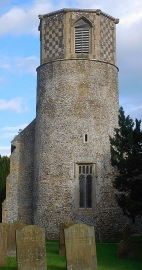
THE HELPFUL FEMALE voice with a North American accent emitting from our mobile ‘phone was quite persistent in trying to direct us onto the A47 road, the most direct route from Swaffham to Norwich, but we chose to ignore the advice we were being given. Instead, we forced ‘her’ to change her instructions so that we could follow a far longer but more pleasant route via Watton and Old Buckenham. As we wound our way between the two last mentioned places, we spotted a church with a round tower, made with flint and mortar, topped with a newer octagonal structure. This was in a Norfolk village that rhymes with freckles: Breckles. The church is St Margarets in the parish of Stow Bedon.

Churches with round towers are a rare breed in England compared with those with square towers. There are only 186 of the rounded versions (www.roundtowers.org.uk/) and some of them are in ruins. Of all the examples of this kind of church, the greatest number can be found in East Anglia, 131 of them in Norfolk.  Church towers were built to house bells and sometimes the items used in services (e.g., church vessels). It is unlikely that they were built as part of the country’s defence against invaders because many of them were built after the last invasion of England (www.roundtowers.org.uk/about-round-tower-churches/).

But why were so many churches with round towers built in East Anglia and relatively few elsewhere? The following (from https://historyhouse.co.uk/articles/round_tower_churches.html) provides one possible answer:

“It has been suggested that the main reason was the lack of suitable local building material. Square towers require strong stone cut and dressed into blocks at each of the corners. But there is no suitable stone to be found in East Anglia and to transport stone from another county was very expensive for a small parish.

The only locally available stone was flint. Flint is a small, knobbly stone which, although creates strong walls when set in mortar, is not suitable for tower corners.”

The round tower of St Margarets was built in the 11th century (https://historicengland.org.uk/listing/the-list/list-entry/1248441), so could have been constructed either before or after 1066, when the Normans invaded. The octagonal structure on the top of the tower, the belfry, is late 15th century (www.norfolkchurches.co.uk/breckles/breckles.htm).  Restored in 1856, the nave and chancel were constructed in the 15th and 14th centuries, respectively.

The interior of St Margaret’s is attractively simple. The carved, probably highly restored,  wooden rood screen, separating the nave from the chancel, is one of the few decorative features in this small church. However, for me, the greatest attraction is the carved stone font, which is decorated with patterns and four carved figures standing in archways. The latter are carved in a simple, almost naïve or unsophisticated style, which made me wonder whether they date to pre-Norman times. Various sources describe it as being Norman.  Whatever it is, it is a lovely piece of carving. When we saw it, it was decorated with flowers and foliage as part of the church’s preparations for celebrating the harvest season.

Having seen this charming church, we were pleased that we did not obey the voice on our GPS app, but instead took a route that our electronic navigator was initially so dead against. The more round about route allowed us to find a lovely church with a round tower.