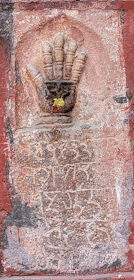
ON THE WALL NEXT to one of the several gates, the Daulat Prole, that leads into the Junagarh Fort in Bikaner, you can see a set of what look like the impressions made by pressing hands into a soft material. Each of these hand prints is labelled in Hindi (Devanagari) lettering. These impressions are amongst the last actions of widows about to commit sati.
Sati was the usually forced self-immolation of widows. Sati was the tradition in India that involved widows being forced to throw themselves on their husband’s burning funeral pyre. Sometimes, they did it apparently voluntarily. It was a tradition often practised by Rajputs, but not restricted to them. During the British occupation of India, there were various attempts to outlaw sati, but incidences of it continued into the 20th century. Finally, in 1987, the Government of India passed an Act criminalising the practice of sati and its glorification.
Returning to the hands at the Junagarh Fort, one of the officials guides told us the following. Prior to being caste onto her spouse’s funeral pyre, the noble Rajput widow would dress in her finest clothes and jewellery, and approach the Daulat gate. By this time, her hands would have been covered with henna (mehndi). She would then press the palm and digits of her right hand on a stone slab, leaving a print of her hand on it. Later, an artisan carefully carved a three-dimensional impression of the widow’s hand. By that time, the poor woman had been incinerated.
In Rajasthan, various of the Princely States abolished sati in the first half of the 19th century. In Bikaner, the last Maharani to die on her husband’s pyre was in about 1825, so we were told by the guide at the fort.
My eye was immediately attracted to the sati memorials. I wonder how many other visitors to the Junagarh Fort stop and contemplate these tragic memorials before proceeding with taking photographs of each other at the many picturesque spots within the fort.
THE MEHRANGARH FORTRESS rests on massive rock overlooking the city of Jodhpur in Rajasthan. At night the walls of the fort are brightly illuminated and can be seen from many places in the city. The older districts of Jodhpur cling to the lower slopes of the rock upon which the fort rests. To take advantage of the splendid views of the fort, many restaurants in the old parts of the city are located high above street level on rooftops. Some of these eateries are as much as five storeys above street level, and none of them have lifts to reach them.
A restaurant is at the TOP
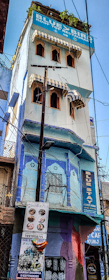
One rooftop restaurant, which we have visited twice, is on the second floor of an old building. Called Indigo, we have eaten excellent Rajasthani meat dishes there, and were looking forward to visiting it a third time today (the 3rd of December 2024).
At about 4 am. on the 3rd of December, I awoke briefly and noticed that there was no electricity in the hotel and the alley next to it. By 7 a.m., the electrical supply had been restored. At breakfast, which is always served on the fourth floor rooftop of our guest house, Mr Manu, the owner of the place, told us that there had been a fire in the kitchen of the Indigo restaurant, which we had begun to enjoy. Burn marks were clearly visible from our guest house’s rooftop.
The reason the power had failed early in the morning was that the Indigo restaurant is located close to an electricity transformer, and the authorities were concerned that the fire might spread ⁷to it. Luckily, it did not.
After breakfast, we decided to walk to Indigo to offer our sympathy to its charming owner. When we arrived, we found his wife and a few other women seated in the restaurant’s ground floor courtyard. Each of them had very sad expressions on their faces. I felt that it was like visiting the bereaved soon after a loved one had passed away. They asked us to sit with them, and soon after that, the owner arrived. We told him how sorry we were about the disaster which had befallen him and his family. I believe that he appreciated our brief visit.
Had the fire not happened, we would have eaten all the rest of our evening meals at Indigo during the remaining few days of our stay in Jodhpur. I hope that Indigo will recover soon and that anyone who happens to read this and is visiting Jodhpur will eat at this excellent restaurant.
CONSTRUCTED IN 1974, it was 221 feet tall. It overshadowed the homes of many people including many of the wealthier inhabitants of West London’s Kensington. And I imagine that the wealthy inhabitants of the elegant crescents and other thoroughfares near it did not appreciate the views from their windows being spoiled by this Brutalist block of flats containing less well-off people, about whom they would rather not think. Between 2015 and 2016, the block was refurbished and made less of an eyesore by the addition of cladding – ostensibly to improve insulation – to its exterior.
On the afternoon of the 13th of June 2017, I was walking around North Kensington, taking photographs as usual. I stopped to take pictures of the recently built Kensington Leisure Centre and its near neighbour the Kensington Aldridge Academy – both are interesting examples of contemporary architecture. While I was taking these photos, I had my back to the tower block I have just described. Had I looked at it then, I would have thought that it would have been of little interest to me. How wrong I was.
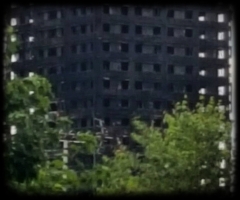
Just after midnight on the following day, a fire broke out in that tall block – Grenfell Tower – that edifice which overlooked the homes of the wealthy residents of Kensington. The fire spread rapidly because of the highly inflammable nature of the cladding used to make the tower more attractive to its neighbours. Seventy-two people died in the conflagration; many were injured; and all the surviving residents were not only badly scarred psychologically, but also lost their homes and possessions.
From wherever you looked in a large area around Grenfell, including from the homes of the prosperous residents of Holland Park and Notting Hill, one could see the horrifically charred tower block – a fear-inspiring eyesore – the result of local government officialdom ignoring repeated warnings about the already known potential fire hazards that the cladding presented and inadequate planning for escape during a fire. I felt – and I am not alone in thinking this – that the local council hardly cared for a few impecunious residents in a tower block. What was more important was to save money so as not to impose high local taxes on people who could have easily afforded to pay them.
Soon after the fire, the charred tower was covered with protective wrapping to assist forensic investigations and to contain debris, which might otherwise have flown away and dropped in the neighbourhood. It also removed from sight the scarred, charred remains of the building – a 24 hour a day reminder of the avoidable, tragic loss of life, which was not altogether disconnected with civic and possibly criminal negligence. The remains of the tower are still covered up. Before the heart-rending remains of the conflagration were covered up, filmmaker Steve McQueen (born 1969 not far from Grenfell Tower) made a short film about the tower. It is currently on show at the Serpentine South Gallery in Hyde Park until the 10th of May.
The film is without words in its soundtrack and without any captions. It looks as if it might have been filmed with a drone or a camera held within a helicopter. It begins with a flight over beautiful countryside far beyond the edge of London. The camera moves above the scenes of rural serenity and slowly the city of London comes into view. We pass over London’s sprawling suburbs, and then the charred Grenfell Tower begins to be seen in the centre of the screen. The camera moves closer and closer to the blackened building, and then slowly circles around it many times. Each time the tower is slowly encircled, and the camera moves closer to it, more and more details of the destruction entered my consciousness, and my understanding of the horror of what had befallen Grenfell and its inhabitants gradually increased. As the camera moved around the wreck, you could catch glimpses of the parts of London surrounding it – the houses and flats of those who must have witnessed the fire, but were not affected by it, at least not physically. As the camera moved, one could see trains moving on nearby tracks and vehicles travelling along roads. I felt that I was witnessing life going on as usual at the same time as witnessing the horrors of a disaster. The absence of commentary added to the powerful impact that seeing these images of a lethal incineration simultaneously with scenes of normality made on me. There was a soundtrack, which consisted of recordings of everyday sounds – both natural and man-made. However, while the camera encircled the tower of death, there was no sound at all. I wondered whether this signified the fact that the victims, who had died, will no longer be able to enjoy the sounds of everyday life.
McQueen’s film is a sophisticated and solemn memorial to an event that could easily have been avoided. Without a soundtrack or explanations, the viewer is left to ponder the tragedy in his or her own way.
MUSEUMS OFTEN CONTAIN interesting surprises for visitors. The small museum in Burnham on Crouch (in Essex) is no exception. It amused me to see that amongst the exhibits there were several early examples of so-called pocket calculators – too large to fit most pockets. I was given one of these (made by Casio) in about 1974, and at the time this was a wonderful gift as well as being a useful tool. I was able to replace my slide-rule with my Casio. These calculators, along with other things that were regarded as being ‘the latest thing’ in the 1960’s and ‘70s, were not what surprised me most at the museum. Hanging on the wall of one side of a staircase, there was a huge piece of cloth with advertisements printed on it. It is part of the fire safety curtain that was used in the local cinema, The Rio (see: https://adam-yamey-writes.com/2021/11/13/a-small-cinematic-survivor/) , in the 1930s.
Fire curtains are usually made of metal or heavy materials containing asbestos (or some other fire retardant). They are designed to be lowered (often automatically) should a fire break out on the stage of a theatre or cinema in order to prevent the fire spreading to the auditorium. In 1613, a cannon misfired on the stage of Shakespeare’s Globe Theatre, causing the thatch on the building’s roof to catch fire; the theatre was destroyed. There were no fire curtains in those days.
The first fire curtain (it was made of iron) to be installed in the UK was in 1794 at the Theatre Royal Drury Lane in London. A large fire at the Theatre Royal in Exeter in 1887 led to the wider use fire curtains in British theatres, and later in cinemas. However, these safety devices were not infallible. A fire that began on the stage of the Iroquois Theatre in Chicago (USA) led to the deaths of about 575 people when the fire safety curtain snagged and could not be fully lowered. This led to the invention of an improved automatic fire curtain by John Clancy a year later in 1904.
Fire curtains, which must be lowered at least once during every performance in the UK can be plain or decorated. Plain fire curtains, when lowered, can serve as screens on to which advertisements are projected. The example at the museum in Burnham has advertisements printed or painted on it. Local businesses paid the cinema to have their adverts printed on the curtain that hung in the Rio during the 1930s. The Treasurer of the museum explained that of the many Burnham firms, who placed adverts on the fire curtain, only one of them is still in business. Thus, the old fire curtain (or at least the half of it that is in the museum) not only protected Burnham’s cinemagoers from burning but also serves as a valuable record of the town as it was almost 100 years ago.
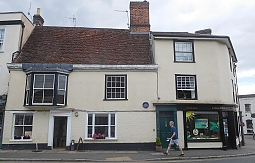
COGGESHALL IN ESSEX is an attractive place to visit. The small town contains over 300 buildings of historical interest, all of which have given protected status. Amongst these is Paycockes House, which I will describe another day. One of the many other old buildings in the centre of the town is a large house, once the home of Thomas Hawkes.
House of Thomas Hawkes in Coggeshall
Hawkes was a retainer of John de Vere (1516-1562), the 16th Earl of Oxford, who became a supporter of the Roman Catholic Queen Mary, who became the monarch in 1553 (following the deaths of the Protestant King Edward VI and the unfortunate Lady Jane Grey). Mary decreed that England should return to Roman Catholicism and the Earl of Oxford concurred with this.
Thomas Hawkes, a fervent Protestant, decided to leave his ‘employer’, who had become sympathetic to Mary’s religious cause. He returned to his home (known as ‘Constantynes’) in the centre of Coggeshall. Unwilling to partake in any Roman Catholic practices and a vocal opposer of that branch of Christianity, Hawkes soon became regarded as heretic by the Catholic authorities.
Under great suspicion by those then in power, Hawkes did something that got him into really bad trouble: he refused to have his newly born son baptised into the Catholic faith. He was arrested and taken to Newgate Prison in London. From there, he was taken to the palace of Bishop Edmund Bonner (c1500-1569) several times, and asked to recant. Having refused each time, on the 9th of February 1555, Bonner condemned him to be burnt at the stake. After Bonner had given him one last chance to recant, he is believed to have said:
“No, my lord, that I will not; for if I had a hundred bodies, I would suffer them all to be torn in pieces, rather than I will abjure or recant.” (https://coggeshallmuseum.org/thomas-hawkes/)
After some months, Hawkes was taken to Coggeshall, where on the 10th of June 1555 he was burnt at the stake.
Hawke’s house still stands and is marked with a commemorative plaque. It was built in the mid-15th century, but has been much modified since then.
FIREFIGHTING IS NEVER without hazard. This is something that James Braidwood (1800-1861) knew only too well when he attended a fire in Tooley Street near London Bridge station on the 22nd of June 1861.
Braidwood was born in Edinburgh, Scotland and in 1824, he was appointed Master of Fire Engines just before The Great Fire of Edinburgh, which began on the 15th of November 1824 and lasted for 5 days. Having been trained as a surveyor, he understood building techniques and materials. This along with his recruitment of various types of tradesmen helped him deal with the conflagration. His methodical approach to firefighting gained him a good reputation.
In 1833. He left Edinburgh and shifted to London, where he took over the running of the city’s London Fire Engine Establishment, the forerunner of The London Fire Brigade. In October 1834, he was involved in tackling the fire that destroyed much of the Palace of Westminster. His reputation was already great when he attended the fire in Tooley Street on the 22nd of June 1861. Three hours after the fire broke out, he was crushed to death by a falling wall. It took two days to recover his body and he was given a hero’s funeral. The fire, which began in Cottons Wharf, continued to burn for a fortnight. The reasons for its long duration included:
“The first was that firefighters were unable to get a supply of water for nearly an hour due to the River Thames being at low tide. The second was that the iron fire doors, which separated many of the storage rooms in the warehouse, had been left open. It is believed that had they been closed, as recommended by James Braidwood, the Superintendent of the LFEE, the fire could have been contained, avoiding disaster.” (www.historic-uk.com/HistoryUK/HistoryofBritain/Tooley-Street-Fire/)
Overlooked by London’s recently constructed, glass-clad Shard, is short Cottons Lane that leads north from Tooley Street. Where these two roads meet, there is a sculptural plaque high up on a wall. It depicts a wreath entwined with a firefighting hose pipe. Behind the wreath, the artist carved the façade of a building with smoke billowing out of its windows. There also depictions of other tools used to fight fires in the 1860s when this memorial was constructed. Within the wreath. there are words:
“To the memory of James Braidwood, superintendent of the London Fire Brigade, who was killed near this spot in the execution of his duty at the great fire on 22nd June 1861” This is not the only memorial to Braidwood. Others, which I have not yet seen, can be found in Edinburgh and in Stoke Newington’s Abney Park, where Braidwood was buried.
SNAPE MALTINGS ON Suffolk’s River Alde is a famous venue for music (mainly) and the other arts. It is the home of the Aldeburgh Festival, started in 1948 by the composer Benjamin Britten (1913-1976) and his partner, the singer Peter Pears (1910-1986). We have yet to attend a concert there, but we have eaten a fine lunch in its beautifully designed River View eatery. From the Maltings, you can enjoy views across the water meadows and if you look carefully enough, you can spot the tower of the Church of St Botolph in the tiny village of Iken across the river.
St Botolph, who died in about 680, is believed to have brought Christianity to Iken in about 654. He is the patron saint of boundaries, and, because of this, also of trade and travel. The present church dedicated to him is curious because its nave has a thatched roof. It was preceded by a minster built by Botolph but destroyed by the Danes in the 9th century. In 870, a Saxon timber church was constructed. This has also gone. It was replaced by a stone edifice, the beginning of what we can see today.
The Norman flint-rubble nave of the current church was built between about 1070 and 1110. The western tower, also with flint and other masonry was constructed soon after Robert Geldeny and William Baldwyn bequeathed money for its construction in 1450 and 1456 respectively. During the Reformation in the 16th century, various changes were made to the church’s interior to conform with the restrained liturgical requirements of the Reformed Church. This would have included whitewashing over colourful frescoes and destruction of stained glass and other decorative features. By the 19th century, the church was becoming somewhat dilapidated. Between 1850 and 1860, restoration works were undertaken. A new chancel was constructed in the style of the early 14th century on the foundations of the original mediaeval chancel. It was designed by John Whichcord (1790-1860) of Maidstone in Kent.
In 1942, during WW2, the whole of the population of Iken was evacuated so that the area could be used for battle training. The church was also closed. It reopened in 1947 after the villagers returned to Iken. During the 1950s, they did much work to improve the condition of their church. In 1968, sparks from timber being burnt nearby set fire to the thatched roof of the church. The nave was badly damaged, but the chancel survived. Today, visitors to the church would not be able to imagine that it had suffered such a conflagration, so well has it been repaired.
Inside the church, several things attracted my attention. The most fascinating is the Saxon cross shaft in the northwest corner of the nave. Covered with bas-relief Celtic-style carvings this 4 ½ foot fragment of a stone cross (possibly, originally 9 feet in length) was created either in the 9th or 10th century. Near to this, there is a lovely octagonal stone font, which is 15th century. It is covered with superb carvings, some of which depict the emblems of the four Evangelists. These are separated from each other by angels. The wooden altar reredos, a panel behind the altar, was carved by Harry Brown of Ipswich and dedicated in 1959. It bears a bas-relief of The Last Supper, which Mr Brown based on the famous painting of that occasion by Leonardo da Vinci. I have mentioned a few of the items within the church that I found interesting but there is plenty more to see, all listed in an informative booklet on sale in the church.
From the boundary of the graveyard surrounding this lovely church, you can catch glimpses of the River Alde, which flows nearby. Visitors to Snape Maltings should spare some time to visit the church at Iken. It is so nearby yet feels so far away.
LESS THAN 580 FEET long, Rathbone Street runs parallel to part of London’s Charlotte Street. Short though it is, it is not lacking in interest. The quiet thoroughfare was originally named ‘Glanville Street’, before being renamed Upper Rathbone Place, and then its present name (www.british-history.ac.uk/survey-london/vol21/pt3/p12). Rathbone after whom Rathbone Place and Street were named was a carpenter and builder, Thomas Rathbone (died 1722), who lived in a house on the Place around 1684. Rathbone Street was laid out 1764-65 (www.ucl.ac.uk/bartlett/architecture/sites/bartlett/files/chapter31_hanway_street_and_rathbone_place.pdf). During the late 18th and early 19th centuries, Rathbone Street was occupied by various artists including the sculptor M Bordier and the painter John Rubens Smith. Today, various vestiges of the past can be seen on the short street.
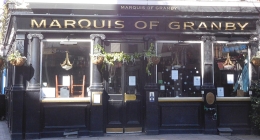
The Marquis of Granby pub at the southern end of Rathbone Street was named in honour of Lieutenant-General John Manners, Marquess of Granby (1721-1770), who fought heroically at the Battle of Warburg (1760) during The Seven Years War (1756-1763). He became Commander of the British Army in 1766. There are many pubs named after him because, it is said, he set up many of his soldiers as publicans when they retired from military service. The pub bears old boundary markers marking the demarcation line between the parishes of St Pancras and St Marylebone. The pub now stands in both the Boroughs of Camden and Westminster. In the past, the pub’s customers have included Dylan Thomas and TS Eliot. The building housing the pub was already built by 1765.
There are two other pubs in Rathbone Street. One of them halfway along it is The Newman Arms, another haunt of Dylan Thomas and also frequented by George Orwell. Established in the 1730s, this pub features in two of Orwell’s novels: “1984” and “Keep the Aspidistra Flying”. Once upon a time, the pub was a brothel. A painting depicting a prostitute in period costume covers a bricked in upper storey window. Across the road from the pub there is a plaque on a building that bears the words: “Hearts of Oak Benefit Society” and the date 1888. This marked the rear entrance to the offices of the Society. Its main entrance was 15-17 Charlotte Street (www.londonremembers.com/memorials/hearts-of-oak-benefit-society-w1). At the north end of the street, there is a third pub, The Duke of York. Bearing the date 1791, it was where the author Anthony Burgess was drinking when he witnessed an attack by a gang bearing razors (https://en.wikipedia.org/wiki/The_Duke_of_York,_Fitzrovia). The pub’s sign bears a portrait of someone who is far younger than the pub, the current Prince Andrew. This pub is the only one with the name The Duke of York which has a pub sign depicting the current Duke of York. The pub was originally named to honour an earlier Duke of York.
Rathbone Street, short as it is, contains three pubs. Its continuation southwards towards Oxford Street, Rathbone Place, contains two pubs and another drinking place, once a pub but now named The Liquorette, in a stretch of road even shorter than Rathbone Street. Thus, there used to be 6 pubs within a stretch of roadway 364 yards in length.
Returning to the south end of Rathbone Street, its southwestern corner, we reach what first got me interested in this short lane. During WW2, there was a London Auxiliary Fire Station, Sub Fire Station 72Z, on this spot. During the night of the 17th of September 1940, it was hit by a bomb dropped by the German Luftwaffe. The building burst into flames. Seven firemen lost their lives. However, two men were saved by the brave actions of Fireman Harry Errington, who was later awarded a George Cross to recognise his bravery. He rescued two of his comrades from the flaming ruins. Harry Errington (formerly ‘Ehrengott’) was son of Jewish immigrants living in Soho. Harry, son of Baila and Shepsel Ehrengott who arrived in London from Poland in 1908, was born in Soho in 1910 (https://british-jewry.org.uk/New%20Member%20Area/BJ%20News/100806/Microsoft%20Word-B-JNews8final.pdf).
After training to become an engraver, he had to abandon this because his lungs became affected by nitric acid fumes. Then, he joined a relative, a tailor in the Savile Row firm of Errington and Whyte. He became a master tailor. Then, WW2 broke out. Mike Joseph wrote in the “B-J News” of August 2006:
“It was in 1940 that Harry earned true celebrity status. Having joined the Auxiliary Fire Service at the outbreak of the Second World War a year earlier, he was one of several firemen on duty in a basement rest-room during an air raid, when the building collapsed. An enemy bomb had scored a direct hit, and twenty people died, including six firemen; Harry was lucky: he was only knocked out! When he came round, the building was on fire. He could have escaped with little difficulty, but two of his comrades were trapped under rubble: how could he leave them? He wrapped a blanket round his head against the flames and, digging with his bare hands, managed to free one of the men. He dragged him to safety, upstairs into the street, and then, although he was already badly burned, went back and rescued the other man.”
Harry was true to the words quoted from the Book of Joshua, which are written on one of the two commemorative plaques marking the former fire station in Rathbone Street:
“Be strong and of good courage.”
Harry returned to tailoring when the War was over but remained in touch with the London Fire Brigade. When he died in 2004, he was the last surviving Jewish holder of the George Cross.
Though less lively than nearby Charlotte Street in ‘normal’ times, Rathbone Street is worth a detour, if only to quench your thirst in one of its three pubs. I wonder whether Harry Ehrengott and his colleagues made use of any of these drinking holes during the odd quiet moments between their brave firefighting tasks.
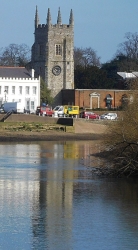
THE TOWER CAN BE seen from far away. From a distance, the visitor to Old Isleworth on the River Thames might be fooled into believing that the 14th century stone square church tower topped with four pinnacles, one at each corner, is attached to an equally venerable church, but this is no longer the case. The mediaeval tower is almost all that remains of the mediaeval church of All Saints in Isleworth. It is attached to a twentieth century structure that now serves as the church. When I saw this, I wondered what disaster had befallen the rest of the original pre-20th century church.
The origin of the name Isleworth is unknown. In the Domesday Book, it is listed as ‘Gistelworde’ and Norden, writing in 1591, named it both ‘Thistleworth’ and ‘Istleworth’. Simon de Montfort (c1205-1265), who expelled the Jews from Leicester in 1231, and his barons are known to have camped in Isleworth Park in 1263. To digress, maybe, in view of his anti-Semitism, the authorities of De Montfort University in Leicester, ought to reconsider its name. Getting back to Isleworth, the Domesday Book records that there was Christian worship in Isleworth (https://allsaints-isleworth.org/about-us/church-history/) and a vicarage is mentioned in records compiled in 1290 (www.british-history.ac.uk/vch/middx/vol3/pp122-129). The church, whose tower is still standing, was dedicated to ‘All saints’ in 1485 and was connected to Syon Abbey, a Bridgettine establishment, founded in 1415 in Isleworth, which was disbanded by Henry VIII. Interestingly, it was in the Abbey’s chapel that the body of Henry VIII lay overnight on its journey from Westminster to St Georges Chapel in Windsor (https://en.wikipedia.org/wiki/Syon_Abbey). The abbey stood where Syon House stands today.
The church is said to have been ‘very ancient’. Its chancel was rebuilt in 1398-99. By 1701, the church was in a poor condition and needed rebuilding. Christopher Wren, architect of London’s St Paul’s Cathedral, was invited to redesign the church. His design was deemed to costly to be carried out and was discarded. Eventually, the churchwardens brought out Wren’s plans and modified them to make the construction of the church more economical. James Thorne, author of “Handbook to the Environs of London” (published 1876), wrote that:
“Apart from its ivy-covered tower, there could not well have been an uglier ch[urch] than that of Isleworth a few years ago…”
However, he added:
“…but it has been transformed, the windows altered, a new roof of higher pitch, and a lofty white-brick Dec. [i.e. gothic revival] chancel added, greatly to the benefit of the general effect.”
He also described many improvements to its interior and noted the existence of a fine organ built by Father Schmidt (Bernard Schmidt: c1630-1708). Alas, none of what Thorne described, apart from the tower, can ever be seen again.
Except for the tower, the church was destroyed by fire in 1943 during WW2. The fire was not the result of military activity but was caused by two young boys. These same two miscreants also set fire to Holy Trinity Church in Hounslow a few days later. This is what happened (https://stmargarets.london/archives/2013/05/fire_starter.html):
“In the early hours of Friday, 28th May 1943, All Saints Church, standing by the Thames in Old Isleworth, was destroyed by fire. The alarm was given at 2.30am by Miss Burrage who lived next door and again by Mr. McDonald, the publican of the “London Apprentice”. Against the darkness of the wartime black-out the glow of the huge fire could be seen for miles.
Three days later, on the afternoon of Tuesday 1st of June 1943, the Parish Church of Hounslow (Holy Trinity) was completely destroyed by fire. Shortly after 5.00pm smoke was reported to be issuing from the church … The police noted that an attempt had been made to open the church safe…”
Two boys, one aged 12 and the other 13, were arrested and tried at Brentford in the old courthouse, which is now home to a restaurant/café called The Verdict. These two youngsters had been in court several times before for crimes of petty theft. In court, they admitted:
“…that they only set fire to the churches out of spite and only if they found no money to steal. They told the chairman Mr. A. J. Chard J.P, how easy it was to break into churches and how easy it was to burn them down. At the Mission Hall they set fire to the curtains. At Broadway Baptist Church they set eight separate fires. At Holy Trinity it was five. The older boy also confessed to burning down a haystack in a coal yard a year earlier.”
The two arsonists were sent to approved schools. The Chairman of the Court recommended:
“…to the Home Office that the two lads should go to separate schools and that the schools should be of the strictest kind; further, that they should be kept there for the full period of three years.”
All Saints Church was rebuilt yet again in 1970 to the designs of architect Michael Blee (1931-1996), who built several churches. From the outside it is quite an attractive structure attached to the mediaeval tower.
While wandering around the church, two things caught my eye. One is a stone placed close to a large yew tree in the churchyard. The stone informs us that the yew tree is growing upon the site where 49 people, who died in the Great Plague of 1665, were buried. The other feature that interested me was a group of stones set in the wall surrounding the churchyard. Each of these records the level to which water reached when the Thames flooded on various years between 1774 and 1965. The building of The Thames Barrier, completed in 1984, brought an end to these flooding events.
All Saints Church stands a few yards away from the riverbank from where there are wonderful views of the Thames and Isleworth Ait and a rich selection of waterfowl swimming in the river. Given how close the old part of Isleworth is to suburban west London, it has a remarkably rustic feeling, and is a peaceful place, providing you ignore the low-flying aircraft that pass above every few minutes.





 yamey
yamey 