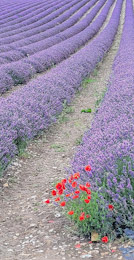
ON OUR WAY to visiting new friends in Kent, at their recommendation, we stopped en-routr at Castle Farm near Shoreham. We were delighted to discover that this agricultural enterprise specialises in cattle and growing lavender. It is the largest lavender farm in the UK.
I had no idea until we visited the farm that lavender was grown on such a large scale in England. I have visited lavender farms in Provence and seen many glorious photographs of lavender fields in that and other regions of France. However, it came as a complete surprise to discover similar fields in South East England. I am grateful to Asha and Matthew for introducing us to this place.
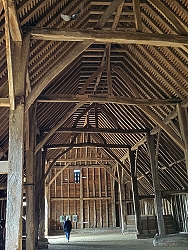
IF WE HAD NOT MISSED a turning at a road junction in Essex, we might never have visited Prior Hall Barn (near Widdington). Maintained by English Heritage, this well-preserved, huge timber-framed, wood-cladded 15th century barn. Constructed entirely of timber – without any metal, it has been estimated that its 900 pieces of timber were derived from 400 trees. Some metal structural elements have been added since the barn’s original construction, which judging by the date of the timbers commenced no later than about 1472. It remained in use as a barn until 1976.
A mediaeval barn such as this one is fascinating enough. However, the land on which it stands has a most interesting history. Just before William the Conqueror set sail for England, he assembled his fleet in the river port of Saint-Valery-sur-Somme. It is believed that he was made welcome in the town’s priory. As a gift of thanksgiving for his successful conquest of England in 1066, he gave the farm on which the barn stands to the priory in St Valery.
In the 14th century, lands owned in England by foreign owners became a drain on the economy, and properties such as the village of Widdington were confiscated by King Edward III. In 1377, the land where the barn and village stand were given to William of Wykeham, the Bishop of Winchester. In 1379, Wykeham founded New College Oxford and endowed it the farm, The college owned the farm from 1379 until 1920, when a local farmer purchased the freehold. It was resold in 1950, and in 1976 its owner, Mr Jeremy Dillon-Robinson placed the barn into the care of the Department of the Environment. Now, it is cared for by English Heritage.
Although I have no idea whether William the Conqueror ever set foot in Widdington, the place’s connection with St-Valery-sur-Somme adds to the excitement of seeing this historic barn. Had we stuck to the ‘beaten track’, we might well never have even heard of the barn, let alone the land’s interesting ownership history.
THE BATTLE OF PORTOBELLO (or ‘Porto Bello’) was fought between the forces of Britain and Spain on the 20th of November 1739. The British were aiming to capture the settlement of Porto Bello in Panama during the early stages of the War of Austrian Succession (1740-1748). The victorious British naval force of only six heavily armed vessels was commanded by Admiral Edward Vernon (1684-1757). This gentleman has been accredited for coining the word ‘grog’, meaning rum diluted with water.
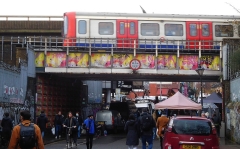
Rail bridge over Portobello Road
A map of Kensington drawn in about 1810 marks a ‘Portobello Farm’ next to what is now Portobello Road. The owner of the farm is said to have named his farm thus to honour Admiral Vernon’s capture of the Panamanian town of Porto Bello. The road or track running past the farm was called ‘Portobello Lane’. In the early 19th century, the farm stood alone amongst open fields where cows, pigs, and sheep grazed.
A detailed map surveyed in 1865 shows the farm located near a slight bend in Portobello Lane, about 270 yards north of a bridge carrying the railway across the lane, 280 yards east of ‘Notting Hill Station’ (now Ladbroke Grove Station). Almost across the road from the farm, there is marked ‘Notting Barn Lodge’. A lane led west from there to a larger building marked ‘Notting Barn’.
Notting Barn was the manor house of the Manor of Knotting Barns. Writing in 1820, Thomas Faulkner, author of “History and Antiquities of Kensington”, noted:
“In the midst of these meadows stands the Manor House of Knotting Barns, now occupied by William Smith esq. of Hammersmith, it is an ancient brick building, surrounded by spacious barns, and outhouses; the road to Kensal Green passes through the farmyard.”
The manor was part of the property of the De Veres, as is evidenced by a document dated 1476. In that year, it was seized by the Crown. In 1543, when the manor was owned by Robert Wright, it was sold to King Henry VIII. Then, through the centuries the manor changed hands frequently. The manor gave its name to the area now known as ‘Notting Hill’. The name of the manor and the present district might well have Saxon origins. Florence Gladstone, writing in 1924 (www.theundergroundmap.com/article.html?id=56157&annum=3000), suggested that a:
“…Saxon family, the Cnot-tingas, or ” sons of Cnotta,” may have made a clearing for themselves in the denser wood to the north. No less an authority than Dr. Walter W. Skeat suggests this Saxon solution for the name of Notting Hill. Other writers have thought that the encamp-ment was founded by followers of King Knut. Whether Saxon or Danish in its origin the little colony seems to have been entirely wiped out before the Norman Conquest; nothing but the name remaining to testify to its former existence. The popular belief that Notting Hill owes its name to the nut bushes which grew upon its slopes is a pleasant, but untenable, tradition. The name occurs in the Patent Rolls for A.D. 1361. There it is ‘Knottynghull’, proving that the ‘k’ is original as is also the double ‘t’ .”
By 1897, both Notting Barn and Portobello Farm no longer appeared on the map and Portobello Lane had been renamed ‘Portobello Road’. Notting Barn Manor House stood approximately where today St Marks Road and Bassett Road meet. Where the farm had once stood, there were residential streets that still exist, including Bevington, Blagrove and Raddington Roads. Across Portobello Road almost opposite the site of the farm there was a large building labelled ‘Franciscan Convent’ and opposite it just north of the former farm there was another large building, which is unlabelled on the map but was ‘St Joseph’s Home for the Elderly’.
St Josephs was founded by a Roman Catholic order, The Little Sisters of the Poor (https://ezitis.myzen.co.uk/stjosephshome.html). They bought Portobello Farm on the 7th of June 1865. They resided nearby whilst the farm buildings were demolished and their new convent and home for the elderly was being built. The home for the elderly opened in 1869. The home was finally closed in 1978. After being demolished in the early 1980s, a new housing estate, St Josephs Close, was built in 1986 with its entrance on Bevington Road. The old convent wall that runs along the east side of Portobello Road has become an open-air public art gallery.
Across the road and almost opposite the former farm and its successor, St Josephs, stands a formidable looking building that currently houses a Spanish school, the Vicente Cañada Blanch Spanish School. This was originally occupied by nuns of the Third Order of St. Francis, whose convent had been founded in 1857. The building was designed by Henry Clutton (1819-1893) and built in 1862, but it was modified and enlarged later.
Nothing remains of either the manor house or Portobello Farm. However, the slight bend in Portobello Road near the Spanish school is as it was when the farm existed as can be seen on detailed maps that marked the farm. The entrance to the farm was on a stretch of Portobello Road north of the elevated Westway (the M40 motorway). On Fridays and Saturdays, this section of the road becomes an open-air ‘flea market’, a scruffy extension of the main Portobello Road market south of the motorway and railway bridges that have been built close to each other where they traverse the busy market precinct.
I worked in Golborne Road for several years, near the streets that now cover the former Portobello Farm. Many of my patients lived in those streets. Most of them are probably unaware of the erstwhile existence of the farm, as was I until I researched this short essay.

 yamey
yamey 