
Finding a box of photographs and rediscovering a forgotten artist

UNTIL ABOUT 1991, my widowed father resided in my childhood home in northwest London. For as long as I can remember, there was a collection of black and white photographs in a cardboard Kodak photographic paper box. The photographs contained images of sculptures, which my mother Helen Yamey (1920-1980) had created at St Martins School of Art in London during the later 1950s and first half of the following decade. In 1991, my father married again, and moved from our childhood home to another address. Every now and then, after my father moved, I used to ask him what had happened to the photographs. He used to reply that he did not know where they were. Maybe, he suggested, they were stored somewhere in the garage of his new home. He died in 2020. After that, I thought that it was extremely unlikely that I would ever set eyes on the photographs again.

A year or two after my father’s demise, his widow, my stepmother, arranged to meet me at a café. When she arrived, she was carrying a plastic carrier bag, which she handed to me. To my great delight, I found that it contained the Kodak box filled with photographs of my mother’s sculptures. I posted a few of these images on the Internet. Some months after that, my friend Edesio mentioned that he was impressed by the images of my mother’s sculptures, and suggested to me that I should write something about my mother and her art. This I have done.

When I began writing my mother’s biography, our daughter Mala, who is an art historian and a curator, sent me a pdf file containing the contents of a catalogue of an exhibition held at London’s Grosvenor Gallery in the 1960s. It contained mention of some of my mother’s work that appeared in the exhibition. Mala did a little more research and discovered the existence of catalogues of other exhibitions in which my mother’s sculpture was included. I investigated these catalogues and came across a few more, I was surprised by what I discovered.

During the first half of the 1960s, my mother’s sculptures were selected to appear in exhibitions alongside artworks created by artists, many of whom are now quite famous. These include, to mention but a few, David Hockney, Henry Moore, Barbara Hepworth, Howard Hodgkin, Bridget Riley, Kim Lim, and LS Lowry. These exhibitions were held when I was between 8 and 13 years old. In those days, I was not particularly interested in my mother’s artistic activities and was too young for the names of these artists to mean anything to me. In addition, I do not recall even having been told that my mother was participating in exhibitions, let alone showing her work alongside that of these now famous creators.  So, until I studied these catalogues more than 40 years after my mother died, I had no idea that for a while she was in the vanguard of 20th century British sculpture. Had I not been stimulated into beginning to write about her, I would not have known that my mother, who never boasted about her achievements, had been an artist of such a high calibre.

I have written my memories of my mother in a book called “Remembering Helen: My Mother the Artist” (available from Amazon: https://www.amazon.co.uk/dp/B0DKCZ7J7X/) . In it I have tried to describe her upbringing; what she was like as a mother; and her achievements in the world of sculpture. I have included many of the images I found in the box of photographs, and our daughter has written some insightful notes on her grandmother’s sculptural styles and the techniques. I hope that my book will help bring my mother’s artistic  achievements out of obscurity. Modest as she was, I feel that it would be good if she were to get at least a little of the fame she deserved.
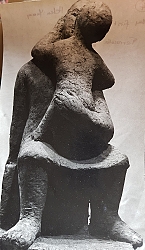
Images of my mother’s sculptures rediscovered

MY LATE MOTHER (Helen Yamey: 1920-1980) trained as a commercial artist in Cape Town (South Africa) before WW2. In 1948, she came to London to marry my father. In London, she painted and, according to my father, took lessons from the great Stanley Spencer (1891-1959). Around the time when I was born (1952), my mother began making sculptures. The first of these was a terracotta mother and child. Maybe, she was depicting herself with me in her arms.  By the 1960s, she was working in the sculpture studios of St Martins School of Art, which was then near Foyles bookshop on Charing Cross Road. There, she was in the company of artists such as Anthony Caro, William Tucker, Philip King, and William Turnbull. At least one of these now famous artists taught my mother how to weld and solder.

My mother exhibited her works in important art galleries at least twice. In late 1961, she exhibited at the Institute of Contemporary Art in a show called “26 young Sculptors”. In 1962, she exhibited sculptures at the Grabowski Gallery, along side works by Maurice Agis and David Annesley. Although she sold a few of her creations, she did them more for pleasure than for profit.

My mother was a perfectionist. She destroyed much of what she created. However, at some time during the 1960s, she had a series of professional photographs taken of some of her mainly abstract works. These were kept in a yellow Kodak photographic paper box in a drawer in our home in Hampstead Garden Suburb. As a teenager, I used to look at them occasionally and wonder what became of some of the creations recorded in these photos.

My mother died in 1980 and my father remarried 11 years later. After remarrying, he and my stepmother moved from our home in Hampstead Garden Suburb to another house (near Primrose Hill). After the move, I used to ask him what had happened to the photographs of my mother’s sculptures and other family photos. Each time I asked, he would say that they were stored somewhere, possibly in the garage of his new home. After a while, I gave up hope of ever seeing these pictures again because it was clear to me that Dad had little or no interest in these photographs and in addition he could not imagine why anyone else would find them interesting. My father died, aged 101 and 6 months, in 2020. What with covid19 and its associated problems, we did not see his widow, my stepmother, again until recently this year (2022).

When, at last, we met her, she arrived carrying a plastic carrier bag, which she handed to me. To my great delight, it contained the box of photographs described above and another filled with family photographs taken mainly in the late 1950s. My stepmother told me that she had found them when she was sorting things in the garage of the house where she and my father had lived.

The photographs of my mother’s sculptures all bear the name of the photographer: Joseph McKenzie, ARPS (95 Blenheim Gardens, Wallington, Surrey). According to Wikipedia, Joseph McKenzie (1929-2015) is regarded as “father of modern Scottish photography”. More relevantly in the context of my mother’s works, he taught photography at the St martins School of Art.

Some of the photographs have notes written on their backs. The handwriting is my mother’s. One of the pictures, that of the mother and child has the words: “my first ever sculpture, terracotta, mother and child, 24””. Some of the other photos have information about the size and the material of the work depicted.

About 10 years before she died, my mother became disillusioned and practically gave up making sculptures. Although she made a few abstract images in pen and ink and a few carvings in alabaster, her abandonment of sculpture making as a full-time activity left a great hole in her life.

I have taken pictures of the photographs, and they can be seen on:

http://www.ipernity.com/doc/adam/album/1323344

A great art gallery near the sea

UNTIL WE WENT to Southend (in Essex) in February 2022, it was not the first place to spring to mind when thinking about art galleries. To my mind, Southend was mainly associated with its spectacular pier, which is over one mile in length. Now, to the pier I will add the Beecroft Art Gallery to the good reasons for visiting Southend.

The gallery has been housed in a distinctive 20th century building on Victoria Avenue since 2014. Its current home was formerly Southend’s Central Library. The edifice was designed by Borough Architect R Horwell and opened in 1974. Prior to moving there, the gallery was housed in a large Edwardian house on Station Road in nearby Westcliffe-on-Sea.

The permanent collection of art in the gallery was donated to the town in 1952 by a local collector, a solicitor called Walter Beecroft, who worked in Leigh-on-Sea. His paintings ranged from the 17th century to the late 19th, and a few from the 20th. A selection of these was on display in the first-floor gallery of the Beecroft when we visited. Newer additions, mainly on long-term loan, to the gallery’s collection were hung alongside examples donated by Beecroft.

We went to the Beecroft to see a temporary exhibition of 20th century artists from London’s East End. It was excellently curated. I will write about this in the future. There were also temporary exhibitions of Pakistani wedding outfits and feminism during the covid19 lockdown. The basement of the Beecroft is currently dedicated to the history of jazz.

All in all, the Beecroft Gallery is well worth visiting. The quality of the exhibitions we saw there puts to shame a few of the better-known art galleries in London.

A notable local art centre in north London

BETWEEN 1960 AND 1965, I was a pupil at The Hall School in London’s Swiss Cottage. I used to travel between it and home by buses that ran along Finchley Road between Golders Green and Swiss Cottage Underground station. For most of the time I was at the school, Finchley Road between Childs Hill and my destination was plagued by road works connected with widening the road. The bus used to move slowly, and I began to learn by heart what lined both sides of the road. Oddly, one building on the corner of Arkwright Road and the main road escaped my attention. Unbeknownst to me, this Victorian gothic building, erected in 1897, was the Hampstead Central Library, which functioned until 1964 when a newly constructed library, which I remember well from its earliest days, was opened close to Swiss Cottage station. It was at this time that the old Edwardian Swimming Pool that used to stand on the west side of Finchley Road between Swiss Cottage Station and John Barnes (now a large branch of Waitrose food stores) was closed and replaced by a brand new one next to the new library.

Exhibition of works by Phoebe Collings at the Camden Arts Centre

In 1965, the abandoned library on the west end of Arkwright Road became a nucleus for local artists and artistic activity, The Hampstead Arts Centre, which was given its present name, The Camden Arts Centre in 1967 (https://camdenartcentre.org/about/history/). Soon after its creation, the centre became an important hub for artistic education and activities as well as exhibitions. In 2004, the centre underwent a major refurbishment, which was supervised by Tony Fretton Architects.

Today, the Camden Arts Centre is a very pleasant place to visit. Its exhibition spaces are large and airy. It has a fine bookshop and a lovely café with food and beverages that offers seating both indoors and outside next to a well landscaped hillside garden.

During our latest visit, on the 10th of October 2021, we saw three very different exhibitions at the Camden Arts Centre. One was a multi-media installation (photographs, video, sculpture, and music) related to the memories and concerns of its creator, Adam Farah. It is called “What I’ve learnt from You and Myself (Peak Momentations/Inside my velvet Rope Mix)” and was somewhat puzzling at first, but, Jay, one of the invigilators, helped make some sense of it. More easily accessible to my mind was “Softest place (on earth)” a collection of handmade images by Zaineb Saleh. The exhibition I liked most of the three on offer was “James – A Scratch! A Scratch”, a collection of mainly ceramic sculptures by Phoebe Collings. These three shows continue until the 23rd of December 2021 and are worth seeing if you happen to be in the neighbourhood. If these do not appeal to you, then head straight for the centre’s wonderful café!

After enjoying artworks at the Camden Arts Centre, a short, pleasant stroll up Arkwright Road will bring you into the heart of old Hampstead, a district that has been home to artists of all kinds for several centuries, although these days only a very few artists are likely to afford the area’s high property prices.