Some interesting places around Hampstead

I LIKE THE WORD “environs”. I believe that I first encountered it as the title of an American road map of Philadelphia, which I acquired when I was living in Chicago, Illinois, in 1963. In those days, I was an avid collector of maps, and I had a relative who lived in Chicago and worked for the Sinclair Oil Corporation. It was he who gifted me a collection of Sinclair’s company road maps and some others, which included the one mentioned already.

The word ‘environs’ is according to an etymological website (www.etymonline.com):

“… late 14c. (implied in environing), “to surround, encircle, encompass,” from Old French environer “to surround, enclose, encircle,” from environ “round about,” from en- “in” (see en- (1)) + viron “a circle, circuit,” also used as an adverb, from virer “to turn” …”
So, it was an appropriate word to use in my book “BENEATH A WIDE SKY: HAMPSTEAD AND ITS ENVIRONS”, which I published in 2022. The ‘Wide Sky’ refers to the firmament above Hampstead, which fascinated, and was often painted by, the artist John Constable. The ‘environs’ include several places around Hampstead, which are described in the book, and listed below.

My book includes West Hampstead and North End, which although some distance away from the heart of Hampstead, have always been considered part of Hampstead. Its many residents have included a former British Prime Minister -William Pitt, the Elder – and a famous architectural historian – Nikolaus Pevsner. Golders Hill Park, once the grounds of a stately home, lies partly in the borough of Camden, and partly in Barnet. So, much of it is an environ of Hampstead.

Hampstead used to be separated by countryside from Swiss Cottage. I have written about this place, which is where I went to school between 1960 and 1965. Close to my old school, there is a drama school and a separate, highly acclaimed theatre. Although not as old as Hampstead, Swiss Cottage is not devoid of interest. For example, Sigmund Freud lived the last years of his life in the area. And near his former home, there is the Tavistock Institute, which has attracted some controversy in recent years. And the architecturally interesting Swiss Cottage Library, built in the early 1960s, is well worth a visit.

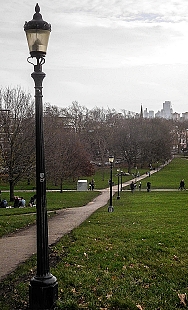
Primrose Hill (see photo above) also deserved a chapter in my book. It was visited by the artist/poet William Blake. The windows of the house where the philosopher Friedrich Engels for several years lived looked over towards the Hill. It was here that Karl Marx visited his friend Engels often. Nearby, later, the poet Sylvia Plath also resided for a while.

I have written quite a long chapter about Highgate, which is where I went to school between 1965 and 1970. Like Hampstead, the old village is rich in historic buildings and has had many now famous residents. This chapter also includes amongst many other places of note Highgate Cemetery, Kenwood, and its close neighbour the Spaniards Inn. Lesser-known places including a former school for Jewish boys and a block of flats designed by the Modernist Lubetkin are also described in this section of my book.

As you are probably beginning to realise, my book about Hampstead, which focusses mainly on the place, does include a great deal about areas that surround the old village. Apart from being factual, my book includes personal reminiscences of all the places described in it. What you will find when you read it is that you are in the hands of a guide who has known the area well for over six decades.

To obtain a copy of the book (or its Kindle version), head for an Amazon website such as:

https://www.amazon.co.uk/BENEATH-WIDE-SKY-HAMPSTEAD-ENVIRONS/dp/B09R2WRK92/

Sleeping tightly in Cornwall and India

DURING A WANDER through the rooms of Trerice House in Cornwall, which was constructed in the 15th and 16th centuries, we came across a 16th century four-poster bed in one of the bedrooms. Unlike most four-poster beds, which can be seen in many National Trust properties, this one was missing its mattress. What could be seen is a rope threaded through holes drilled around the rectangular base of the bed. A long single rope was threaded through the holes so that a lattice of ropes formed a set of adjoining squares – a grid. The mattress would have been supported on the rope lattice. From time to time, the lattice would have become loose, -and the mattress would have sagged. The solution was to untie a knot at one end of the rope, and tighten the latticework before re-tying the rope.

My wife pointed out that this latticework arrangement resembled what is commonly seen in India: charpoys. A charpoy looks like a bed frame with four legs, but without a mattress. Ropes or strips of plastic are tied to the frame to produce a latticework very much like what we saw at Trerice. In India, charpoys are used to rest upon. Mattresses are not usually used.

A lady volunteer in the room at Trerice told us that the phrase “sleep tight” originated from the process of tightening the rope that supported mattresses on beds made long ago. This is the most common explanation of the expression. However, there is another (www.straightdope.com/21342710/what-s-the-origin-of-the-expression-sleep-tight), which is based on a definition in the Oxford English Dictionary:

“… what they say: ‘It seems that tight in this expression is the equivalent of the only surviving use of the adverb tightly meaning ‘soundly, properly, well, effectively.!’”

So, it is up to you to decide which of these two explanations sound most likely to you. Or, perhaps, you know of another.

Gone for a barton in Bruton

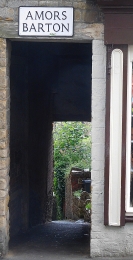
BRUTON IN SOMERSET lies along the River Brue. Most of the old town is high above the river on its steep banks. Narrow passageways run along the steep slopes, connecting the High Street with the riverbank below. These steep passageways in Bruton are called Bartons. The word ‘barton’ means ‘farmyard’ in Old English. However, why these passages are called ‘bartons’ in Burton is a bit of a mystery despite the fact that there used to be farmsteads close to the town.

A castle, a bridge, and the law

RIVER CROSSINGS HAVE often had great historical significance. The small town of Wallingford in Oxfordshire has been a place for crossing the River Thames since Roman times or maybe even before. According to “The Concise Oxford Dictionary of English Place-names” by someone with an interesting name: Eilert Ekwall, a fascinating book that I picked up for next to nothing at a local charity shop, the town was known as ‘Waelingaford’ in 821 AD, as ‘Welengaford’ in c893 AD, and ‘Walingeford’ in the Domesday Book. The meaning of the name is ‘The ford of Wealh’s people’, clearly referring to a river crossing place. It is said the William the Conqueror used the ford. Today, a fine bridge with many arches crosses the river.

Wallingford Castle

There has been a bridge at Wallingford since 1141, or before. The construction of the first stone bridge was probably constructed for Richard, the first Earl of Cornwall (1209-1272), a son of King John, who became King of Germany (Holy Roman Empire) in 1256, a title he held until his death. Some of the arches of the bridge may contain stonework from the 13th century structure. Much of the present bridge dates from a rebuilding done between 1810 and 1812 to the designs of John Treacher (1760-1836). During the Civil War (1642-1651), four arches were removed and replaced by a drawbridge to help defend the besieged Wallingford Castle.

The huge castle was built on a hill overlooking the town; the river – an artery for water transport in the past; and, more importantly, the bridge, which was an important crossing place on the road leading from London to Oxford via Henley-on-Thames. Between the 11th and the 16th centuries, the castle was used a great deal, being used as a royal residence until Henry VIII abandoned it. During the Civil War, the castle was restored and re-fortified and used as a stronghold by the Royalists. It was of great importance to them as their headquarters were at nearby Oxford. To simplify matters, the Parliamentarians began laying siege to Wallingford Castle in 1645. This initial attempt was unsuccessful because the besiegers had underestimated the strength of the castle’s fortifications. After the Royalists were defeated at the Battle of Naseby (14th June 1645), Wallingford was one of only three strongholds in Berkshire (now in Oxfordshire) still loyal to King Charles I. A second siege of Wallingford commenced on the 14th of May 1646, shortly after the Parliamentarians had laid siege to Oxford. The latter fell on the 24th of June 1646, but Wallingford held out until the 22nd of July 1646 (https://en.wikipedia.org/wiki/Wallingford,_Oxfordshire). The castle was demolished in November 1652.

The castle grounds are open to the public. Here and there, few and far between, there are ruins of what must have once been a spectacular castle. Within the grounds of the former castle, there are several informative notices that give the visitor some idea of which part of the castle used to stand near the signs. From the grassy areas that formed the motte and bailey of the castle, there are fine views of the river below and some of the town.

Although our first visit to Wallingford was brief, I learnt that the judge Sir William Blackstone (1723-1780) had presided as the Recorder at Wallingford from 1749 to 1770. “So, what?”, I hear you asking. At first, I hoped that he was something to do with the road, where we lived in Chicago (Illinois) in 1963: South Blackstone Avenue (number 5608). But I think that thoroughfare was more likely named after the American politician and railway entrepreneur Timothy Blackstone (1829-1900). The Wallingford Blackstone, who lived in the 18th century, was most probably a distant cousin of Timothy’s father (https://en.wikipedia.org/wiki/Timothy_Blackstone). Related or not, Sir William Blackstone had an extremely important influence the legal affairs of the USA.

Having studied at the University of Oxford and the Middle Temple, where he was called to the Bar, Sir William taught law at Oxford for a few years. Just before resigning his prestigious academic position in 1766, he published the first volume of what was to become a best-seller, a real money-spinner, “Commentaries on the Laws of England”. Eventually, this work was completed in four volumes. They contain:

“… first methodical treatise on the common law suitable for a lay readership since at least the Middle Ages. The common law of England has relied on precedent more than statute and codifications and has been far less amenable than the civil law, developed from the Roman law, to the needs of a treatise. The Commentaries were influential largely because they were in fact readable, and because they met a need.” (https://en.wikipedia.org/wiki/Commentaries_on_the_Laws_of_England)

The “Commentaries” are widely regarded as being the definitive sources of common law in America before the American Revolution. Blackstone’s writings were influential in the formulation of the American Constitution. His words embodied his vision of English law as a method of protecting people, their possessions, and their freedom. Blackstone’s ideas are well exemplified by this quotation from the “Commentaries”:

“It is better that ten guilty persons escape than that one innocent suffer.”

This is known as ‘Blackstone’s Ratio’.

Leaders of the American Revolution recycled the idea with words such as:

“It is of more importance to the community that innocence should be protected, than it is, that guilt should be punished; for guilt and crimes are so frequent in this world, that all of them cannot be punished…” (John Adams; 1735-1826), and:

“…it is better 100 guilty Persons should escape than that one innocent Person should suffer…” (Benjamin Franklin; 1706-1790)

As already mentioned, Sir William presided in the court in Wallingford from 1749 onwards, three years after being called to the Bar. During his career, he served as a Tory Member of Parliament a couple of times: for Hindon (1761-68) and for Westbury (1768-70). In the House of Commons, he was:

“…an infrequent and ‘an indifferent speaker’: during the seven years 1761-8 only 14 speeches by him are recorded, mostly on subjects of secondary importance. Very learned and original, over-subtle and ingenious, in major debates he showed a lack of political common sense.” (www.historyofparliamentonline.org/volume/1754-1790/member/blackstone-william-1723-80)

The Blackstone family owned a large estate at Wallingford including 120 acres of land by the River Thames. He died in Wallingford and was buried inside St Peter’s Church, which is close to the bridge over the river.  

What little we saw of Wallingford, its castle, its riverside including the Thames towpath, its attractive market square, and streets rich in historic buildings, during our brief visit recently, we saw enough to whet our appetites for a future and lengthier visit.

Chewing gum


It was in Turkey that I first tried chewing gum. I was ten years old. It was 1962, and we were staying at the Hotel Çınar at Yesiliköy on the Marmara Sea just west of Istanbul. We walked from the hotel into the nearby village, where my parents bought me a small pack of chewing gum. The pieces of gum were coated with a hard, sugary outer layer. I thought that this layer extended right through the piece, and I was surprised to find when I bit into it that it contained a soft gooey substance. I was not impressed.

GUM 1

Source: wikipedia

A year later, the family spent the last three months of 1963 in Chicago, Illinois. It was while we lived in the USA that I became very keen on chewing gum and its close relative bubble gum (specially the Bazooka brand). Between arriving in America and leaving Turkey, I had learned how to enjoy chewing gum. In America, the range of flavours of gum was huge compared with what was available in the UK. I used to chew a piece of gum and when its flavour had weakened, I added another piece, and then another, and so on until there was a huge mass of gum in my mouth. This ever-growing glob of gum would remain in my mouth for several hours.

I attended school while we were in Chicago. In each class room there were desks with swivelling desk-tops for writing on. I soon discovered that the undersides of these desks were covered with soft blobs. After touching these blobs, I discovered that the tips of my fingers acquired different pleasant odours. Naïve as it may sound, I only discovered after returning to England that these ‘perfumed’ squishy mounds were bits of discarded chewing gum.

In the late 1960s and the following decade, we used to visit Greece almost every year. In those days, Greek cities and towns had numerous kiosks selling newspapers, magazines, and … chewing gum. The most commonly found brand of gum was ‘Chiclets’. This trade name, established in 1900 in the USA is derived from the Spanish word chicle, which means ‘chewing gum’. The range of flavours available at these kiosks was much greater than what was available in the UK at the time.

We took many flights during my childhood. In the 1960s and ‘70s, many ‘planes were not as well pressurised as modern aircraft. During take-off and landing, there was a risk of much ear-popping. Sucking sweets or chewing gum was recommended to reduce the unpleasantness of the ear popping.

I was happily chewing gum as was usual on a flight when a thought occurred to me. The endless chewing of gum brought the rumination of cattle to mind. Suddenly, I compared myself to cattle chewing the cud. Although I have no objection to cattle moving their jaws endlessly, I felt that it was inappropriate that I should be doing the same. Since then, I have rarely chewed gum, and when I have done so I have found that my jaw muscles tire easily.


GUM 2

Source: CollectingCandy.com