THE ARAL SEA which is a lake on the border between Uzbekistan and Kazakhstan was once the world’s third largest lake. From the 1960s onwards, it began to shrink because the rivers that fed it were diverted to be used for Soviet irrigation projects. Now it has shrunk to less than 10% of its original area. From the 1960s onwards, the decline of the sea’s size has been monitored by satellite imagery.
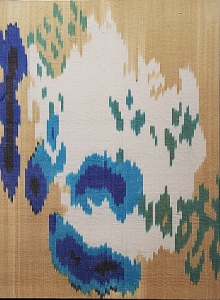
During March 2026, Vadehra art gallery has put on a temporary exhibition (at London’s Cork Street) of works by the Indian artist Himali Singh Soin and the British artist David Soin Tappeser, an artistic duo called ‘Hylozoic/Desires’. The show includes a series of images based on what can be seen of the Aral Sea in the satellite pictures that chart its decline. Their images are made of cloth woven using the traditional ikat method. Simplifying the technique, it involves weaving with threads that have been dyed in several colours in varying patterns along their length. We first saw this extremely complicated method of fabric production at Patan in Gujarat (India: see https://gujarat-travels.com/2019/02/05/weaving-in-patan/ for more about the technique). The ikat pictures at the exhibition were woven in Uzbekistan. By using this technique to capture the essence of the satellite images, the artists have produced a beautiful artistic representation of an environmental disaster that has take place over almost seven decades.
Although the ikat fabrics chart a tragic history, there is some good news. The Kazakhstan government has been able to increase the depth of the sea significantly, and as a result its salinity has dropped.
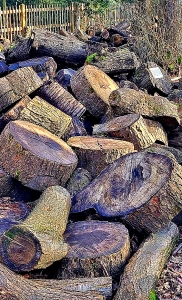
WHILE WALKING ALONG a path in Holland Park, I passed a pile of sawn, short logs. The timber was not arranged tidily. It was piled up haphazardly. At first, I thought that the park workers had created this collection of wood prior to it being removed elsewhere, but then I noticed that one piece of wood had a label attached to it, which read:
“This loggery is a habitat for invertebrates such as Britain’s largest Coleopteran, the stag beetle. The larvae live in rotting wood for up to seven years …”
So, what I thought was a temporary storage place for the sawn timber is intended to be more of a permanent feature. At other parks, I have seen collections of dead tree stumps, which are called stumperies, but this was the first time I have come across a loggery. Out of curiosity I looked up the word ‘loggery’ on the Internet, and discovered that websites concerned with wildlife conservation use the word as the notice in Holland Park states.
However, loggery has another, older meaning. It is an adjective meaning ‘rank growth’, rank meaning ‘strong’ or ‘vigorous’. The Oxford English Dictionary quotes this example of its usage in “The farming and memorandum books of Henry Best of Elmswell” by Henry Best (c1592-1645):
“When barley is loggery and full of greenes.”
Well, let us hope that the loggery in the park will allow the stag beetle larvae to achieve rank growth.
I HAD NEVER HEARD of the artist Anna Boghiguian (born 1946) until we visited her exhibition at the Turner Contemporary Gallery in Margate (Kent). Anna was born in Cairo (Egypt), where she studied political and social sciences at The American University. She also studied fine arts and music at Concordia University in Montreal (Canada). The works on display at Margate until 26 October 2025 are a superb synthesis of both her interests in world affairs and artistic talents.
Anna’s show at the Turner is called “The Sunken Boat: A glimpse into past histories”. It consists of three installations, one in each of three spacious galleries. One gallery contains an installation comprising a set of sandy beaches littered with the remains of wrecked boats and sails along with other flotsam and jetsam. The walls of the room have frames containing images relating to historical and ecological events. Regarding this fascinating and beautifully composed exhibit, the gallery’s website noted that the installation:
“… the centrality of the sea in shaping histories of labour, trade, ecological collapse, and political conflict. It combines sculpture, painting, cut-out figures and sound, inviting reflection on rising sea levels and geopolitical tensions around undersea communication cables.”
Another room has a cluster of cut-outs depicting famous people of the past including Einstein, Gandhi, Queen Victoria, Napoleon, Pythagoras, and many others. Each of the cut-outs are colourfully painted and are suspended from the ceiling by fine threads, and hang above a large black and white chess board. They rotate gently in reaction to movements of the air caused by motions of the viewers.
The third gallery contained an installation that evoked being under the sea. Figures either swimming or drowning are suspended from the high ceiling. The room is lit with a blueish glow that gives the viewer the feeling of being below the sea’s surface. The floor of the gallery is a representation of the seabed, with undersea cables, marine creatures and plants, assorted debris, and other objects one might expect to find there. The lighting was chosen to evoke the reduced illumination that one can imagine exists deep below the sea’s surface. It reminded me a little of the church at Tudely (Kent) whose stained-glass windows by Chagall create the same impression. In this church, Chagall designed the windows to create the impression of being below the sea because the edifice is dedicated to the memory of someone who died by drowning. Unlike the church at Tudely, the installation at the Turner expresses a less specific, more global concern: that of the sea’s ecology at present and in the future.
Words can hardly do justice to the amazing show at Margate. Without doubt, it must be seen to be fully appreciated. The exhibition illustrates that Anna Boghiguian is a competent and imaginative artist with a great grasp of past and contemporary political and present ecological challenges facing the waters in our seas and oceans. And she knows how to express these matters in imaginative and compelling ways,
A LIVING WALL (aka ‘green wall’) is a vertical structure covered with living plants attached to an exterior wall. Architecturally, they can add visual interest to the buildings on which they are attached. One building, whose visual interest is far from great, is the brick and concrete Kensington Town Hall, which was constructed in 1976. An attempt to improve its image has recently been completed. It is the addition of a living wall, 82 feet high and 16 feet broad.
This wall of greenery, doubtless paid for by the people living the Royal Borough of Kensington and Chelsea, has been justified by the council as being useful for providing additional natural habitats for pollinators and other friendly creatures, as well as for helping to purify the air. Attractive as it is, it does little to distract me from the overall lack of beauty of the building to which it is attached. As the saying goes …
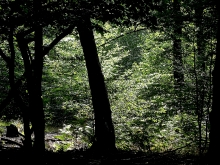
AN ANCIENT WOOD IS one that is at least 400 years old and has probably been in existence since time immemorial. Several of these ‘prehistoric’ woods have survived the spread of London over the centuries. Often, they are islands of wildness in a sea of suburbia, as is the case of Coldfall Wood near East Finchley and Muswell Hill in North London. We visited it on a damp afternoon when the trees were dripping with rainfall. This heightened the sense that we were strolling through a landscape little changed from the time when London had not extended so far into what was mostly untamed countryside.
Coldfall Wood was originally named ‘Colefall’, a word possibly derived from the Old English words ‘cole’ and ‘gefeall’, probably used to describe a place where charcoal was burnt. It is named that way in a document dated 1599 and on an Ordnance Survey map published as late as 1877. In 1599, there was a murder in the wood. This was not an uncommon event in Finchley, whose common land (which included Coldfall Wood) was the haunt of highwaymen and other miscreants for many centuries, and especially during the 18th. The wood made history in the world of geology in 1835 when (according to an article that can be found at http://www.locallocalhistory.co.uk/gd/gdpage04.htm):
“…At a spot in Coldfall Wood, just beneath the vegetable soil, an eminent London geologist, Mr. N. T Wetherell, of Highgate, discovered a strange accumulation of fossil remains, consisting of miscellaneous rocks, shells, teeth of fish, and bones of saurians of extinct species, evidently brought hither by some unknown agency from the formations of various northern areas of England.”
The importance of this discovery led to the suggestion that:
“… the southern lowlands of England, as well as the mountains of Wales and the northern counties, showed traces of their former occupation by glaciers, and perhaps a glacial sea.”
However, this idea mooted in the 19th century has been challenged. It is now thought unlikely that Muswell Hill was once submerged beneath a glacial sea (although the glaciers did reach the area).
The present Coldfall Wood, which is a reduced version of what it was before the mid-19th century, is a deformed square in plan, its southern border, which is bounded by Creighton Avenue, being longer than its northern one. In the past, the wood extended southwards and reached the road now called ‘Fortis Green’ that existed from the early 19th century. Incidentally, the settlement of Fortis Green was in existence by the 16th century. The wood slopes downhill from its southern and western edges. At its southwest corner, it is just over 300 feet above sea level and at its north eastern corner, it is at least 60 feet lower.
Distinct footpaths both circumnavigate and traverse the wood. Because of the density of the trees, the buildings surrounding the wood are mostly hidden and the 14-hectare (35 acre) woodland feels much larger than it is. Every now and then, the footpaths cross small footbridges. These structures traverse often barely perceptible beds of streams, many of which were waterless on the August afternoon of our visit. In the lower reaches of the wood, the streams were filled with water. At the lowest corner of the wood, there is a wetland area traversed by an elevated wooden walkway. The water that flows down the slopes of Coldfall Wood disappears underground at the lowest (north east) corner of the woodland.
East Finchley, in which Coldfall Wood is located, is a watershed for two of London’s rivers, both tributaries of the Thames. From the western slopes of East Finchley, water runs into the River Brent whose mouth is at Brentford in West London. Water from the eastern slopes heads eastwards towards the River Lea whose waters flow into the Thames in London’s East End. I believe that this is the case for the water from the streams in Coldfall Wood.
I believe that I might have visited Coldfall Woods once before while visiting a dear friend, sometime in the late 1970s. Neither then nor a few days ago, when I made my second visit there, did I have even the slightest inkling of its history and geological significance. As we still have good friends who live close to it, it is likely that my next visit to Coldfall Wood will be in much less than forty years’ time.
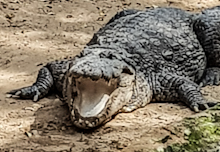
THE CROCODILE LYING LAZILY in the hot sunshine with its teeth lined jaws wide open lay motionless as we and many other visitors gaped at it with amazement.
We reached the Crocodile Bank at Semencheri (near Mahabalipuram) after a two hour drive northwards from Pondicherry along the East Coast Road (ECR), which as its name suggests runs close to the east coast of India. We drove through flat terrain with luxuriant vegetation. The road passes many picturesque backwaters and other water bodies, some covered with flowering waterlilies. We also passed a small collection of saltpans, alongside which there were small piles of white salt. This salt gathering area was on a much smaller scale than can be seen at the south eastern edge of Kutch. The road is dotted with numerous hatcheries for edible crustaceans such as shrimps and scampi.
The Crocodile Bank was established in 1976 by Romulus Whitaker and is now being run by his ex-wife, our friend Zai. It was started to breed cricodiles and other reptiles in captivity in order to counter the reduction of their populations in the wild. It is now an important centre for herpetology, education , wildlife conservation, and breeding reptiles. It is open to the public, who gain great enjoyment from seeing and learning about the reptiles.
We first visited the Crocodile Bank about five years ago. When we entered, my first impression was of looking at a sea of grey logs. On closer examination, these ‘logs ‘ were motionless crocodiles. We learnt that crocodiles and aligators are very somnolent unless they are hungry. Therefore, they tend to lie about motionless, basking in the sun or keeping cool in shallow water.
During our first visit, we saw a pair of beautifully coloured iguanas, which Zai and her colleagues were hoping would mate. She told us that they did produce a clutch of eggs eventually, and that some of the baby iguanas were enjoying life at the Crocodile Bank.
We were pressed for time on our visit in February 2020. So, we did not have a chance to have a good look around. On our first visit, Zai arranged for one of her team to give us what turned out to be a very informative tour.
I can strongly recommend a visit to Crocodile Bank. It is not far from the superb archaeological remains at Mahabalipuram and provides an interesting contrast to them. Instead of stones of historic interest, you can enjoy seeing creatures that have survived the passage of time even longer than the ruins.
There are plans to make a cycle super highway through west London. This might make cycling more attractive to people living in the areas it passes through as well as making it safer for cyclists by separating them from other road users. All very well, so far.
In order to creat this cycle thoroughfare, quite a number of well-established old trees will have to be cut down and removed. While cycling no doubt reduces the amount of toxic gases emitted by vehicles, removing the trees cannot be so beneficial to the climate of the future, about which so many people have become concerned.
The authorities have said that the felled trees will be replaced by new trees nearby. That is good, but many trees take a long time to reach the size and ecological efficiency of the trees that will get the chop. A large number of people have protested about the proposed sacrifice of trees for the cyclists, so we wait with baited breath to see whether the trees will survive or the new cycle route will come to fruition. Being Britain, there will probably be a compromise!
Picture by Natalia Goncharova in an exhibition at the Tate Modern, London
Currently, many people want to “save the planet”. This is a worthy desire.
One way to help save our planet is to ditch plastics, which are not biodegradable, and replace them with paper that can be degraded biologically. Thus, plastic bags are giving way to paper and cloth bags. Supermarkets in the UK are now charging customers, who have not brought along their own reusable bags, a fee to buy a new plastic bag in which to carry home the goods which the supermarket companies have packed in non-biodegradable plastic!
Now, enter your café and order a drink with a straw. Trendy cafés, which are trying to be eco-friendly, supply biodegradable drinking straws Instead of the old fashioned plastic ones. This offers no problems if you suck your drink rapidly. If you prefer to linger over your drink, the paper straw absorbs fluid and becomes soggy. You might well need to use more than one paper straw to finish your drink. This will result in creating more rubbish than using a single plastic straw.
One solution to the straw problem, which I favour, is not to use one, but to put your lips to the glass or bottle that contains your drink: slurp, don’t suck!
Finally, to escape from the humble drinking straw, let us raise our heads to the solar panels with which we adorn our roofs in order to reduce our consumption of the rapidly reducing sources of natural fuels. A learned friend once told me that in order to manufacture these panels, more fossil fuel energy is expended than will ever be saved by the panels!
Save the planet by all means, but make sure that these means will actually save the planet, rather than simply salve our consciences.





 yamey
yamey 