If you are feeling peckish in Peckham …

GENERALLY, I AM NOT A FAN of food courts. Many of them in England are merely a collection of branches of well-known fast-food chains (such as KFC, McDonalds, Pizza Hut, Subway, and Burger King). A notable exception to this is a food court in Trinity Market in Hull, which visited in April 2025. On 9 May 2025, we visited Peckham in south London, having just viewed an exhibition in nearby Camberwell.

While strolling along Peckham’s busy Rye Lane, we came across the entrance to Rye Lane Market. After entering it and walking along an arcade lined with shops, we arrived in a large, covered area filled with food stalls: a food court. Unlike many other food courts, the food outlets were not branches of well-known chains. Instead, there were stalls catering to the multi-ethnic local population. We sat down at a table that was surrounded by stalls serving Mexican, Carribean, Colombian, and other many cuisines. We ordered the set lunch offered by a small Peruvian kitchen. As first courses, we ate cold boiled potatoes dressed in a red pepper flavoured mayonnaise and a delicately flavoured beef soup. These were followed by a fried rice dish containing chicken, pork, and smoked sausages, and another consisting of a whole fish beautifully fried, served with lentils, rice, and a salad containing onions, lime juice, coriander, and tomatoes. Freshly prepared and reasonably priced, everything was delicious.

There were more stalls serving food from other countries, mostly Latin American and African. One stall offered a range of vegetarian Indian dishes, including a snack, dabeli, that is popular in Kachchh (once an independent state, and now part of Gujarat). The lady working there told us that she is from Rajkot in Gujarat. When we mentioned to her that we have always thought that dabeli is a dish from Kachchh, she said it was Gujarati, but added that:

“It does not matter because the people of Kachchh are our brothers”.

Our first visit to Rye Lane Market’s food court has whet our appetites for further visits. There are so many enticing dishes on offer that I feel sure that we will venture across the Thames more often to sample the fare offered in that food court.

See it, savour it, but do not put it in your mouth

IF YOU HAVE NEVER heard of ‘shokuhin sanpuru’, you are not alone. It was only after visiting an exhibition called “Looks Delicious” at Japan House in London’s High Street Kensington on its penultimate day (15 February 2025) that I realised that I had often seen examples of shokuhin sanpuru (replicas of food) without realising what they are called in Japanese.

Replica of toast with melted cheese

Japanese restaurants and eateries display lifelike replicas of the food they offer to customers. They are designed both to show the customer both what to expect and to entice him or her to enter the establishment to order and then eat their kitchen’s fare. The replicas are ‘hyper-realistic’. These mouthwatering looking models are both informative and of a commercial nature: they are designed not only to depict the dishes but also to evoke in the viewer’s mind the desire to consume them. According to the exhibition catalogue (see: https://www.japanhouselondon.uk/whats-on/looks-delicious-exploring-japans-food-replica-culture/) the origin of these replicas:

“… can be traced back to the early 20th century. As ‘Western’ cuisine grew in popularity in Japan, restaurateurs needed a way to visually communicate their menus to a curious yet cautious public. Food replicas were made entirely out of wax until the 1970s, when the introduction of synthetic resin transformed their production, allowing for greater detail, durability and more dynamic display.”

The catalogue noted:

“Every effort is made to ensure food replicas appear as realistic as possible. Food replica craftspeople not only reproduce the appearance of food; they also recreate the memory of it in people’s imaginations. For example, while red bean paste may, in reality, not be that grainy, people often associate it with a grainy texture.”

The exhibition at Japan House includes examples of replicas of many kinds of Japanese food as well as of European (‘Western’) dishes.  As the catalogue explained, the replicas are not only made to entice customers into eateries, but also for other purposes:

“Beyond their use as a marketing tool, food-replica technology also has wide ranging applications, notably in nutritional education and medical science.”

In addition, replicas can be made to be used as standards by which the appearance of actual food products and ingredients can be assessed.

The show at Japan House includes models and films showing how the replicas are created. Often the real food is coated with a liquid material that is used to make a three-dimensional impression (mould) of the dish. The food is then removed from the newly formed impression, and the detailed impression/mould is then set in a solid base of plaster of Paris. Then, wax or resin is poured into the mould to produce a replica. The replica is then carefully painted to recreate the appearance of the dish or food item. To recreate textural features, such as the delicate marbling on Wagyu beefsteak or fish scales, there are carefully prepared stencils, which can be laid on the models whilst paint is applied through the perforations in them. I have simplified the description of the manufacturing process, but rest assured that the production of these unbelievably realistic replicas can only be done by highly skilled craftsmen.

The unusually fascinating exhibition should not be viewed, as we did, when hungry. The replicas on display can only increase your desire to eat. They looked so enticing that it was difficult not to reach out and pick them up to eat. However, apart from not being allowed to touch them, as realistic as they look, they are completely inedible.

Biryani in Bangalore, Calicut, and Surat

SO FAR – THAT is since January 1994, the very best biryani I have eaten was at Paragon in Calicut (Kerala) in 2006. It was a Moplah recipe – Arabic and Indian flavours combined most harmoniously. Last December, I enjoyed an almost as good biryani in the restaurant of the Sifat International Hotel in Surat (Gujarat).

Biryani at Bheema’s

When in Bangalore, where we find ourselves often, we like to visit Bheema’s restaurant on Church Street. It serves Andhra-style cuisine. I have never been disappointed with the biryani dishes served there. Although not as supremely superb as the two biryanis I have mentioned already, Bheema’s delicious biryanis are way above average – in my humble opinion.

Red coloured meat dish from Rajasthan

LAL MAS IS a traditional meat dish that originated in Rajasthan. Its name means ‘red meat’ and its colour comes from the use of mild, fragrant, fresh red chillies. The best sort to use are those grown at Mathania in Rajasthan, but if these are not available, Kashmiri chillies can be used but they are less satisfactory. Originally, lal mas used to be prepared to feed hunters after a day of hunting. The meat being game.

We have been staying at the Sharad Baug Palace homestay in Bhuj (Kutch, Gujarat), which is owned and run by members of the Royal family of Kutch. Several members of the family are great cooks. The food they have been preparing for our evening meals has been superbly tasty.

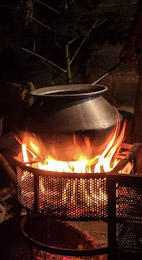
Last night, one of the family gave us a very special treat. While we watched, he prepared lal mas on a pot heated on a wood fired brazier in the garden. The smoke from the burning wood enhances the flavour of the dish.

Even if I knew the exact recipe for lal mas, it would be pointless giving it to you. This is because to achieve a good result, the person cooking it must be constantly tasting the sauce and adding ingredients as required, as well as checking the degree of tenderness of the meat. This is something that cannot be described in writing.

That said, this is, roughly speaking, how he prepared the lal mas. First, good quality cold-pressed mustard oil was heated to a high temperature. Then, he added whole spices including the Mathania chillies. Next, chopped onions, followed by pureed onions and pureed Mathania chillies. Following this, the goat meat was added. Later, chopped tomatoes followed by ginger and fresh green chillies – both minced. After a while at various stages, other ingredients including ground cumin, turmeric, coriander powder, fenugreek leaves (added at the end), hot red chilli powder, salt, and water were added to the stew. Throughout the cooking process, which took almost two hours, the stew has to be stirred often, and water added as required so as to maintain the sauce’s thick consistency and to prevent the spice mixture from burning.

I can say, without exaggeration, that the resulting dish was one of, if not, the very best Indian meat dishes I have ever eaten. It was fragrant, tasty, and not too piquant. It was without fault.

We are very grateful that our host took the time and care to produce this miracle of culinary art for us.

Eating off a banana leaf in the south of India

DURING OUR HONEYMOON in 1994, we travelled around places in southern India. At one point, we had to change trains at Coimbatore in Tamil Nadu state. With a few hours to spare, we ate dinner at a modest small restaurant near the station.

At Bheema’s restaurant in Bangalore

We sat down and banana leaves were placed on the table in front of us. These served as plates. There was no menu. A waiter hurried around the restaurant, stopping next to each diner and placing dollops of vegetarian culinary preparations on the leaves. He returned and placed a pile of steamed rice next to the mounds of vegetable items. He kept running from table to table, replenishing foods as required by the diners. This seemingly endless distribution of food set us back a total of 12 Rupees, which in 1994 was about £0.40 (yes, 40 pence). The coffee we drank at the end of the meal was the same price.

Yesterday, the 9th of November 2023, I was reminded of this experience whilst watching a waiter serving Andhra style vegetable preparations on a banana leaf in Bheema’s restaurant on Bangalore’s Church Street. Naturally, the meal cost a lot more than we paid in Coimbatore in 1994, but it was still very good value.

Having lunch with my father at the White House

AFTER MY MOTHER DIED in 1980, I began practising dentistry in Kent. Almost every weekend, I used to spend Saturday nights at my father’s house in Hampstead Garden Suburb. We used to have Sunday lunch together in one of his several favourite restaurants in Golders Green and Hampstead. Many of these restaurants no longer exist.

There were a few Chinese restaurants, which my father liked, in the Golders Green area. One of them was in Temple Fortune near the branch of Waitrose, which has been in existence since I was a child in the 1960s. The Chinese restaurant, which served a wonderful hors d’oeuvre that included a scallop in its shell, has long since closed.

In Golders Green Road, there were two more Chinese restaurants, both now gone. In one of them, my father was always greeted by the friendly manager (or, maybe he was the owner) with the words:

“Hallo Professor. How are you, professor?”

The food was well-prepared and tasty in both of them, just as it was in the Temple Fortune eatery.

Almost opposite the Hippodrome theatre, on the corner of North End Road and West Heath Drive, there was an Italian restaurant. Here, my father and I always received a warm welcome and enjoyed reasonably good Italian food. Currently, the site is occupied by a Turkish restaurant, which I have not yet tried.

Some weekends, we travelled up to Hampstead village. One of the two restaurants we visited occasionally was La Cage imaginaire, which still exists at its original location at the lower end of Back Lane, where it meets Flask Walk. Back in the 1980s, this place served classic French cuisine prepared to a high standard. I remember the cheese trolly which was richly supplied with ripe French cheeses. We revisited the place in about 2021 for ‘old times sake’. The management had changed and the food was nothing to write home about.

Today, the 3rd of November 2023, we ate at Mani’s in Hampstead’s Perrins Court. It was our third visit there, and the quality of the food in this busy eatery is highly satisfactory. Near the corner of Perrins Court and Hampstead High Street, there stands the Villa Bianca (‘white house’). This Italian restaurant must have first opened its doors to customers sometime in the 1980s. Never cheap, this restaurant was one of my father’s favourites in northwest London. Being a regular diner there, he was always welcomed like an old friend. Unlike many of the places where my father and I ate Sunday lunches in the 1980s and early 1990s, The Villa Bianca still exists, and is popular. Today, I looked at the menu. Although not suitable for those on a tight budget, many of the dishes did not seem much more costly than those served in far less fancy looking establishments.

DISCOVER MUCH MORE ABOUT HAMPSTEAD BY READING MY BOOK AVAILABLE FROM AMAZON, e.g., :https://www.amazon.co.uk/BENEATH-WIDE-SKY-HAMPSTEAD-ENVIRONS/dp/B09R2WRK92/

Once there were two in Hampstead; now there is only one

YESTERDAY (16th SEPTEMBER 2023), we met one of my cousins in Hampstead village.  We ate a very satisfactory lunch at The Flask pub in Flask Walk. We chose items from the ‘brunch menu’. Each of the three dishes we ordered was tasty and generous in portion size. The dish with wild mushrooms was exceptionally good.

Long ago, there were two pubs with the word Flask in their names in Hampstead: The Upper Flask and the Lower Flask. The Upper Flask was located close to where East Heath Road meets the top (northernmost) end of Heath Street, close to Whitestone Pond. It was a meeting place for noteworthy cultural figures, but it was closed in 1750. The pub in Flask Walk, where we ate lunch, was known as The Lower Flask. Here is something about it from my book “Beneath a Wide Sky: Hampstead and its Environs”:

“Once upon a time, Hampstead had two pubs or taverns whose names contained the word ‘Flask’. This is not surprising because the word ‘flask’ used to be common in the naming of pubs. One of them, the erstwhile Upper Flask, has already been described. The other, the once named ‘Lower Flask’, now renamed, is on Flask Walk, not far from Hampstead high Street. The Upper Flask was a remarkable establishment, as already described. It figures several times in ‘Clarissa’, a lengthy novel by Samuel Richardson (1689-1761), first published in 1747. The Lower Flask pub (in Flask Walk) is also mentioned in the novel, but unflatteringly, as:

“… a place where second-rate persons are to be found often in a swinish condition …”

Unlike the Upper Flask, the Lower Flask is still in business, but much, including its name and clientele, has changed since Richardson published his novel. Located at the eastern end of the pedestrianised stretch of Flask Walk, the Lower Flask, now The Flask, was rebuilt in 1874. Formerly, it had been a thatched building and was a place where mineral water from Hampstead’s chalybeate springs was sold. Oddly, despite visiting Hampstead literally innumerable times during the last more than 65 years, it was only on Halloween 2021 that I first set foot in the Flask pub, and I am pleased that I did. The front rooms of the pub retain much of their Victorian charm and the rear rooms, one of them with a glass roof, are spacious.”

Although the Flask Pub is interesting enough, there are plenty more interesting places to see along Flask Walk and in other parts of Hampstead. You can discover these by reading my book, which is available from Amazon websites such as:

https://www.amazon.co.uk/BENEATH-WIDE-SKY-HAMPSTEAD-ENVIRONS/dp/B09R2WRK92/

The Brass Rail

I WAS FOURTEEN IN 1966. That year, Selfridges in London’s Oxford Street opened the Brass Rail restaurant on the ground floor, with windows facing Orchard Street. Its speciality was then, and still is, salt beef. I recall visiting the place once or twice with my mother back in the 1960s. In those days, I did not particularly care for the taste of salt beef. For some reason, maybe the cost of the place, we did not frequent the Brass Rail.

Winding the clock forwards several decades, I now enjoy eating salt beef occasionally. Today, the 22nd of March 2023, we needed to go to Selfridges for something, and as we were there, I suggested that we ate at the Brass Rail. Unsurprisingly, the eatery has changed its appearance considerably since the 1960s, but it is still located in the same part of Selfridges as it was originally. Its tables are enclosed in an area lined banquettes upholstered with red fitted cushions. The service was brisk and attentive. We ordered Reuben sandwiches in rye bread. These are generously filled with warm salt beef, sauerkraut, Swiss cheese, gherkin, and Russian dressing.

The Reuben was enjoyable, filling, and quite tasty. However, I felt that the taste of the salt beef was overpowered by that of the dressing and the other ingredients. Good though it is at the Brass Rail, I prefer eating the bagels crammed full of salt beef, which are served at the 24 hour Beigel Bake in Brick Lane. At half the price of the Brass Rail, but without the great service, they are more than twice as enjoyable.

A long way from Paris

BANGALORE IS ABOUT 4800 miles from Paris (France). The French capital is noted for its gourmet delights, but on the whole the same cannot be said for Bangalore. One exception to this statement is Sunny’s restaurant currently located on Lavelle Road.

Arjun Sajnani created Sunny’s at least 25 years ago. Then, it was in a tall narrow house on a lane leading off Lavelle Road. The kitchen was on the ground floor and there were dining areas in the two floors above it. Often, Arjuna could be standing, working in the kitchen. Back in those early days, Sunny’s was one of Bangalore’s few suppliers of imported Western European cheeses, such as genuine parmesan.

Later, Sunny’s shifted to larger premises on the corner of Lavelle and Vittal Mallya Roads, next to a petrol filling station. The dining area was elegant.

For a brief period, Arjun ran a restaurant serving delicious Sindhi dishes in his original premises. Sadly, he decided to discontinue this interesting eatery.

Even later, Arjun shifted his restaurant to its present location – a two storey villa constructed about 20 years ago. The balconies on the upper floor are supported by stout carved timber pillars which remind one of pillars that you can see in much older traditional South Indian edifices. Diners can sit at tables within the building, or in the garden surrounding it, or on the first floor balconies. At lunchtime on Christmas Day 2022, every table was occupied.

At each of Sunny’s different locations, the food has been magnificent. As our daughter correctly said, eating at Sunny’s is as good as eating in a good Parisian restaurant. Also, Sunny’s Italian food (mainly pasta and pizzas) is above average in quality.

Arjun is an actor and director of theater and films, in addition to being a restaurateur. Dramatic productions require many skills. The same is the case for running a restaurant. Some of the required skills are the same for restaurants and for stage/screen. A restaurateur has to perform well both in the kitchen and the dining room to satisfy his or her clientele. Arjun achieves this successfully. If you have never been to Sunny’s, give it a try!