
An extraordinary exhibition of art by an artist born in Czechoslovakia

BORN IN WHAT was Czechoslovakia in 1990 just after the end of Communist rule in that country, Klara Hosnedlova graduated at the Academy of Fine Arts in Prague. She creates in many different ways, including photography, sculpture, furniture, embroidery, and site-specific installation. A collection of her work is on display at the Bermondsey branch of White Cube Gallery in south London until 29 March 2026.
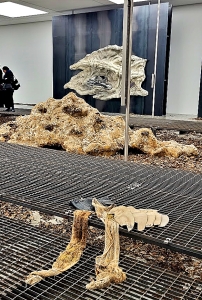
One room of the gallery is occupied by tall sculpture made with knotted natural fibres. Its base is a collection of thick serpent-like fibre ropes that spread across the floor like the roots of a tree. Attached to this structure, there is something that resembles an enlarged seashell which contains an image that includes depictions of fingertips. This inclusion reminded me of the appearance of mitochondria when viewed with an electron microscope. Although I find it difficult to describe this artwork in words, what can be seen in the far larger gallery next door is almost indescribable.

 The larger of the two galleries containing Hosnedlova’s work is ‘mind-blowing’. Many of the artist’s sculptures and embroideries (which look like paintings) have been assembled to create an extraordinary immersive art installation. Both fantastic and exciting, it is at the same time the stuff of nightmares. The website of the White Cube described it as follows:

“The principal room of the gallery opens onto a central, metal platform flanked by looming metal walls, each mounted with prodigious sandstone sculptures upon which further embroidered images are embedded. Constructed from industrial and composite materials, the architectural implements of Hosnedlová’s installations often contain impressions of built environments. Intended to be walked and sat upon, the stepped, quadrangle platform is composed of metal grilles … While the platform recalls the openness of urban, public space – exposing, if not intimidating, sites cleared of natural shade or protection – the grille meanwhile refers to its function in the city as an interface between terrestrial and subterranean worlds. Strewn carelessly over the platform, like shed skins, are some abandoned articles of clothing …”

But even these words are inadequate to describe the scene that confronts the viewer. It must be seen to be believed. I asked gallery employee whether the huge installation was to be sold as a single whole item.  I was told that although the installation was created to provide a fascinating visual experience, the individual items that it contained were to be sold separately.

When we visited the large room of the exhibition, a South Asian security guard saw the expressions of amazement on our faces, smiled, and pointed out where to stand to get a good photograph of the whole installation. And after we had seen it, and were leaving the room, he smiled at us, and gave us the thumbs up. I returned this gesture of satisfaction.

Divided but unified

CZECH BLOG

Notting Hill Gate, not to be confused with ‘Notting Hill’ as in the Hugh Grant film, on the western edge of central London is not lacking in mediochre modern architecture, mostly constructed in the 1960s and 1970s. One building stands out as being aesthetically a cut above the rest. This is the former Czechoslovak Centre, the Embassy of Czechoslovakia, a fine (if that is an appropriate adjective) example of ‘Brutalist’ concrete architecture.

The Centre was built between 1965 and 1970, and was designed by “…Šrámek, Stephansplatz and Jan Bočan, from the Atelier Beta Prague Project Institute, were the architects of the embassy, working in cooperation with British architect Robert Matthew and based in his office” (see HERE for detail). The building won an architectural award from RIBA in 1971. Unlike many buildings built at te same time, the Czechoslovak Centre building has not suffered from ageing. It stll looks in great condition.

In 1993, Czechoslovakia ceased to exist. It split into the Czech Republic and the Republic of Slovakia. Despite this, the Czechoslovak Centre building continued to have diplomati cfunctions. The building was divided into a Czech Embassy and a Slovak Embassy.

Before and after the separation of the two parts of what was once Czechoslovakia, I was a member of  the Dvorak Society, an English organisation for promoting interest in music from  the Czech and Slovak lands. The Czechoslovak, and then later the Czech and Slovak embassies used to host occasional congenial recitals of music for the Dvorak Society.

On one occasion after 1993, my wife and I attended a recital at the Slovak Embassy. After the music was over, we were treated to delicious food and Slovakian wine. The ambassador mingled amongst the guests. My wife asked him how the Czechs and Slovaks were coping with sharing the same building. Smiling, he replied:

We have to cope well because we have to share the central heating and hot water system that was installed to serve the building when it was a single embassy.”

An Enquiring Mind

blahnik


People who know me well, or even not so well, would be surprised to learn that I greatly enjoyed an exhibition of designer footwear.

The designer is Manolo Blahnik (born 1942 in Santa Cruz de la Palma, Spain), whose father was Czech and mother Spanish. His rapid rise to fame in the field of footwear design began in the early 1970s. 

The exhibition called “An Enquiring Mind” is being held at the Wallace Collection in London until the 1st of September 2019 and should not be missed.

According to a leaflet about the exhibition, Blahnik has been long inspired by the  collection of diverse fine artworks (paintings, sculpture, furniture, porcelain, armour, etc.) on display in the rooms of the Wallace Collection. The shoes he designs, especially those on display at the exhibition, reflect the artistic finesse and skillfulness of the Collection’s permanent works.

The footwear in the temporary exhibition is tastefully arranged amongst the Wallace Collection’s artworks. If one dd not know that the shoes were designed and  made in the last 50 years or less, you would believe that they came from  earlier eras when most of the Collection’s artworks were created. The shoes mingle harmoniously with creations made several hundreds of years earlier. Not only that, but also they are displayed very artistically, making the temporary exhibition a joy to the viewer.

So, even if you, like me, are put off by the idea of an exhibition of shoes, please try to make it to this superb exhibition.