
Between chance and control on sheets of paper

THE ARTIST BARBARA Nicholls (born 1963) invited us to the opening of her solo show at the Patrick Heide Contemporary Art gallery in Church Street, near Edgware Road. All her creations on display are watercolours on paper. Each of them resembles what looks like a natural phenomenon, but an imagined one. Although her pictures do not depict actual natural occurrences, each one of them is a result of the artist exploiting the unpredictability of the behaviour of the materials she is using at the same time as exerting some control over how they behave. To give some idea of what I am trying to say, here is something written in the notes issued by the gallery:

Nicholls’ operations begin at times with large-scale sheets of heavyweight paper laid flat on the studio floor. The physicality of her practice is vital; she moves across and over the surface, first guiding water into pools or creating delicate lines with transparent washes. Once water touches the paper, it no longer remains flat, requiring Nicholls to carefully manage the buckling surface as she introduces pigment, experimenting with how much liquid the paper can handle. The drying process can be natural or carefully controlled through appliances like electric fans and heaters, which create microclimates that accelerate evaporation, allowing layers of colour to settle and crystallise over time.”

In other words, the artist chooses the places on the paper  where the pigment and the water can be allowed to act as nature determines, and then lets them get on with it, producing whatever result the conditions permit. Thus, she covers the paper with a composition that is partly her choosing and partly the result of chemical and physical processes within the areas she has chosen for them to occur. The results are colourful abstract images, which are both beautiful and intriguing.

The exhibition continues until 21 June 2025.
Taxi in Tirana

In May 2016, my wife and I landed in Albania at Tirana’s airport. There was a line of taxis whose drivers were all eager to drive us into the city centre and to accept either local currency or Euros. At other times during our trip, getting a taxi was never a problem. However, thirty-two years earlier, when Albania was a strictly controlled Stalinist dictatorship (at least as as repressive as North Korea is today) , getting to hire a taxi was impossible as this excerpt from my book “Albania on my Mind”  will demonstrate.

TAXI 2

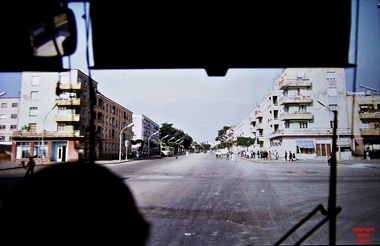
A ‘busy’ street in Tirana in 1984

“After we had eaten lunch at the hotel, a group of us went into the square outside it. We saw a long line of taxis, which were waiting vacantly by a booking booth. We wondered how often these were hired and by whom; there was not a soul in sight taking the slightest interest in them. One of us walked up to the booth and asked the man sitting inside whether we could hire a taxi to take us up to Mount Dajti, some way outside Tirana. Just when it seemed that we had succeeded in hiring a cab, another person inside the booth lifted a telephone receiver, listened for a moment, and then whispered something to the man with whom we had just negotiated. He beckoned to us, and pointed at the hotel. Somehow, he made it clear to us that we needed to book the taxi not from him, but from the hotel reception desk.

TAXI 1

Tirana 1984. Typically empty main square (Skanderbeg Square)

We trouped back into the hotel’s lobby and made a beeline for the reception desk. Two suited men, sitting on a sofa nearby, looked at us over the tops of their newspapers. As we reached the desk, I noticed that the doors of one of the hotel’s two lifts were opening. Our Albanian guide Eduart hurried through them and towards the receptionist, who was beginning to attend to us. 
“What do you need?” Eduart asked us, out of breath.
“We want to hire a taxi.”
“Why?”
“We want to visit Mount Dajti?”
“Why should you do that?”
“We need some fresh country air. We’ve been in the city for too long.”
“That’s ridiculous,” Eduart protested. “You have already spent many days in the countryside.”
“But, that’s what we want, and we believe that the views from Mount Dajti are magnificent.”
“You cannot go.”
“Why ever not?” we asked.
“There is a lot of traffic. The roads are crowded.” We looked at Eduart disbelievingly. Traffic congestion was certainly not a problem in Albania in 1984.

“You know that there’s a big national cycle race on at the moment.”
“That was over long ago,” one of us objected. “We saw the posters announcing it along the roads.”
“You can visit Mother Albania, but no further.”
We had already visited the Mother Albania monument, which was located in the outskirts of the town. However, as we were determined to not to give in to our obstreperous guide, we agreed to his compromise.
“Alright,” we said.
Then, Eduart said menacingly:
“You may take the taxi to Mother Albania, but remember that if anything happens to you, we cannot take any responsibility for your safety. You will not be protected by your group visa.” “We’ll risk it,” one of us said.
I did not like the threatening sound of Eduart’s voice, but followed the rest of our small group back to the taxi rank. When we arrived there no more that ten minutes after we had left it, we found that all of the taxis had disappeared, and also there was an extremely long line of people waiting in a queue outside the booth. Accepting defeat, we made our way on foot to …”

TAXI 3

Traffic in Tirana, 2016

DISCOVER  WHAT IT WAS LIKE VISITING COMMUNIST ALBANIA IN 1984 IN “ALBANIA ON MY MIND” by ADAM YAMEY

It is available from Amazon, Bookdepository.com, lulu.com, and on Kindle