THE FIFTH of November is celebrated each year to commemorate a non-event. It was on that day in 1605 that a plot to blow up the the Houses of Parliament and its inmates, which on that day included King James I. The plotters, led by Guy Fawkes (1570-1606), were Roman Catholics who were annoyed that the king would not grant greater religious tolerance of the Catholics. Had the king been killed, the conspirators would have tried to replace him with a Catholic monarch.
Guy Fawkes Day, the 5th of November, celebrates the fact that the plot failed. For several days before the 5th of November, and for a few days after it, fireworks are let off both in private and public spaces all over Britain. And because the Hindu festival of Diwali (Deepavali) is often celebrated with fireworks close to Guy Fawkes Day, between that festival and the 5th of November, the sky is filled with sounds of explosions almost every evening.
A JAIN BANIA (BUSINESS MAN) called Hiranand Shah travelled from Rajasthan to Patna in 1652. In 1707, he financed Prince Farrukhsiyar sufficiently for him to become the Mughal Emperor (he ruled from 1713 to 1719). Manik Chand, a later head of this Jain family was then rewarded with the title ‘Jagat Seth’, which means ‘banker or merchant of the world’. By the eighteenth century, the family or house of of Jagat Seth was the largest banking house in the Mughal Empire.
The Nawabs of Bengal used the banking services of the house of Jagat Seth to pay tribute to the Mughal emperors in Delhi. William Dalrymple wrote that the Jagat Seth family were able to:
“… make or break anyone in Bengal, including the ruler, and their political instincts were sharp as their financial ones.” (quote from Wikipedia)
When the young Siraj-ud-Daulah became Nawab of Bengal in 1756, he alienated many people including Jagat Seth Mehtab Chand. Siraj demanded 30 million rupees as a tribute from the banker. When the banker refused, Siraj-ud-Daulah slapped him. As a result, Jagat Seth took part in the conspiracy to defeat Siraj-ud-Daulah. He and others, including Mir Jafar, helped the British, led by Robert Clive, to defeat Siraj-ud-Daulah at the Battle of Palashi (Plassey) in 1757. Jagat Seth’s money funded the British to help them defeat Siraj-ud-Daulah.
The Jagat Seth family was at least as influential as tycoons such as the Rothschilds in Europe and figures such as Jeff Bezos and Donald Trump’s current ‘chum’ Elon Musk. Taking the story of Siraj-ud-Daulah as an example, one could say it is best not to upset your wealthy supporters. So, Donald, it would be best not to upset Elon!
Soon after the Battle of Palashi, the fortunes of the house of Jagat Seth began to decline. Today, this remarkable family is commemorated by an opulent mansion, which they built in Murshidabad, sometime after it became the capital of Bengal (for 70 years during the eighteenth century). In 1980, the house was opened up as a museum, which is privately owned and run. We visited this place before we knew about the family’s involvement with the downfall of Siraj-ud-Daulah and the following capture of Bengal by the British. Like many other places in Murshidabad, it is a fascinating reminder of Murshidabad‘s history during the era when Europeans, especially the British, were beginning to make their mark on Bengal.
DUNCHURCH IN WARWICKSHIRE is located where the old road between Oxford and Leicester crosses that between London and Holyhead. This charming village was a place where, in its heyday, up to forty carriages a day stopped to change their horses for a fresh team. This was done at the various coaching inns in the village. One of these hostelries, which is still in business today, is The Dun Cow, where we ate a good English breakfast. Some of this inn’s previous guests included the engineer George Stephenson (1781-1848) and his son, another engineer, Robert (1803-1859), who dined at the hotel on the 23rd of December 1837. Their dinner was to celebrate the completion of the Kilsby Tunnel on the Birmingham to London Railway, a project supervised by Robert.
While we were wandering around the graveyard of Dunchurch’s St Peters Church, which dates back to the 12th century, we asked a gardener working there about where one of Dunchurch’s former famous characters had once stayed. He told us that he had no idea. Half-jokingly but with some earnestness, he added: “…we could do with another one like him.”
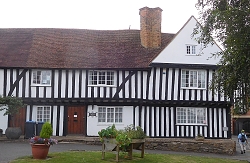
Guy Fawkes House in Dunchurch
The man about whom we were asking had associates, who were staying at the village’s former inn, The Lion Inn, in the early 17th century, the year 1605 to be exact. It was in early November of that year that those waiting at The Lion in Dunchurch were wondering about their colleague who was 79 miles away in London.
The fellows at The Lion were waiting to hear whether their co-conspirator Guy (Guido) Fawkes (1570-1606) had been successful in blowing up the House of Lords in London. He was not, and the conspirators waiting in Dunchurch were arrested. Had the plot to blow up Parliament and along with it the Protestant King James I succeeded, the men at The Lion were to have travelled to nearby Combe Abbey to seize Princess Elizabeth (1596-1662), who became Queen of Bohemia. As an informative website (www.ourwarwickshire.org.uk/content/article/rugby-school-science-teaching-around-1900-2) explains:
“In 1605 the monarch was James I; the Princess Elizabeth was his eldest daughter and sister to the future Charles I. In 1605 she was nine and being educated by Lord Harington at Coombe Abbey. She wasn’t a Catholic, but the conspirators planned to convert her and use her as their figurehead … Her main importance with regard to British history is that one of her grandsons (the son of her youngest daughter Sophia of Hanover) became King George I.”
The man about whom we were chatting with the gardener was neither of the Stephensons, who dined at The Dun Cow, nor the Duke of Wellington, who also stayed in the village, nor Lord John Douglas-Montagu-Scott (1809 – 1860), whose statue stands facing The Dun Cow. He was referring to Guy Fawkes, but this time a Guy Fawkes who completes the job before being arrested!
The former inn, a lovely half-timbered edifice is now a private house, named ‘Guy Fawkes House’, even though the famous man never lived there. The rest of the village contains several old thatched cottages, a thatched bus shelter, and the old village stocks. Close to the town of Rugby, this village is well worth a visit.
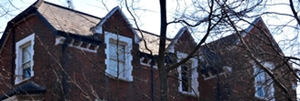
The picture shows the roof of a house in London’s Highgate district where, between 1905 and 1910, Indian patriots (including Shyamji Krishnavarma, VD Savarkar, Madanlal Dhingra, and VVS Aiyar) plotted the downfall of the British Empire in India. You cand discover much meore about this fascinating, but relatively unknown episode in the history of India’s struggle for independence in the book “IDEAS, BOMBS, and BULLETS” by Adam Yamey.
[In the UK, the 5th of November is remembered as being the day that many centuries ago the Houses of Parliament were saved from being blown-up by plotters led by Guy Fawkes (1570-1606)]



 yamey
yamey 