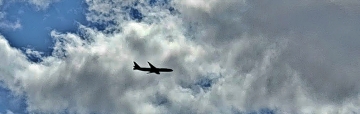
Above the park
And beneath the looming clouds
Plane’s coming in to land

Above the park
And beneath the looming clouds
Plane’s coming in to land
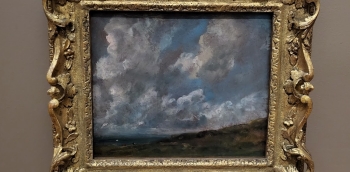
THE TATE BRITAIN art gallery in London is holding a special exhibition of the works of John Constable (1776-1837) and John Mallord William Turner (1775-1851) until 12 April 2026. Amongst the many magnificent paintings on display, there are several small paintings of clouds by Constable. I was particularly interested to see the cloud studies because I had written about them in my book “Beneath a Wide Sky: Hampstead and its Environs”. Here is an extract from my book. It deals with Constable and his interest in clouds:
“One of Hampstead’s attractions for Constable was its wide expanse of sky, which, as Barratt wrote, the artist:
‘… regarded as the keynote of landscape art, and so assiduously did he study cloud, sky, and atmosphere in the Hampstead days that Leslie, his biographer, was able to become possessed of twenty of these special studies, each dated and described. Constable was a man of Wordsworthian simplicity of character, fond of all things rural, and devotedly attached to birds and animals.’
The website of Cambridge’s Fitzwilliam Museum reinforces what Barratt wrote:
‘While living at Hampstead, Constable made a series of oil sketches of the sky alone, each one marked with the date, time and a short description of the conditions. His interest in clouds was influenced partly by the work of the scientist Luke Howard, who had in 1803 written a pioneering study, classifying different types of cloud ...’
In ‘The Invention of Clouds’ by Richard Hamblyn, a biography of the chemist and amateur meteorologist, who devised the modern classification of clouds (cumulus, nimbus, etc.), Luke Howard (1772-1864), it is noted that Constable, who was familiar with Howard’s work, focussed his concentration:
‘… on the extension of his observational range and clouds were the means that he had chosen for the task. After years of searching for an isolated image, seeking a motif upon which to weigh his technical advancement as a painter, he had found it at last in the unending sequences of clouds that emerged and dissolved before his eyes like images on a photographic plate.’
During the summers of 1821 and 1822, Constable made over one hundred cloud studies on the higher ground of Hampstead and its heath. Writing in 1964 in his ‘The Philosophy of Modern Art’, the art critic Herbert Read (1893-1968), who lived in Hampstead, commented that Constable was:
‘… rather a modest craftsman, interested in the efficiency of his tools, the chemistry of his materials, the technique of his craft. His preparatory ‘sketches’ are no more romantic than a weather report. But they are accurate, they are vividly expressed, they are truthful.’
And here the extract from my book ends. It is because of Constable’s ‘connections’ with Hampstead and the clouds above it that I chose the title “Beneath a Wide Sky …” I had seen a few of Constable’s cloud studies before, but never so many together as I viewed at the Tate Britain exhibition. My book is available both as a paperback and a Kindle from Amazon: https://www.amazon.co.uk/dp/B09R2WRK92

Cows are grazing
Beneath the billowing greyish clouds
A pleasant scene

There is a grey sky over Chelsea Old Town Hall this cold Sunday morning in October. The sun is trying to penetrate the clouds. Will it succeed? We hope so, but possibly we are being over optimistic.
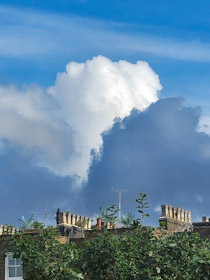
Clouds grey and white
Always very unpredictable
That’s British weather

Clouds on windows
Glass panels reflecting summer sky
A sight indeed
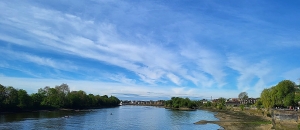
Clouds loom over the stream
High above Chiswick Eyot
On Sunday morn

High and dry
A wooden boat waits idly beneath
Blue sky and white clouds

Rays of sunshine
Burst through a hole in the heavens
High above the sea

There is beauty
Even when clouds above are grey
And rain is falling
 yamey
yamey 