
Two architects and a painter in Ahmedabad

ON TUESDAY THE 24th of January 2023, we arrived in the city of Ahmedabad in the Indian State of Gujarat. That evening, we visited a friend who had been the curator of a building in Ahmedabad, which had been designed by the architect Le Corbusier. Our friend was pleased to see us but was upset because a close friend had died that morning at the age of 95. That friend had been a disciple collaborator of Le Corbusier.

Our friend’s friend was Balkrishna Vithaldas Doshi, who was born in Pune in 1927. He worked with Le Corbusier in Paris between 1951 and 1954. He returned to Ahmedabad to supervise Le Corbusier’s architectural projects in that city. In 1955, Doshi established his own studio in Ahmedabad, and was working there until the day before he died.

Clearly influenced by Le Corbusier and Louis Kahn, with whom he designed the campus of the Indian Institute of Management (Ahmedabad), his (some might say Brutalist) architecture embodies the ideals of Le Corbusier in a much more user-friendly form than that which his mentor produced.
Amdavad ni Gufa

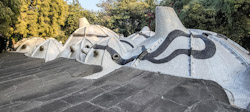
Next door to CEPT University in Ahmedabad much of which was designed by Doshi, there stands Doshi’s most unusual edifice, the Amdavad ni Gufa (the Ahmedabad Cave), which was completed by 1990. Its is difficult to describe this structure, but I will try. Covered in a mosaic of black and white ceramic tiling, it resembles an enormous caterpillar partially submerged in the ground. It is a giant caterpillar punctuated by bulbosities of various sizes, some of which have hemispherical windows at the end of short stalks that project from the dome-like bulbosities.

Steps descend to the two entrances of the Gufa. Originally designed as an art gallery, its irregular shape and wavy floor deemed it unsuitable for its intended purpose. Within the Gufa, the ceiling is supported by irregularly shaped columns that resemble stalactites with have joined with stalagmites beneath them. The strange space, which was too odd to be used as a gallery, is now decorated with sculptures and murals painted by the celebrated Indian artist MF Husain (1915-2011).

The Gufa is one of the ‘must-see’ sights of Ahmedabad. With the recent demise of Doshi and the earlier death of Husain, the Gufa makes a fitting memorial to these two great creators.
Moore than meets the eye

“HOW COULD YOU SPEND FIVE DAYS IN MOUNT ABU?”, someone asked me, adding that “one day is more than enough – you see the Jain temple, and that’s it”. How wrong this is. Even a fortnight would not be long enough to absorb all that Mount Abu (in Rajasthan) and its surroundings have to offer. I write this not because I was lucky enough to meet the amazing Dr Arun Sharma, but because even before we met him I had that idea.

Dr Sharma, a local medical practitioner, is an artist who expresses his ideas by composing music, painting canvases, as well as writing poetry and dramas. He is also a mine of information about the history of Mount Abu.

Major General Arthur Thomas Moore (1830 – 1913 or 1923) was a British officer in India. At the age of 26, and serving in the 3rd Bombay Light Cavalry, he was awarded a Victoria Cross for bravery at the Battle of Khushab in Persia.

Dr Sharma told us that for many years Moore’s whereabouts in India during a period of 3 or 4 years were completely unknown. After he resurfaced and returned to Europe, he died in his native land Ireland, where he is buried.

The regiment that Moore served has been renamed The Pune Horse, but nowadays it uses tanks instead of horses. Since 1947, it has been involved in over 60 skirmishes and battles and never been defeated. The members of the regiment believe that the spirit of the incredibly brave Moore is their guardian angel.

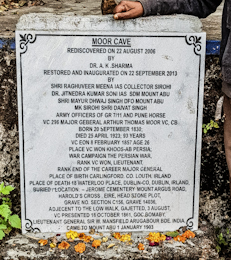
The regiment was delighted when in 2006, Dr Sharma accidentally stumbled on a cave near Sunset Point in Mount Abu. This cave had inscriptions carved in beautiful handwriting by Arthur Thomas Moore. These inscriptions include the date 1901, which was during the period that Moore had gone missing. What Moore was doing in this cave that Dr Sharma discovered we may never know, but at least we now know that Mount Abu was one of the places he visited during his period of disappearance.

Dr Sharma took us to see the cave, whose restoration he instigated, and proudly showed us the informative memorial plaque he created.

This cave and many more natural and man made historical sights and sites have convinced me that Mount Abu has more to see than most people realise.

I wish to thank Dr Sharma for opening my eyes to the exciting history of Mount Abu and its surroundings.