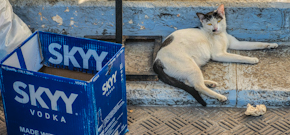
I’ve had my fill
The vodka is fully consum’d
Now I’ll have a snooze

I’ve had my fill
The vodka is fully consum’d
Now I’ll have a snooze

Tablet the cat
A friendly furry creature indeed
Enters the room
WE HAVE ALREADY seen many fantastic historical places in Istanbul, and I plan to tell you about some of these. But before proceeding with descriptions of landmarks in the history of Istanbul/Constantinople, let me relate something current.
Istanbul is full of cats. Wherever you look you are bound to see a cat – often looking extremely healthy. They feed both by scavenging and they are also fed by local people. They seem unafraid of humans.
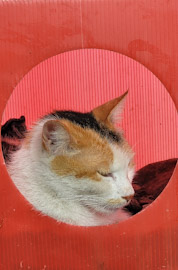
During our first three days in Istanbul, we have noticed something we had not seen before. In several places, we have seen small kennel shaped ‘sheds’ which are large enough to house one big cat or a couple of smaller ones. The floors of some of these shelters are lined with soft material including bits of old bedsheets. Most of the sheds have round holes through which the cats can enter and leave the shelters.
Another feature that makes life more pleasant for felines is that compared with many other cities I have visited, there are few dogs around in the streets.
The cats of Istanbul have much to purr about!

She sits on the wall
The full moon is over Funchal
Her eyes on me
THE FIRST PLACE I practised dentistry was in Rainham, Kent. Every Thursday, we climbed into my then boss’s open-topped TR 7 sports car, and drove down the High Street to a pub called The Cricketers. There, we used to enjoy a hearty meat and two veg lunch. One of the waitresses, a middle-aged woman, was a patient at the practice and always made sure that we were given large portions. On other days, I used to eat either in the practice or in one of the other local eateries. Sometimes, I would go into the local branch of Tesco’s supermarket to buy myself a few items for lunch. These always included either a Mars bar or a chocolate covered honeycomb caramel called a Crunchie. All the cashiers in the supermarket knew where I worked, and often, whilst I was paying, they would raise the Mars or Crunchie in the air, and shout:
“Look what the dentist is eating!”
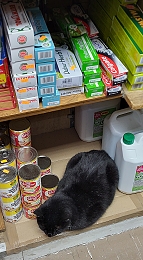
Recently, I entered a grocery shop near Portobello Road. I noticed a black cat resting on a shelf surrounded by tins, bottles, and boxes containing tubes of toothpaste. Seeing this creature reminded me of my days long ago in Rainham. There was a small ‘corner shop’ across the road from our surgery. The lady who owned it made very acceptable, generously filled sandwiches. Every now and then I used to buy one of her sandwiches for lunch. I used to accompany this with a packet of potato crisps. These packs were kept in an open topped cardboard box in no particular order. I used to rummage through its contents and select the pack that I fancied.
One day, I entered the shop to buy my lunch. When I turned to look at the box containing the packs of crisps, I saw a very plump cat comfortably curled up on top of the packets of crisps. Despite the fact that the crisps were sealed in their packets, I did not feel like choosing one. As I left the shop, I wondered where else that cat chose to rest during the day. Thinking about that put me off ever entering that little shop again.

Can you tell me
If the cat’s happy or sad
By the shape of its tail?
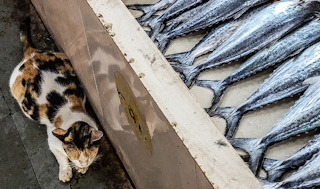
She waits with hope
Maybe some fish will come her way
There is plenty here
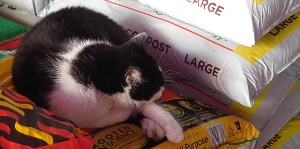
With paws crossed
Curled up on a sack of compost
A cat naps serenely
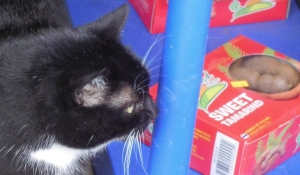
A furry feline
Finds box’d tamarind
But she has no need for it
AMONGST THE COURSES on offer in the third year in the Physiology Department at University College London Lon, there was one with the mysterious title of ‘Connective Tissue’. I went to see our tutor Dr Roger Woledge, a specialist in muscle physiology, and asked him about this. He told me that it had been on offer for years, but no one had ever asked to take it. He suggested that I enrol in it so that it would be held for the first time ever, and at the very least he would discover what was on offer. I agreed, and he sent me to the office of Prof Robert Harkness to let him know that I was interested in finding out about his course.
As soon as I entered Robert’s cluttered office, I knew that I would enjoy studying whatever was on offer. There was barely any, if any, free space on the Prof’s huge desk. The walls of the office were crowded with books, runs of journals, pictures, old engravings, and even framed cartoons. There was a small paper notice stuck on the glass door of one cupboard. It was typical of Robert’s sense of humour and his take on common sense.
His rotating office chair looked antique, rather like something you might expect to see in a bank manager’s office in the old Wild West. There was a glass fronted wooden cabinet filled with books and other objects. On the floor, there was a variety of things including polished wooden microscope cases. I was asked to close the door behind me quickly because he told me that his life would not have been worth living if the new black kitten, which had just emerged from a cupboard, was allowed to escape from the office. He and his wife, Margaret. would be taking it home that evening.

I imagine that Robert must have told me something about his Connective Tissue course whilst I stroked his affectionate young cat, but I do not remember what. All I can recall is that by the end of our brief but friendly interview, I had been enrolled on his course. When I reported this to Dr Woledge, he was delighted. The course was not to be held until well into the academic year, and, by the time it commenced, its participants included G Clough, who is now a professor at a major University, an MSc. Student, and me.
Some months later as I neared the date of graduation, I began investigating the possibility of starting a PhD and began visiting various people who were potential supervisors. While I was walking beside the iron railings enclosing the gardens of Lincolns Inn Fields after just having had two interviews that I had not enjoyed, I had a revelatory moment. It dawned on me that however prestigious a laboratory or potential doctoral supervisor might be, I would have to get on with him or her as well as his or her team of co-workers. I would be spending at least 3 years in their company. It was important, at least for me, that I should feel at ease with whomever I was to collaborate. If I did not, as I had just felt during the recent interviews, I knew that I would not be able to flourish as a doctoral student. Since that day, I have always asked myself whether I would feel comfortable working with whoever was interviewing me when applying for a post. Only once, I did not follow this rule, and then I ended up in a job that did not suit me at all.
On the next day, I visited Robert Harkness in his office. As I entered and surveyed his undoubtedly individual office, I decided that whatever project that he had to offer would suit me as it would give me the chance to work in the genial company of Robert, Margaret, and their friendly team. He told me that he would be able to get hold of a Medical research Council (‘MRC’) grant for me, providing that I thought of an interesting topic related to connective tissue. He was not going to tell me what to research – I had to make that decision.
Then all of a sudden, he opened one of the leather-bound volumes that contained reprints of his published papers, and showed me a graph published in a paper that he had written for the prestigious Journal of Physiology. I forget what the graph illustrated but recall that it was divided into sections by several vertical dotted lines. He explained to me that he always had a great deal of trouble from the editors of the Journal. They were forever returning the manuscripts of the paper that he submitted to them, wanting him to make minor modifications and thus delaying publication. He asked me to examine the vertical lines with a magnifying glass, and then I saw that they were made up of dots and dashes, which looked like Morse code. He asked me whether I was able to decipher Morse code. I told him that I could not. Gleefully, he translated the dots and dashes which he had drawn on the published graph and revealed that they spelt out the words ‘drat those flies’ repeatedly along the length of the lines. They had not been noticed by the journal’s fussy editors and were Robert’s revenge for their pernickety interferences.
Not only did I complete my PhD under the supervision of Prof Harkness, but also, I established a close relationship with him and his family. This friendship with the family, which my wife and I value greatly, has endured long since the deaths of the Prof and his wife.
 yamey
yamey 