An unexpected story told in a cafe in London’s North Kensington

LAST YEAR I READ a fascinating book, “Staying Power”, written by Peter Fryer and first published in 1984. It is a history of black people in Britain from the time of the Roman conquest until 1984. In it, the author gives plenty of examples of the hostile reception that black people arriving in Britain received from their racist British neighbours and workmates.

Today (the 28th of March 2024), I was sitting in the Lisboa Patisserie, a cafe in North Kensington’s Golborne Road, when I began chatting about the ‘good old days’ with a gentleman, who is a few years older than me. He told me that he had come to Britain from the West Indies in the early 1950s when he was 8 years old. Having read Fryer’s book and having heard stories of racist behaviour, I asked him whether it had been difficult for him and his family after they arrived in England. I was astonished and very pleasantly surprised by his reply.

He told me not to believe that everything was as bad as is often recorded. From the moment his family arrived, the English people they encountered were all very kind and friendly. As an example, he described what happened when his family were evicted from their flat by their (black) landlord. They were literally out on the street with nowhere to go. Two English (i.e., white) ladies, who were chatting to each other over a garden fence, saw them, and asked what had happened. Hearing their plight, one of them said that she had a spare room in her attic, where they could live until they found somewhere of their own.

The gentleman in the café told me that once they had settled into new accommodation, they were at a loss as to how to deal with things that they had not had previously encountered in the West Indies. For example, back in the Caribbean, their home did not have electricity or gas or many other domestic things that were usual in British homes in the 1950s. It was their white milkman, who came to their rescue. If there was something they could not deal with – for example replacing a fuse – their milkman would come into the house and help them out.

Our friendly neighbour in the café said that he could give me many more examples of kindness and friendliness of white British people, which his family had encountered. However, as he could see that we had finished our coffees, he concluded by saying that contrary to, as he put it: “what millennials only want to hear”, it was not all bad as far as white British behaviour towards immigrants from the Caribbean were concerned. He did not know that I do a lot of writing, but he said that I should write down what he told us as it needed to be known – and that is what I have done.

I must add that his story is somewhat unusual because even today, we still hear of too many cases of intolerance and even harm to Afro-Caribbean people.

PS: although this has been published on the 1st of April, it is NOT an April Fool’s joke!

The first and only Queen of Haiti

UNTIL FEBRUARY 2022, only very few people with specialised knowledge of history would have been able to point out the house in which Marie-Louise Christophe lived in London between 1821 and 1824. Now, there is a plaque on the house in Marylebone’s Welbeck Street that marks the house in which she resided. And by now, you might well be wondering why anyone might want to know.

Marie-Louise (1778-1851) was born into a free black family, which ran a hotel, in St Dominique (which is now Haiti). In 1793, she married Henri Christophe (1767-1820), who had been one of her father’s slaves before he had earned enough in tips to purchase his freedom. After several years of revolution, in which Henri Christophe was an important freedom fighter, Haiti gained independence from France in 1804. In 1811, Henri was crowned the King of Haiti and the following year, Marie-Louise was given the title of Queen of Haiti. After the death of her husband in 1820 and the assassination of her two sons, she fled from Haiti along with her daughters. Their escape was assisted by the British, and they settled first in Blackheath, where they were hosted by the Anti-Slavery activist (abolitionist) Thomas Clarkson. After several changes of address, the Queen and her daughters settled in number 49 Welbeck Street.

According to the British press of the time, she and her daughters were popular with British people in all the social echelons. In 1824, they left London for Europe. Marie-Louise died in Rome, where she is buried. She never returned to Haiti. It was only in February 2022 that the Nubian Jak Community Trust were able to put up the commemorative plaque which you can see on number 49 Welbeck Street. It correctly describes Marie-Louise as “First and Only Queen of Haiti.”

Buried in Bath

THE WALLS OF Bath Abbey are lined with memorials to the dead, many of whom are buried within the church. A remarkably large percentage of the funerary memorials commemorate the lives of people who worked in Britain’s colonies. There are monuments to people who lived and worked in the Caribbean, North America, and Asia, especially for the East India Company, which ‘ran’ and exploited India until 1858.

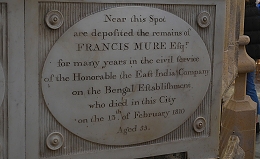
For example, Francis Mure Esq worked for many years in the civil service of “the Honourable the East India Company on the Bengal Establishment”. He died in Bath in 1810 aged 53. Henry Lynch Esq MD “of the island of Barbadoes” died in Bath in 1823, aged 49. Also from this place in the Caribbean was Benjamin Alleyne Cox Esq who died in Bath in 1802 aged 74.   In 1812, 78-year-old Rawson Hart Boddam also died in Bath, after having served as the Governor of Bombay in 1784. Robert Brooke Esq, who had served in the Bengal Civil Service died in 1843 aged 72 is also interred in Bath Abbey. Peter Read Cazalet, “of the Honourable East India Madras Civil Service”, who died in 1859, aged 37, is yet another old ‘India hand’, who is buried in Bath. Also in the abbey are the remains of Major General Sir Henry White KCB, part of whose inscription reads chillingly like some of the news bulletins in the current Ukraine crisis: “The judicious Position taken by his Division in the Attack on Agra Which accelerated its fall And the Reduction of The Strong Hill Fort at Gwalior By Siege Are Proofs of Zeal and Military Skill…” He died in 1822.

What puzzled me was why did so many of these men from the colonies ended their lives in Bath. Was it because they were sick and had come to the place to take the curative spa waters, which failed to cure them? Or had they retired to Bath? Or, as someone suggested, Bath is close to Bristol, which was in many ways involved with colonial affairs.

The answers to these questions must remain uncertain at present. However, I wondered why the wealthy American Senator William Bingham died in Bath in 1804, aged 49. He was involved with the Barings Brothers bank in London, which might have been a reason for him being in England at the time of his death. He left for England in 1801, when his wife was taken ill. What he was doing in Bath remains unclear.

Amongst the many fascinating memorials in the Abbey are several commemorating people who died abroad. Some of these people had been in India when their lives ended. An interesting example of this, which illustrates the hazards of warfare and the difficulties in subduing people, who have no wish to be colonized, is the monument to 1st Lieutenant George Dobson Willoughby, of the Bengal Artillery and the Commisary of Ordnance at Delhi, who died in 1857. His inscription includes the following details: “As a brave and zealous soldier he stood firm in the defence of the post intrusted to him, and when resistance failed blew up the Delhi Magazine on 11: May 1857 to prevent it falling into the hands of the mutineers and rebels. Burnt and wounded he subsequently fell a prey to the insurgents …”

Maybe, this is a lesson from which the dutiful Russian soldiers in Ukraine should take heed.