
A BOOK FROM A LIBRARY IN SOUTH AFRICA AND AN ANCESTOR

IN AUGUST 2003, we spent a day in Aliwal North (now called ‘Maletswai’). This small town on the northern border of South Africa’s Eastern Cape Province is not on many tourists’ itineraries. We went there for a special reason. It was originally named after the Battle of Aliwal (1846), a British victory during the First Anglo-Sikh War.

The town was laid out in 1849. When this happened, the Jewish mercantile firm, Mosenthals, opened a branch in the newly established town. After a few months, they sent a young man, Heinrich (later ‘Henry’) Bergmann (1831-1866), to manage the new store and to help sell land in the embryonic township. Very rapidly, Bergmann became one of the most prosperous people in Aliwal North. He owned much land and managed a bank in the town. Soon, he was so successful that he took over the town’s other two banks. For reasons that are not altogether clear, but they might have had something to do with a financial problem, Bergmann shot himself. Having committed suicide, neither the small Jewish cemetery nor the Christian one was prepared to bury him. In the end, his friends the De Wet family, who farmed in the district, buried him in their private family cemetery, and that is where we saw his gravestone when we visited Aliwal North in 2003.

Henry Bergmann was my mother’s grand uncle.

Arriving in what was then the Cape Colony in 1849, he was the first member of my family to migrate from Germany to southern Africa. He was also amongst the small number of Jewish people who came to that part of the world in the first half of the nineteenth century. The majority of Jewish migrants to what is now South Africa began arriving after the late 1860s, as I have described in my book “Exodus to Africa”.

We visited Aliwal North in 2003 as part of my research into the life of Henry Bergmann. Apart from meeting members of the De Wet family, descendants of those who buried Bergmann, who showed me family histories containing details of my ancestor’s life and fields that were once owned by him, we spent some time with Mrs Joubert, the librarian of Aliwal North’s public library. She was extremely helpful and took a great interest in my research.

Aliwal’s library was selling a few books that were no longer needed. My wife bought a few novels, one of which was “Mr Mirakel” by E Phillips Oppenheim (1866-1946). The book we bought contains the words: “First printed  … 1943”. It is a first edition. Inside the book, there are labels inserted by the library. They are printed both in English and Afrikaans. There are also four imprints of an inked rubber stamp. Each one reads: “Aliwal North. Public Library. Cape of Good Hope.”

Just before 1910, when the Unification of South Africa occurred, what had been known as the Cape Colony became known as ‘The Cape of Good Hope Province; (‘often shortened to ‘the Cape Province’). In 1994, this vast territory was divided into the Northern Cape, Western Cape, and Eastern Cape provinces. Given that the book can only have been acquired in or after 1943, the words ‘Cape of Good Hope’ on the stamp intrigued me. Although they do refer to a geographic entity, they have never, as far as I can see, referred to an administrative area, and did not do so on or after 1943 when the book was published.

Had we not been sorting out our books recently, we would not have come across the book from Aliwal North. Seeing it and its library labels and stamps brought back memories of our visit to Aliwal North 22 years ago.
A house on the Isle of Wight and a plantation in Sri Lanka: chapter 2

THE PHOTOGRAPHER Julia Margaret Cameron (1815-1879; ‘JMC’) was born in the Garden Reach district of Calcutta (now Kolkata in West Bengal). Her father, James Pattle, was a prosperous English official in the East India Company. JMC and her six sisters, the surviving children of James and Adeline Marie Pattle, had a Bengali ancestor, Thérèse Josephe Blin de Grincourt (1768-1866) She was JMC’s maternal grandmother, a Bengali woman who had married a French man, Ambroise Pierre Antoine de l’Étang (1757-1866, whose presence in Bengal was recorded in “The India Office List 1825” as “De l’Étang, Chevalier Antoine, Knt. St Louis, assist. Stud at Poosa, 1796” (Poosa is in what is now Madhya Pradesh). They married in 1788. At that time, it was not uncommon for European men to have lasting relationships with Indian women. This is well-described in William Dalrymple’s book “White Mughals”. Later, in the 19th century, such interracial liaisons were heavily frowned upon. It was expected that ‘white’ men would only marry ‘white’ women. Incidentally, Thérèse was daughter of a French colonist and his Bengali wife.

As with her sisters, JMC was sent to France to be educated. She remained there from 1818 to 1834, when she returned to India.

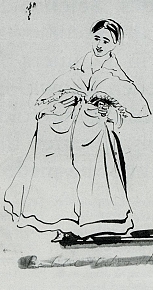
Julia Margaret Cameron by James Prinsep

In 1835, suffering from ill-health, JMC travelled to the Cape of Good Hope. This part of what is now South Africa was favoured as a place to convalesce by Europeans based in India. It was in the Cape that JMC met not only the famous astronomer and an inventor of photography Sir John Herschel (1792-1871), but also the man whom JMC would marry in 1838: Charles Hay Cameron (1795-1880). Charles was in the Cape recovering from a malarial illness. A disciple of the philosopher Jeremy Bentham, he was a reformer of law in India and education, who also invested in coffee plantations (in 1848) in Sri Lanka.

Julia and Charles married in Calcutta, where she became a prominent hostess in the city’s British Indian society. During the 1840s, she corresponded regularly with John Herschel about developments in the science and technology of photography. He sent her two dozen calotypes and daguerreotypes, which were the first photographs he had ever set eyes on. The Camerons raised eleven children: five of their own; five orphans (children of relatives); and an Irish girl named Mary Ryan (whom they found begging on Putney Heath).

The entire Cameron family relocated to England in 1845, possibly because their two older children had settled there, and Charles had retired. They settled in Royal Tunbridge Wells in Kent. They became friendly with one of their neighbours, the poet Henry Taylor (1800-1886), who had worked in the Colonial Office under Robert William Hay (1786-1861), who might well have been related to Charles Hay Cameron’s mother. Later, the Camerons moved to East Sheen, which is closer to London than Tunbridge Wells.

It was through Henry Taylor and Julia’s sister Sara (1816-1887), who was married to Henry Thoby Prinsep (1793-1878), an official in the Indian Civil Service, that JMC was introduced to a set of noteworthy Victorian cultural figures. Henry and Sara had returned to England from India in 1835, and were living in (the now demolished) Little Holland House next to the house of the artist Lord Leighton, near Holland Park in west London. Their home became a meeting place for famous artists, as will be described later. It was here that Sara held a salon for pre-Raphaelite artists, poets, and aristocrats with an interest in artistic activities. At Sara’s home, JMC encountered, amongst other worthy cultural figures, the poet Alfred Tennyson (1809-1892).

Tennyson rented Farringford House in Freshwater Bay on the Isle of Wight (‘IOW’) in 1853, and purchased it three years later. In 1860, after a long visit to Tennyson on the IOW, the Camerons bought a property next door to Tennyson’s and named it Dimbola after one of their (then coffee) plantations in Sri Lanka. TO BE CONTINUED