An artist who campaigned against slavery

HE WAS PASSIONATE about sketching and painting. However, his father, a wealthy Quaker brewer in Hitchin (Hertfordshire), insisted that his son should dedicate himself to working in the family business and use his spare time to create his art. The artist was Samuel Lucas (1805-1870). There is a wonderful exhibition of his creations at the beautifully laid out North Hertfordshire Museum in central Hitchin until the 12th of November 2023.

After schooling and an apprenticeship in London’s Wapping, Samuel worked in the family business in London before returning to work in Hitchin in 1834. As for his artistic ability, this appears to be self-taught. However, he was a keen visitor to the Royal Academy exhibitions in London. In 1837, he married Matilda Holmes, who had been a pupil of the artist John Bernay Crome (1794-1842). She was keen on sketching, but none of her works have survived. I speculate that it is not beyond possibility that Matilda, a water colourist, might have helped Samuel develop his superb water colour techniques.

Samuel’s sketches range from extremely detailed to impressionistic, resembling the work of JMW Turner to some considerable extent. The finished oil paintings, some of which were displayed at the Royal Academy, are beautifully composed, full of detail, and of great visual interest.

Two of the exhibits interested me more than the others. One of them is a pen and ink sketch depicting Thomas Whiting of Hitchin reading Harriet Beecher Stowe’s anti-slavery novel “Uncle Tom’s Cabin” (published 1852) to a gathering of people in a hall in Hitchin. Nearby, there was one of Samuel’s oil paintings. This shows seven men seated around a small table listening to a man standing with his left hand on the table. The standing man is Bishop Samuel Wilberforce (1805-1873). He is addressing members of the Oxford Mission amongst whom is the novelist Lord Lytton of Knebworth (Hertfordshire). The bishop was a son of the anti-slavery activist William Wilberforce. Bishop of Winchester from 1870 until 1873, he was both against slavery and Darwin’s Theory of Evolution. Samuel Lucas’s painting depicts him when he was Bishop of Oxford, which he became in 1845, and remained until he was shifted to Winchester. The Oxford Mission was an Anglican missionary organisation, which became important in Bengal in the late 19th century.

The two pictures described relate to Samuel Lucas’s involvement of the anti-slavery movement. In 1840, he was Hitchin’s delegate to the Anti-Slavery Convention held in London at Exeter Hall on the 12th to 23rd June 1840. During this period, he and his wife hosted some of the delegates who had come from the USA. The convention is portrayed in a painting by Benjamin Haydon (1786-1846), which is now in the National Portrait Gallery. The gallery’s website has a photograph of this painting, which has been displayed so that the viewer can identify each of the people in it. Samuel Lucas can be found near the back of the gathering near a pillar.

Lucas was against slavery, as were many of his fellow Quakers. In addition to this activity, his artistic creations, and his involvement in the family business, he was also an active contributor to the life and development of Hitchin. One of the largest of his paintings in the gallery, but not included in the exhibition, is a depiction of Hitchin’s Market Place. Each of the many people shown in the painting is a portrait of an actual person. The museum has an interactive guide to identify the people. One of them was Isaac Newton (1785-1861). This gentleman was not the famous scientist but the owner of a family firm of painters, plumbers, and glaziers. One of the many folks in the picture has a dark complexion. This is a portrait of Samuel ‘Gypsy’ Draper (1781-1870). He was a violinist, who played for dances and fairs in the area in and around Hitchin for about 20 years. Some of the local Quakers disapproved of him, but Samuel Lucas placed him at the front of the crowd in the centre of the painting. Had we not visited the North Hertfordshire Museum out of pure curiosity, I doubt that we would have ever come across the life and works of Hitchin’s Samuel Lucas. We spent most of our time looking at the superb exhibition about him, so that we had hardly any time left to see the rest of the museum. A fleeting glimpse of the other galleries in the lovely modern building was enough to persuade us that we need to return to see more.

Why don’t trees fall down?

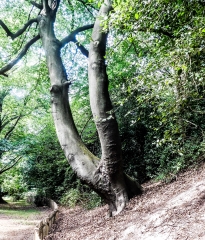
SOME YEARS AGO, I was walking in Stoke Common (just north of Slough) with my teacher and close friend, the late Professor Robert Harkness. The Common was a wooded area with a variety of trees. Some of them looked very awkward in that their curved or leaning trunks seemed to defy gravity. Yet, the trees did not fall over despite this.

TREE 3

Robert, who was a renowned physiologist, was also a naturalist. Everything natural aroused his interest. As we walked through the woods, he explained that the trees did not topple over because each of them maintained their own centres of gravity as they grew. These centres of gravity must, he considered change constantly during the long lifetimes of the trees. How, he wondered, did the trees grow in such a way that they never became unbalanced and always remained standing?

He never told me the answer. Maybe, he did not know, but ever since that damp grey afternoon with him on Stoke Common, I always look at trees and wonder whether anyone knows the answer to his question. This afternoon, I was walking along the lovely tree-lined path that leads to Kenwood House from its public car park, when I noticed some trees growing on a steep slope lining it. The trees’ roots seemed to be clinging to the slope, hanging on for dear life. Seeing them reminded me of Robert and his wondering about arboreal ‘assessment’ of centres of balance and a fine old friend, who passed away in June 2006.

Table for two…

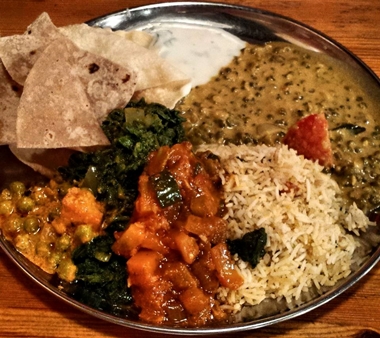
I lived and practised dentistry in the Medway Towns (Chatham, Gillingham, and Rochester) for eleven years beginning in 1982. These towns in north Kent coalesce with each other to form a straggling urban belt along the right bank of the River Medway. When I lived in the area, there were many restaurants serving what was described as “Indian food”. Before reaching the area, Indian friends had helped me to appreciate what good Indian food should taste like. None of the many restaurants I tried in the Medway Towns ever provided Indian food that could be described as good. However, as there was not much else to do in the area when I first arrived there, before making friends locally, I sampled many of the eateries that served Indian food.


curry


One autumn evening, I entered a small establishment in Gillingham. I was its only customer for the duration of my meal. The restaurant was literally freezing cold, unheated. It was so cold that I ate my meal without removing my fleece filled anorak. Before the food arrived, the waiter placed a candle-powered plate warmer in the middle of the table to keep my dishes warm and another one in front of me to keep my plate warm while I was eating. The items, which I ordered, had the names of Indian dishes that I had tasted before. Sadly, none of them had any taste at all.

In another Indian restaurant that I visited one evening, I was not the only customer. There was a couple at another table within earshot. While I was eating, I could listen to my neighbours’ conversation. I remember nothing of the food I ate, but I do recall one small snatch of the other customers’ chatting. One of them said:

“… well, of course, you know, Gillingham is the armpit of Kent…”

having recently moved to the town, I was not happy to hear that.

There was an Indian restaurant close to the synagogue in Rochester. This place was slightly superior to the other Indian eateries in the area. One evening, while I was eating there, I was intrigued by the music being played through the establishment’s speaker system. Although I knew nothing about it then, I now realise that they were playing a soundtrack from a Bollywood film. I asked the waiter about the music. He answered:

“It is Indian music”

“I like it,” I told him, “where can you buy it?”

“We borrow the records from the public library, sir.”

Some months later, on a cold winter’s evening, I visited the restaurant near the synagogue with a female cousin and a male friend. We ordered a large meal and were served by only one Asian (Indian or of another sub-continental origin) waiter throughout. We were the only diners that evening. No one else entered the restaurant, even for take-away food. At the end of the meal, my friend went to the toilet. My cousin and I put on our winter coats and waited for him by the entrance door. Within a few seconds of reaching the door, the waiter, who had been serving us all night, came up to us and said:

“Table for two, is it?”

Either the waiter had not looked at us all evening, or all Europeans looked the same to him.