A photographer and his works exposed at a garden in Chennai

SUNIL GUPTA IS a renowned photographer. He was born in 1953 in New Delhi, and migrated to Canada with his family in 1969. With a degree in accountancy and a diploma in photography, he moved to London (UK) in 1983. There, he married another photographer Charan Singh. Much of Sunil’s work relates to themes of sexual identity, migration, race, and family.

While we were in Chennai, the parents of another photographer, Varun Gupta, told us about the exhibition of Sunil Gupta’s works currently (January 2025) being held in the garden of the Government Museum in Chennai. The show is part of the Chennai Photographic Biennale, of which Varun is one of the founders.

The show is being held in the open air. We saw it when the air temperature was hovering around 29 degrees Celsius. In addition, crowds of schoolchildren were enjoying their packed lunches on the ground amongst the walls upon which the photographs were hanging. The show has been arranged to produce what could be termed an autobiography expressed by photographs.

There is no doubt that Sunil’s photographs are visually superb as well as being of great interest.

While I was looking at the images, many of which are artistic as well as informative, I began to wonder whether photography limits the expression of a photographer’s innermost feelings more than is the case for a creator who is painting or sculpting. The photographer, like other visual artists, can compose his/her pictures, regulate their appearance, and edit them. However, the light coming through the camera lens dictates the final product however many adjustments etc are made. In contrast, the light coming through the eyes of a sculptor or a painter (or a printmaker) impinges on the artist’s brain, and what eventually results reflects the effect that the image projected into the brain has on the creator’s innermost feelings about the subject matter.

Having said this, which I hope makes at least a little sense, I must admit that I do enjoy making photographic images and I hope that my photographic skills will be improved by viewing great works such as we saw at the exhibition of Sunil Gupta’s photographs in Chennai.

A peaceful garden close to the Adyar River in Chennai

THE MEANING AND PRACTICE of Theosophy remain a mystery to me. Suffice it to say that Theosophy was first established by Helena Petrovna Blavatsky and others in 1875. One of its co-founders was the American Colonel Henry Steel Olcott. With some others  they founded the Theosophical Society. In 1895, there was a split in the society. Blavatsky and Olcott both converted from Christianity to Buddhism and established the home of their branch of the Society in India, the birthplace of Buddha. By the way, the Theosophists welcome people of all faiths.


Blavatsky and Olcott established the headquarters of their branch of Theosophy on a plot of land close to the Adyar River in Chennai (Madras). The various buildings used by what became known as the  Adyar branch of the Society are set within a 260 acre garden known as the Huddlestone Garden. This peaceful area is rich in trees, other plants, wild birds, and other wildlife. During our visit there in January 2025, we spotted two mongooses as well as numerous squirrels and dogs.


Although I  can tell you almost nothing about the nature of Theosophy,  I  have two personal connections with it. First, my wife’s paternal grandfather,  Kisanlal Daru, was an influential member of the Bombay branch of the Adyar Theosophical Society. 


Secondly, one of our friends in England is the grandson of Peter Freeman (1888-1956). The managing director of the family’s tobacco business  in Cardiff (Wales), he was a Labour politician, and served several terms as a Member of Parliament.  In addition, he was the General Secretary of the Welsh Adyar Theosophical Society between 1922 and 1944. He was the author of a few publications about Theosophy.  According to our friend, Peter’s grandson, when Peter died, he left all of his considerable fortune to the Adyar Theosophical Society.  I would like to believe that some of this legacy has helped to make the Theosophical Society grounds at Adyar so beautiful.

Beware of upsetting wealthy benefactors: a word of warning to Donald Trump

A JAIN BANIA (BUSINESS MAN) called Hiranand Shah travelled from Rajasthan to Patna in 1652. In 1707, he financed Prince Farrukhsiyar sufficiently for him to become the Mughal Emperor (he ruled from 1713 to 1719). Manik Chand, a later head of this Jain family was then rewarded with the title ‘Jagat Seth’, which means ‘banker or merchant of the world’. By the eighteenth century, the family or house of of Jagat Seth was the largest banking house in the Mughal Empire.


The Nawabs of Bengal used the banking services of the house of Jagat Seth to pay tribute to the Mughal emperors in Delhi. William Dalrymple wrote that the Jagat Seth family were able to:

“… make or break anyone in Bengal, including the ruler, and their political instincts were sharp as their financial ones.” (quote from Wikipedia)


When the young Siraj-ud-Daulah became Nawab of Bengal in 1756, he alienated many people including Jagat Seth Mehtab Chand. Siraj demanded 30 million rupees as a tribute from the banker. When the banker refused, Siraj-ud-Daulah  slapped him. As a result, Jagat Seth took part in the conspiracy to defeat Siraj-ud-Daulah.  He and others, including Mir Jafar, helped the British, led by Robert Clive,  to defeat Siraj-ud-Daulah at the Battle of Palashi (Plassey) in 1757.  Jagat Seth’s money funded the British to help them defeat Siraj-ud-Daulah.


The Jagat Seth family was at least as influential as tycoons such as the Rothschilds in Europe and figures such as Jeff Bezos and Donald Trump’s current ‘chum’ Elon Musk. Taking the story of Siraj-ud-Daulah as an example, one could say it is best not to upset your wealthy supporters.  So, Donald, it would be best not to upset Elon!


Soon after the Battle of Palashi,  the fortunes of the house of Jagat Seth began to decline. Today, this remarkable family is commemorated by an opulent mansion, which they built in Murshidabad, sometime after it became the capital of Bengal (for 70 years during the eighteenth century). In 1980, the house was opened up as a museum, which is privately owned and run. We visited this place before we knew about the family’s involvement with the downfall of Siraj-ud-Daulah and the following capture of Bengal by the British. Like many other places in Murshidabad,  it is a fascinating reminder of Murshidabad‘s history during the era when Europeans, especially the British,  were beginning to make their mark on Bengal.

It pays to be perceived as being senior citizens

Chennai Airport is very modern and user-friendly until you leave its terminal building. To get a taxi or a hired car, you need to join a queue to board an electric buggy that carries you to a distant car park where you then wait again for your vehicle. Oh, and while travelling on the crowded buggies, you need to hang on to your possibly heavy and/or bulky luggage.

Fortunately, in the eyes of the team handling the buggy loading, we were considered to be elderly people. Therefore, they took us and some other aged people out of the queue and summoned taxis to pick us up outside the terminal building instead of at the distant car park, reached in the buggy.

Making foil in the historic centre of Hyderabad

THE CHARMINAR IS a tall four-sided tower in the centre of Hyderabad (India). It was constructed in an Indo-Islamic style in 1591, soon after the capital of the Golconda Sultanate was moved to Hyderabad by Muhammad Quli Qutb Shah (c1565-1612). Today  this impressive, elegant building is surrounded by market stalls and many shops. Whenever we visit Hyderabad   we spend some time around the Charminar.


Since the first time we visited the city (2012), there has been what looks like a makeshift Hindu temple attached to one corner of the Charminar. During our most recent visit in January 2025, it was still present and looking as makeshift as when we first saw it. On one of our several visits to Charminar,  the square in which it is located was surrounded by armed police and many armoured vehicles. It was during Ramazan and the police had erected barriers around the makeshift temple. The atmosphere was tense.


This January (2025), the Charminar area was peaceful and felt as relaxed as can be in a busy Indian market place. As we strolled along, I heard loud rhythmic tapping coming from a small shop. We wandered over to see what was going on.


The small shop had four men squatting on its floor. Each one held a hefty mallet. They were rapidly banging the mallets on small square, thick leather pads, which they supported with fingers. How they managed to avoid crushing their fingers with the mallets amazed me. We asked them what they were doing. They told us that they were flattening silver and gold to produce sheets of silver and gold leaf/foil. These ultra-thin (0.2-0.8 microns) metal sheets, which are edible,  are sold to caterers, who use them to decorate Indian sweets and other food items.


Known as ‘vark’ (also varak  Waraq, or warq) , these thin foils are made by putting silver or gold particles between two sheets of thin paper, and then pounding them with mallets as we observed. Later, the papers support the incredibly fragile foils, and can be peeled off when they metal is applied to foods.


We had never seen vark being made before. Had we not visited Charminar once again, it might have been a long time before we saw that process elsewhere.

No guide, no happy

Partvif Golconda Fort

THE GOLCONDA FORT near Hyderabad was constructed between the eleventh and sixteenth centuries. It fell into disuse and ruin in 1687. This extensive ruin is very impressive. On arrival, and even after entering the protected archaelogical compound, men offer their services as guides. Employing one of these is unnecessary because the different parts of the fort each have their own information panels with English translations.

When we were approached by one of the guides, we declined his services, and he told my wife (in Hindi):
“Take guide, please your husband.”

On hearing our refusal, another man offering to be our guide said (in English):
“No guide, no happy.”

A palace that was in Pakistan for less than two days

IN 1904 THE WASIF Manzil, a palace in Murshidabad (West Bengal,  India) was restored after an earthquake had badly damaged it in 1897. The palace was built for Sir Sayyid Wasif Ali Mirza Khan Bahadur (1875-1959), who became Nawab of Murshidabad in 1906. It was designed by a Britisher, Mr Vivian, and  a Bengali engineer, Surendra Barat.  This pleasant building is a mixture of architectural styles and includes some turrets with crenellations.


Visitors can explore the interior of Wasif Manzil, which now contains a museum. The exhibits include several wooden framed mirrors, which were imported from Belgium. There are also some glass topped display cases containing dust covered documents, several of which have obsequious addresses to Queen Victoria and some of her royal successors. By the time that Wasif Ali Mirza was living, Indian royalty was very much at the beck and call of the British rulers of India. It was in their interest to appear to be loyal supporters of the Imperial rulers of India.


On the fifteenth of August 1947, when land was divided between the newly formed Pakistan and independent India (by Cyril Radcliffe who only visited  India for the first tine in 1947), Murshidabad was allotted to Pakistan: it became part of East Pakistan (https://en.m.wikipedia.org/wiki/Murshidabad_district).

Thus, the Wasif Manzil stood on Pakistani territory.  However, less than two days later, there was a territorial land swap: Murshidabad, then in Pakistan, was exchanged for Khulna, then in India. Thus Murshidabad became part of India  and Khulna became part of East Pakistan  (now Bangladesh).


Because of a brief period in the second half of August 1947, the Wasif Manzil was in Pakistan for less than two days.

A DISH OF RICE AND MEAT IN HYDERABAD AND ELSEWHERE

HYDERABAD IS FAMOUS for its biryanis. One restaurant that is well-known and highly rated is Shadab, which is not far from the Char Minar in the centre of the old city. We have visited it on previous visits to Hyderabad and thought highly of its biryanis. Today, in late January 2025, we ate a mutton biryani. It was certainly very good, but not nearly as excellent as one we ate in Surat last year and another we ate at Berhampore (West Bengal) a few days ago. However, the best biryani I have eaten to date was a Moplah style biryani served at Paragon in Calicut (Kerala). Blending Arabic and Keralan flavours, this biryani, which we ate more than 20 years ago, was memorably fragrant and tasty: a symphony of flavours.

Almost nothing remains, but this palace and its owner have not been forgotten

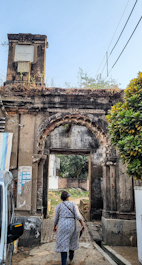
ALL THAT REMAINS OF A MAHARAJAH’S PALACE … IS ONLY A FEW ARCHES.

Not marked on Google maps, but mentioned in a guidebook to Murshidabad (in West Bengal), this remnant of a palace is extremely difficult to find. Our toh-toh (electric autorickshaw) driver asked many locals for directions. To my surprise, all knew about the small remains of a former palace, once a home of Maharaja Nanda Kumar (1705-1775), a tax collector for the British East India Company [see: https://en.m.wikipedia.org/wiki/Maharaja_Nandakumar ], who fell foul of the Company’s law. The guidebook did not mention this or the fact that he, a friend of Warren Hastings, was hanged by the Company for alleged fraud.