TODAY, I MADE MY second visit to the Anselm Kiefer exhibition, which is on at the Bermondsey White Cube gallery until the 20th of August 2023. I was pleased to visit it again because after my first visit, I left it feeling oppressed and somewhat depressed. This might be what the artist (born at the end of WW2 in Germany) intended when he created the extraordinary series of scenes of dereliction and decay on show in Bermondsey. My second visit (on the 15th of August 2023) left me with a slightly more favourable impression, but my opinion that the artist has depicted an image of a world of confusion, conflict, and decay, remains unchanged.
The works, which are distributed in several rooms and the central corridor of the gallery, are, so I read in an information sheet, Kiefer’s reactions to, and representation of, a novel by James Joyce – “Finnegan’s Wake”. The artist has written short quotations from the book on many of the items that together make up the amazing art installations. As I have not read the book, I cannot comment on the appropriateness of what he has created.
In one room of the gallery, there are mainly huge paintings, which I found attractive. On close examination, one can see that the paint has been applied to that it is far from flat. The three-dimensional surfaces create interesting illusions, which change according to from where you view the pictures.
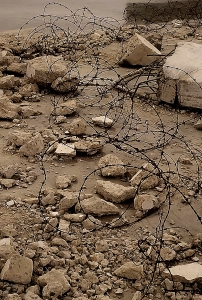
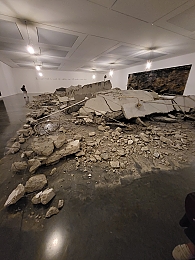
Another room has a huge pile of sand littered with discarded, corroded supermarket trolleys – an impressive but sad sight. In yet another room, most of the floor is covered with barbed wire and huge pieces of concrete – the ruins of a large building. As a friend of ours said, it looked as if it had been imported straight from a bombsite in Ukraine.
Would I recommend visiting this exhibition? It is certainly inappropriate for people who suffer from claustrophobia or depression. However, if you are of an adventurous frame of mind, do head for this show before it ends.
THE ARTIST ANSELM Kiefer was born in Germany a few weeks before the end of WW2 in Europe. He was brought up in a country devastated by warfare and with a shameful recent past. It is said quite reasonably that much of his artistic output has been influenced by the guilt-ridden environment in which he grew up.
Today, the 21st of June 2023, we visited the White Cube Gallery on Bermondsey High Street in south London. Until the 20th of August 2023, it is hosting a spectacular show of works created by Kiefer. To call it an exhibition is a bit of a misnomer – it is really an ‘immersive experience’. It occupies the gallery’s entire exhibition space as well as the long central corridor that links the various large display rooms.
The long central corridor is lined with a large variety of ‘objets trouvés’, which some might well describe as ‘junk’. Together, they form a large-scale cabinet of curiosities like those which wealthy people used to create in the past, but few of the objects would have appealed to such collectors. Three large rooms can be entered from the corridor. The walls of each of these are lined with what at first sight look like enormous paintings. They are made of metal, often quite three-dimensional, and coloured with paint. Each one is both visually exciting and satisfying. In the middle of each room, there is an installation that suggests that it has formed after some apocalyptic event – maybe, an atomic bomb explosion or some similarly catastrophic event. In one room, the centre is filled with a pile of sand in which discarded supermarket trolleys have been abandoned. Another room is filled with what look like huge books damaged by flood waters. In the third and largest room, there are the concrete and rusted iron remains of what might once have been a modern building – it is a scene of horrendous devastation.
Throughout the ‘exhibition’, there are handwritten words, phrases, and sentences. These can be found on the walls, on the painting-like panels, and near objects stored in the corridor. A gallery attendant told us that each of them had been handwritten by Kiefer when he came to inspect the installation of his show. The words were not his but are all taken from “Finnegan’s Wake”, published in 1939 and written by James Joyce (1882-1941). Hence, the exhibition at the White Cube has been given the name of this novel.
Superb as this exhibition surely is, I found it oddly claustrophobic. Although it is a visual feast and a great feat of imagination and creativity, I found it slightly disturbing – that might have been the artist’s intention. But please do not let me put you off visiting this unusual and wonderful show.
YESTERDAY, WE ADMIRED paintings created by the Great Masters of European art, which hang on the walls of the rooms of 18th century Kenwood House in north London. Today, the 12th of April 2023, we enjoyed artworks of a completely different nature within the almost spartan spaces of the White Cube Gallery in Bermondsey Street. Currently, three artists’ works are on display. Three areas in the gallery are dedicated to one of them – Marguerite Humeau. She was born in 1986 in France, and received her MA from the Royal College of Art in London – the city in which she now lives and works.
Humeau creates works in a wide variety of materials. She also makes video art, one example of which was on show in the smallest of the three spaces. A larger room contained panels made with one or more ceramic tiles. The glazed surfaces of these tiles are not flat but contain hand-sculpted three-dimensional features including textural variations and curvy striations, which protrude from the flattish background surface.
The largest room of the show must be seen to believed. Entering is like setting foot on an alien planet inhabited by weird organic shapes that suggested to me plants, fungi, and insects, but all of them greatly magnified. These shapes are sculptures created by Humeau. Some of them were emitting musical sounds. I found the sculptures both intriguing because of their allusions to biological structures and also quite satisfying visually. As to what led to their creation, the gallery’s website (https://whitecube.com/artists/artist/Marguerite_Humeau) explained: “The artist was inspired by eusocial insects such as ants, termites and bees, whose complex cooperative societies enable them to build huge structures and to cultivate other organisms in symbiotic relationships. Reflecting on the ants shepherding their aphids and the termites tending their fungus gardens, Humeau found an equivalent in the place yeast has assumed in human societies, as the essential ingredient of bread and beer around which our human collective has gathered. Contemplating the probability of our imminent, self-inflicted extinction as a species, Humeau sees insect societies as both the inheritors of our ravaged environment, and a prompt to consider how interdependence and cooperation might offer a means to avert our fate.” Fair enough; but even if the works are portents of a gloomy future, my spirits were uplifted by seeing them. The exhibition continues until the 14th of May 2023. If you plan to visit it, save a bit of time for the interesting and attractive, abstract paintings and sculptures by Samuel Ross (born 1991 in London), which are on show in another of the gallery’s spaces.
The thing that amazes me is that even though the paintings by the Great Masters, who painted many centuries ago and which we saw 24 hours ago at Kenwood are immensely satisfying visually, seeing the artworks by Marguerite Humeau today was an equally enjoyable experience. I wonder what it is that happens in the brain to produce the same amount of enjoyment from seeing such widely differing artistic creations.
THE WHITE CUBE Gallery in London’s Bermondsey Street is overshadowed by the recently constructed (2013) glass-clad skyscraper, popularly known as ‘The Shard’. The gallery, a single-storeyed structure, contains a long wide corridor flanked by three vast exhibition spaces and a smaller bookshop. The exhibition spaces are deliberately sparsely decorated so as not to distract viewers from the usually wonderful contemporary artwork on display. At the end of the corridor, there is an auditorium in which videos relating to the existing temporary exhibition are screened. The current exhibition, which fascinated me and closes on the 7th of November 2021, is dedicated to displaying works by Ibrahim Mahama.
Mahama was born in Tamale, Ghana in 1987. He lives and works in the country of his birth but has exhibited widely in Africa and Europe. Not only are the works, which we saw at White Cube, exciting and intriguing visually but they also provide an interesting insight into the artist’s perception of modern Ghana and its past, when it was known as The Gold Coast.
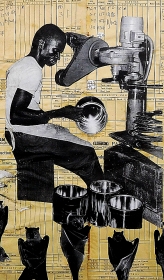
Many of the works on display are gigantic collages, which from afar look like interesting abstracts or even modern tapestries. Closer examination of these reveals that the artist has glued fragments of photographs onto a background of usually either old maps of his country and/or a latticework consisting of numerous production order dockets issued by The Ghana Industrial Holding Company. Photographs of fruit bats in various poses often run around the fringes of the collages or appear within their main body. Photographs of aspects of life in Ghana are glued onto the backgrounds. Often, they have been trimmed so that the backgrounds intrude, and the photographs appear to merge or mingle with them. I felt that this was particularly effective when the map backgrounds mingled with the trimmed photographs, making me think that the maps were being brought to life. Also, they give the impression of modern Ghana emerging from the out-of-date maps. I was also impressed by one collage showing images of flying bats glued onto a sea of old order dockets: wildlife contrasting with man’s industrial enterprise.
One half of the largest display space is dedicated to a fantastic art installation. About 100 old-fashioned wooden school desks are arranged in rows facing a line of black boards to create the illusion of an enormous classroom. On each desk, there is an old-fashioned electric sewing machine. Every few minutes some of the sewing machines begin operating, creating a wonderful, loud noise, which varies as different groups of machines are activated and then silenced. Sewing machines, so the leaflet issued by the gallery inform us, were often used in Ghana by labourers wanting to learn a new trade. This exhibit aims, amongst other things, to resurrect the ghosts that Mahama feels reside within these discarded machines.
In the auditorium, a short video projected onto two neighbouring screens continues the artist’s interest in sewing machines. On one of the screens, the video shows in close-up the innards of sewing machines being cleaned and oiled. Simultaneously, the video on the neighbouring screen shows workmen doing messy maintenance work through a manhole cover and beneath the ground. The circular manhole cover is mirrored in the other video by the small circular orifice through which the innards of the sewing machine are maintained. Odd subjects, but well filmed and fascinating visually.
I am neither an art critic nor a sociologist, nor whatever it takes to ponder the deeper meaning and messages that the artist is trying to convey, but I enjoyed the exhibition greatly without having to worry about its deeper intellectual content. Visually, everything on display was exciting and often quite novel: a feast for the eyes and ears. If you can get to see this show, I am sure that you will not leave it unaffected by its impact. And, after feasting your ears and eyes at the gallery, I recommend a short walk down Bermondsey Street to treat your taste buds and olfactory sense to Vietnamese food, magnificently prepared, at Caphe House.


 yamey
yamey 