
Wonderful India (as it was) in English, Bengali, and Urdu

IN A SECONDHAND BOOKSHOP in Thame (Oxfordshire) I purchased a book called “Wonderful India”. It must have been published by 1943 because inside its front cover there is the name of its first owner, LW Morris, and next to that he added “Royal Air Force, Calcutta, July 1943”. The book is trilingual. Its text is written in Bengali (Bangla), English, and Urdu. It was published by The Statesman and Times of India Book Department. The Statesman is a newspaper that was founded in 1818, and published simultaneously in Calcutta, New Delhi, Siliguri and Bhubaneswar. The Times of India was founded 20 years later. The gloriously illustrated book, which covers pre-Partition India, as well as Sri Lanka, Burma, and Nepal, contains no text in Hindi. In British India, the official languages were English and Standard Urdu, and later Standard Hindi (https://en.wikipedia.org/wiki/Languages_with_legal_status_in_India#History). Oddly, for many years Bengalis were opposed to using their language as an officially recognised one, for a long time preferring to use Persian for formal (especially commercial) use (https://thespace.ink/bengali-and-persian-in-british-raj/). Yet despite this, the book I found favours Bengali and omits Hindi. I suspect that  because the book might well have been published in Bengal, the Bengali script has been included. Hindi written in the Devanagari script only became the official language of India in September 1949, several years after “Wonderful India” was published.

Dhaka (now in Bangladesh)

The book covers all the regions of pre-Independence India as well as some of its neighbours. It is rich in black and white photographs, many of which are superb examples of photographic technique. Each picture is captioned in Bengali, English, and Urdu. The only pieces of prose are the general introduction (which includes a photograph of Mahatma Gandhi) and introductory paragraphs at the beginning of each section. The Urdu introduction is at the rear of the book, and is next to a picture of Jawaharlal Nehru. There is no picture of any member of the British Indian hierarchy.  

Bangalore, a place which I have visited often, is given only one sentence at the beginning of the section on Mysore and Coorg:

“The British retain some territory at Bangalore, which is the administrative headquarters of the state, while Mysore is the capital.”

There are three photographs of the city, Sadly, not the most interesting in the book.  To compensate for this, the book is filled with pictures of touristic sights and daily life of India as it was before WW2 had ended. The book provides a fascinating window on a part of the world that has in many aspects changed beyond recognition.
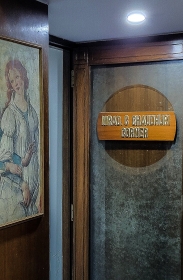
RELICS OF A GREAT INDIAN WRITER AT A LIBRARY IN CALCUTTA

THE CALCUTTA CLUB (in Kolkata) was founded in 1907. Unlike other ‘elite’ clubs in existence at that time, it admitted members regardless of their ethnic background. The Club has a library consisting of several rooms arranged in a line, each one connecting to the next. At the far end of the library, there is a locked door bearing the label:

“Nirad C Chaudhuri Corner”.

Nirad Chaudhuri was one of 20th century India’s great writers. Born in 1897 at Kishoreganj – a place that is now in Bangladesh, but was then in British East Bengal – he died in Oxford (UK), having passed his 101st birthday. He was an original thinker whose views have not been shared by everyone. He wrote about India and its history in an incisive way that was not fettered by the conventional ideas of his contemporaries. In the 1970s, he shifted from India to England, and settled in Oxford. A few years ago, we met and were befriended by his son Prithvi – now a physically and intellectually active octogenarian. When we are staying at the Tollygunge Club (in south Kolkata), we often meet him after breakfast to chat and enjoy cups of coffee.

During one of our morning meetings, he told us how his father’s books and other possessions were shipped to India after his demise. He mentioned that some of these things are now stored in a room at the library of the Calcutta Club in what has been called the ‘Nirad Chaudhuri Corner’. As we expressed interest in seeing this, he said that he would ring the relevant Calcutta Club committee member to arrange for us to view his father’s collection. Although the Club feel they were given the items, Prithvi said that he had simply lent them. The matter is currently being contested in court. He told us that although there is much to see at the Calcutta Club, some of his father’s collection – notably his collection of books written in French – have been stored elsewhere.

The following day, we visited the Club’s library, where a librarian showed us to, and then unlocked, the Nirad Chaudhuri Corner. Apart from books that belonged to Nirad, there are paintings and other objects. One of these is the Royal Proclamation that was written when he was awarded the honour of the Commander of the British Empire (‘CBE’) in 1992. There are also several objets d’art including decorative ceramics (plates and cups), an ancient Egyptian sculpture, some wine glasses, a bottle of vintage port, a set of the first UK metric currency coins to have been issued, and many other things. The paintings include a well-executed hand-painted copy of a picture by Monet – a famous French impressionist. Prithvi told us that when his father bought the painting, he paid a great deal of money for it. Some of the family disapproved, but as Prithvi rightly said, it was his own money.

After examining the Corner, we walked back through the library. On the way, I spotted a small, framed manuscript. It was labelled “Original Signature of Mr Satyajit Ray Membership No. R211”. For those who do not know, Satyajit Ray (1921-1992), born in Bengal, was one of India’s most famous film directors.

Thanks to Prithvi, we were able to see a fascinating collection of possessions once owned by a great Indian writer. Almost hidden in the Calcutta Club’s library, I doubt that many of its members have seen it or are even aware of its existence.

Enjoying forbidden food in Calcutta after waiting many years

JHAL MURI IS a Bengali ‘street food’. Mixture of puffed rice, mustard oil, and other things including: chilli, coconut, channa, peanuts, lemon juice, coriander, onion, tomato, sev, chutneys, … and more! You choose your mix.

Making jhal muri

Usually made in the street, it may pose a risk to weak stomachs. My wife’s mother, a medical doctor, forbade her daughter from eating this when it was sold by street vendors. It was sold just outside Loreto House School, where my wife was a pupil. She felt hard done by when she saw her schoolfriends eating this ‘forbidden’ snack.

Today, having yearned for it for many years, she sampled jhal muri at the Tollygunge Club. Sadly, it did not meet her great expectations.