I HAVE SEEN PHOTOGRAPHS of baobab trees, but until we visited the café of the formerly named Prince of Wales Museum in Bombay, I had never seen one ‘in the flesh’. A member of the mallow family of plants, baobabs are native to Madagascar.
Baobab tree in Bombay
These trees with curious looking conical trunks were imported to India by Arab traders. Although this is the case, this baobab in Bombay is the first such tree I have seen during my 30 years of frequent visits to India.
As we sat with our cold drinks, I looked up at the high branches of the baobab, and saw something flapping about. At first, I thought it was a black plastic bag caught in the branches. Then I noticed that it was a large bat stretching its wings. I saw it was not alone, but one of a large number of bats hanging on the high branches. These large creatures had black wings and dark brown bodies.
Despite the fact we had just seen a wonderful exhibition of ancient sculptures (from India, Ancient Rome and Greece, and Assyria), finding the baobab and seeing the bats in it, made my day.
THE WHITE CUBE Gallery in London’s Bermondsey Street is overshadowed by the recently constructed (2013) glass-clad skyscraper, popularly known as ‘The Shard’. The gallery, a single-storeyed structure, contains a long wide corridor flanked by three vast exhibition spaces and a smaller bookshop. The exhibition spaces are deliberately sparsely decorated so as not to distract viewers from the usually wonderful contemporary artwork on display. At the end of the corridor, there is an auditorium in which videos relating to the existing temporary exhibition are screened. The current exhibition, which fascinated me and closes on the 7th of November 2021, is dedicated to displaying works by Ibrahim Mahama.
Mahama was born in Tamale, Ghana in 1987. He lives and works in the country of his birth but has exhibited widely in Africa and Europe. Not only are the works, which we saw at White Cube, exciting and intriguing visually but they also provide an interesting insight into the artist’s perception of modern Ghana and its past, when it was known as The Gold Coast.
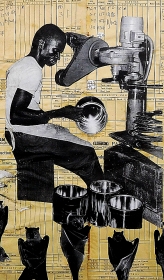
Many of the works on display are gigantic collages, which from afar look like interesting abstracts or even modern tapestries. Closer examination of these reveals that the artist has glued fragments of photographs onto a background of usually either old maps of his country and/or a latticework consisting of numerous production order dockets issued by The Ghana Industrial Holding Company. Photographs of fruit bats in various poses often run around the fringes of the collages or appear within their main body. Photographs of aspects of life in Ghana are glued onto the backgrounds. Often, they have been trimmed so that the backgrounds intrude, and the photographs appear to merge or mingle with them. I felt that this was particularly effective when the map backgrounds mingled with the trimmed photographs, making me think that the maps were being brought to life. Also, they give the impression of modern Ghana emerging from the out-of-date maps. I was also impressed by one collage showing images of flying bats glued onto a sea of old order dockets: wildlife contrasting with man’s industrial enterprise.
One half of the largest display space is dedicated to a fantastic art installation. About 100 old-fashioned wooden school desks are arranged in rows facing a line of black boards to create the illusion of an enormous classroom. On each desk, there is an old-fashioned electric sewing machine. Every few minutes some of the sewing machines begin operating, creating a wonderful, loud noise, which varies as different groups of machines are activated and then silenced. Sewing machines, so the leaflet issued by the gallery inform us, were often used in Ghana by labourers wanting to learn a new trade. This exhibit aims, amongst other things, to resurrect the ghosts that Mahama feels reside within these discarded machines.
In the auditorium, a short video projected onto two neighbouring screens continues the artist’s interest in sewing machines. On one of the screens, the video shows in close-up the innards of sewing machines being cleaned and oiled. Simultaneously, the video on the neighbouring screen shows workmen doing messy maintenance work through a manhole cover and beneath the ground. The circular manhole cover is mirrored in the other video by the small circular orifice through which the innards of the sewing machine are maintained. Odd subjects, but well filmed and fascinating visually.
I am neither an art critic nor a sociologist, nor whatever it takes to ponder the deeper meaning and messages that the artist is trying to convey, but I enjoyed the exhibition greatly without having to worry about its deeper intellectual content. Visually, everything on display was exciting and often quite novel: a feast for the eyes and ears. If you can get to see this show, I am sure that you will not leave it unaffected by its impact. And, after feasting your ears and eyes at the gallery, I recommend a short walk down Bermondsey Street to treat your taste buds and olfactory sense to Vietnamese food, magnificently prepared, at Caphe House.


 yamey
yamey 