
Shifting Identities: movement of crafts across national boundaries in the Indian subcontinent

THERE HAVE BEEN events that have caused people to flee from one part of the Indian subcontinent to another, traversing national boundaries.  The best known of these events was the Partition of India in 1947. Another event was the Bangladesh War of 1971, which resulted in Bangladesh (formerly East Pakistan) becoming independent, no longer united with West Pakistan.


Until I visited an exhibition,  “Shifting Identities”, at Arthshila, an art institution in Ahmedabad, I was unaware of India’s temporary occupation of a part of West Pakistan in 1971. In order to deflect some of West Pakistan’s army from their activities in East Pakistan, India staged an attack on Sindh, a province in West Pakistan.  As a result of this, India temporarily annexed a part of Sindh close to Kacchch (Kutch). This annexation was reversed by treaty in 1972. However, this resulted in a flow of refugees from Pakistan  into border areas of Gujarat and Rajasthan.  Likewise, during the liberation struggle in what was East Pakistan, refugees flowed from what was to become Bangladesh into Indian West Bengal.


Amongst the migrants who sought refuge in India, there were many who were skilled in traditional crafts,  notably textile manufacturing. 


The splendid exhibition at Arthshila contains beautiful examples of textiles made by refugees both from Sindh and the former East Pakistan.  The exhibition also includes documents and photograph albums that belonged to these people who felt it necessary to flee their former homes. The photographs in the albums were those sent to the migrants by family and friends they had left behind.


The show at Arthshila is both attractive and very moving. The exhibits are well labelled with much information. It showcases the skills that were the only riches that the refugees were able to carry with them when forces beyond their control made them feel it was necessary to leave the land that had been their home for innumerable generations.
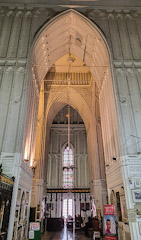
St Paul’s Cathedral without a dome

IN FEBRUARY 1961, Queen Elizabeth II and Prince Philip paid a visit to Kolkata (Calcutta). People lined the streets along which they drove. Every now and then their car stopped and the Queen shook hands with people in the crowds. A little girl stepped forward to shake Her Majesty’s hand. Thirty-three years later that little girl became my wife.

Apart from shaking hands with the future Mrs Yamey, the Queen visited Kolkata’s Anglican St Paul’s Cathedral. Unlike is namesake in London, it does not have a dome. It was built to replace the older St John’s Cathedral. St Paul’s foundation stone was laid in 1839 and the gothic revival edifice was completed by 1847. It was designed by Major General William Nairn Forbes og the Bengal Engineers. Since its completion, various disasters have necessitated repairs, but the edifice looks to be in good condition.

The Cathedral is full of interesting features, a few of which I will now mention. The stained glass window at the western end of the church was designed by the Pre-Raphaelite artist Burne-Jones. The mosaic panels that can be found on the east wall were the creations of Arthur Blomfield, who was involved in the design of many Victorisn churches in London. The walls of the nave have the crests of the Dioceses of the former Anglican Province of The Church of India. Prior to 1947, St Paul’s was the Mother Church of what are now India, Pakistan, Bangladesh, Burma, and Sri Lanka.

I noticed that the pews in the nave are divided into male a female sections, separated by the central corridor. A Church worker explained that the sexes are no longer separated during services and that the signs marking where men and women should sit have been left as historical curiosities.

The TocH Chapel was dedicated on Armistice Day 1927. It contains the impressive sculpted funerary memorial to Sir Charles Allen, Chairman of the Calcutta Corporation. It also contains the helmet of an Indian soldier who died while fighting in the 1971 Bangladesh War. Next to this is a crucifix made from charred timber from a war damaged house in Bangladesh. These monuments to those who fell in Bangladesh are remarkably moving.

I have mentioned a few things that interested me in St Paul’s. In addition to these, there are plenty of memorials to Britishers, who came to India for one reason or another, and died there. One example of these is George Ham from Bristol, who drowned in the River Hooghly in 1866, aged 33.

Photographs of Queen Elizabeth II’s visit to the cathedral are on display within it. When my wife saw these today, the 18th of January 2023, she remembered shaking the hand of royalty back in 1961, and told me about it.