
LEGEND HAS IT that when Rama was searching for Sita, who had been kidnapped, he stopped at a spot in what is now Walkeshwar in Bombay. Thirsty, Rama asked his brother, Lakshmana, to get hom water. Thereupon, Lakshmana shot an arrow (‘baan’) into the ground, and where it landed, a stream began to flow. Although1000 miles away from the Ganges, it was considered to be a tributary of the holy river. This stream has been named the Bānganga, and its water is stored in a large rectangular stepped tank.
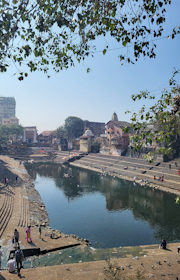
The tank, the Bānganga Tank, was constructed in 1127 AD by by Lakshman Prabhu, a minister in the court of Silhara kings of Thane. It was restored in 1715. The area in which the tank is located, Bānganga, is Bombay’s oldest inhabited district.
We have visited Bāngang often and it is always a treat. Located close to the Arabian Sea, the area around the tank is a complete contrast to the rest of Bombay. The tank is surrounded by small houses and, being a sacred spot, plenty of Hindu temples. The place is more like a quaint village than part of one of the world’s biggest cities.
Between the tank and the rocky sea shore, there is a large colony of ramshackle structures mostly made with sheets of corrugated iron. The inhabitants of this slum have an enviable view of the sea. One day, I suppose, some developer will clear away these poor people’s dwellings, and replace them with swanky apartments or hotels. But developers should be wary because, so we were told, during the monsoon seasons, large areas of the slopes between the tank and the sea become inundated.
We made our most recent visit to Bāngang on the first day of 2026, and found it to be as delightful as ever. However, we noticed that in addition to the pigeons and abundant waterfowl in the tank and on its steps, there was no lack of rubbish.
Since our last visit to Bānganga about two years ago, the RPG Foundation has put up signs that identify various temples and provide some history of each place. Despite these, there seemed ti be few tourists around the tank.

 yamey
yamey 