LADY GODIVA WHO died sometime in the second half of the 11th century (AD), has often been depicted by artists as riding nude through the city of Coventry. She was an Anglo-Saxon aristocrat, who was married to Leofric Earl of Mercia.
According to legend, she made her famous horse ride through Coventry to protest against excessive taxation that her husband had imposed on the people.
Most artists have portrayed her as being totally nude, thus producing images or sculptures with some pornographic content.
The Herbert Art Gallery in Coventry has a small gallery dedicated to Godiva. Most of the artworks on display show her without any clothing. However, one painting shows her on her horse but wearing plain, unrevealing simple garments. This is most likely how Lady Godiva was dressed on her ride. The reason is that penitents used to wear unadorned undergarments when processing in public. It is most likely that Godiva, who would have normally worn fancy clothing and jewellery, rode through the city devoid of these trappings of wealth and position – this would have been described as ‘naked’.
Our short visit to the Godiva exhibit was most interesting because it opened our eyes to another interpretation of Lady Godiva and her protest.
IN THE YEAR 991 AD, the Anglo-Saxons fought a battle with Viking invaders in Maldon (Essex). The Vikings, who often raided for looting and plundering rather than conquest, won. Rather than continue to struggle with the Vikings, the Anglo-Saxon king Æthelred the Unready was advised by the Archbishop of Canterbury to pay them off. He paid the Vikings an enormous sum of money, which satisfied them.
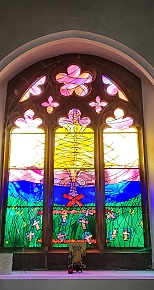
Recently, we visited the church of St Mary the Virgin in Maldon. It stands on a small hill that overlooks the mudflats and rivulets of the Chelmer River where the battle was fought. In its north wall there is a striking, colourful modern stained-glass window. Designed by Mark Angus, it was installed in 1991to commemorate the 1000th anniversary of the Battle of Maldon. It is a great addition to an otherwise unremarkable church.
MALDON IN ESSEX is best known for the sea salt, prized by cooks and gourmets, which is produced nearby. The town perches on a hill overlooking a marshy inlet of the River Blackwater and the River Chelmer, after which Chelmsford is named, flows through a lower section of the place. We have visited Maldon several times over the last 18 months and always walked along part of its promenade that provides attractive views over the marshes and streams watered by the Chelmer and the Blackwater. However, it was only during our most recent visit (August 2021) that we walked the entire length of the promenade to its end point, which is out of sight of the town. The promenade ends abruptly, a bit like the end of a pier. There at the furthest extremity of the walkway, there is a tall statue. It depicts a man in a helmet, brandishing a sword in his right hand, holding a circular shield in his left, and looking out to sea.
The statue overlooking the sea is a sculpture of Byrhtnoth, Ealdorman of Essex, an Anglo-Saxon aristocrat or high official, who lived during the reign of Ethelred the Unready (c996-1016). Byrthnoth died during the Battle of Maldon on the 11th of August 991. The battle was fought by the Anglo-Saxons against an army of Viking invaders. It is said that before the battle, the Vikings offered to sail away if they were paid with gold and silver. Byrhthnoth was recorded as replying that he would only pay the attackers with the tips of his men’s spears and the blades of their swords.
After the battle, the then reigning Archbishop of Canterbury, Sigeric the Serious, advised Ethelred to pay off the Vikings instead of continuing the fight against them. According to an article on Wikipedia, this payment of 3,300 kilogrammes of silver was the first example of the so-called Danegeld in England. This was a ‘tax’ paid to the Vikings in exchange for them desisting from ravishing the territory which paid it.
So, the statue depicts a participant in a defeat of the English (Anglo-Saxons), and much loss of life amongst the Viking invaders. It was created by John Doubleday (born 1947) and unveiled in 2006. Byrhtnoth stands on a tall cylindrical base decorated with bas-relief depictions of scenes of life in the 10th century and moments during the Battle of Maldon. A plaque embedded into the promenade’s pavement near the statue gives more background to the historical event. It reads:
“Byrthnoth, represented by the figure standing on this monument, was the principal voice in rejecting the policy of appeasement which dominated the court of King Ethelred in the closing years of the 10th century. The leading military figure of his time; he was probably aged 68 when he confronted the Vikings at the battle of Maldon. He surrendered his life in defence of the people, religion and way of life represented in the lower relief panel of the column. Above it you will see aspects of the battle in which he died. Around the base is a quotation from his final prayer as recorded in the surviving fragment of the poem ‘The Battle of Maldon.’”
The poem, mentioned above, was written in Old English. However, much of it has now been lost.
Apart from the statue, Maldon has much to offer the visitor. Along the quayside, there are several old Thames Barges with their maroon/brown sails and a lovely pub, The Queen’s Head Inn. Church Street climbs from the riverside to the High Street which is lined by several old houses; a disused church, now a museum; an attractive parish church; and plenty of decent places to eat and drink. Within easy reach of London, this is a delightful place for a day out or as a base for exploring rural Essex.



 yamey
yamey 