
Standing on a bench in Funchal, Madeira

ON THE FLIGHT FROM Stansted to Funchal, I sat next to a young man who was born in Madeira and now lives in the UK. He told me that we were just in time for the grand parade of the island’s annual flower festival. It would be happening on the afternoon of Sunday, the 30th of April (2023) at 430 pm, and that it always attracts large crowds.

At about 2.50 pm on the Sunday, we found an empty bench on the Avenida do Mar. This is a wide dual-carriageway that runs close to the seafront. Our bench was beside one of the carriageways. The parade was due to proceed along the other carriageway. By as early as 3 pm, people were gathering on the grassy divider that separates the two carriageways. They were between us and the route to be taken by the parade. More and more people assembled there, and we wondered how we would be able to see the proceedings.

At about 3.30, an elderly English couple joined us on the bench. We did not speak with them until a few minutes before 4.30. Then, the rather frail looking old lady said to us:
“We’re going to stand on the bench to watch the floats pass by.”
I had thought about doing this but had been concerned about the stability of both the bench and me. But when this older lady and her even older husband climbed on the bench we joined them.

The colourful floats covered with floral decorations and lively girls and ladies moved a little faster than snail’s pace. They were separated by crowds of girls in folk costumes, who were singing and dancing as they proceeded. From our vantage point, we could see the floats easily, but the dancing girls were mostly hidden by the crowds on the grassy divider; only their headdresses could be seen.

After three floats had passed, the lady hopped off the bench, and said to me:
“We’ve got to go now. We don’t want to miss our team, Liverpool, playing.”

All this goes to show that one should never judge people by how old they look. Even some the oldest members of our species can be surprisingly full of life.
Riding the bus without paying


There are some advantages to growing older. When our daughter turned 18 and was no longer eligible for reduced price tickets, we reached an age above which our cinema tickets were subject to discount. Our daughter was not amused.


freedom


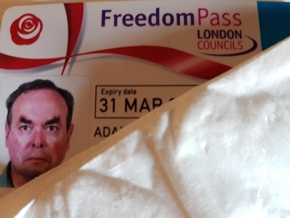
If you are a London resident, you are eligible to receive a Freedom Pass after you pass a certain age over 60 years. This pass allows the holder to travel free of charge on London’s buses, trams, Underground trains, and national railway lines within certain limits. A London Freedom Pass holder can also use most local bus services anywhere within England (but not in Scotland). So, if you have the time and patience, it is possible to travel long distances in England free of charge by using a Freedom pass on local bus services.

‘K’, an old friend of mine, enjoyed exploring England with her Freedom Pass. On one of her earliest explorations, she set off from London to somewhere deep in the heart of Kent. She reached her destination eventually, having used a series of local buses without having to pay. The return journey was less successful.

K began her homeward trip and arrived at Tunbridge Wells at about five pm. When she made enquiries about local buses heading towards London, she received a diappointing answer. The last bus of the day that would taken her in her desired direction had already departed. The next would run on the following day. So, K was forced to return to London by train. Instead of paying nothing, she had to spend money on a costly one-way railway ticket. Her anticipated day of free travel ended up quite expensive. Since then, she has been more careful with her trip planning and not had a repeat of her unexpected travel expenses.

We make great use of the Freedom Pass when we are out of London. One of the best ‘bargains’ we have so far encountered was at Exeter in Devon. We parked our hired car at an Exeter ‘Park and Ride’ and boarded the bus which was to take us into the city. We were fully expecting to have to pay for a day’s parking and also the bus ride. When we showed our passes to the bus driver, he told us that there was nothing to pay.

Never judge a book by its cover: a dental tale

During my last few years in dental practice, I entered my seventh decade of life; I passed the age of sixty. In a way it was creepy: I had become older than my mother was when she passed away, having suffered painfully during the last few months of her life.

DENTURE

[from Wikipedia]

As a dentist, I knew the age of all my patients. Their dates of birth were recorded on their record cards. I used to look at people of my age, and either think that I was looking good compared to them, or that they were doing better than me. Generally, everyone looked young in my eyes, even those who were my senior. Those, who were younger than me usually, but not always, looked young. Interestingly, those, whom I knew to be much older than me did not look as old to me as I might have thought when I was younger. For example, patients in their seventies and eighties would have seemed ‘ancient’ to me when I was in my thirties and forties, but having reached my sixties, they no longer looked so old from my vantage point.

When I was in a dental practice in Kent during my thirties, I worked with a young girl, ‘T’, a first-class dental surgery assistant. She must have been in her late teens or very early twenties at the time. In that practice, we received the record cards of new patients before they entered the surgery. One day, T handed me the record card for a new patient, ‘Mrs M’. As she did so, she said:

“Look, she’s eighty-nine. What can she possibly want at her age? Surely not new teeth – she won’t be wearing them for long.”

Mrs M strode into the surgery and looked around.

“What lovely linoleum flooring,” she said, “where can I get some of that? It would suit my new kitchen.”

“I’ll find out for you. Please sit down. Make yourself comfy,” I said, “how did you get here?”

“I took a taxi, dear, but now that I know where you are, I’ll drive myself next time.”

I carried out the preliminary dental examination, and agreed a treatment plan with Mrs M.

“It will take four or five visits to make your dentures,” I explained.

“That’s alright, dear, I’ll fit them in around my work.”

“What is that you do?” I enquired.

“I do the accounts for my son’s business, dear. Keeps me occupied,” she said, getting up to leave.

When the patient had left the room, I looked at T and said:

“Never judge a book by its cover, or a patient by her age.”