Wonderful Roman mosaics preserved near the Humber river

KINGSTON UPON HULL (‘Hull’) did not exist as a significant settlement until several centuries after the Romans left Britain. However, the Romans built a road that ran north through Brough, which is west of Hull, to Malton (northwest of Hull), and beyond towards York. Along this road, at Horkstow and Brantingham, and at Rudston and Harpham, along a side road northeast of Hull, remains of buildings constructed by the Romans have been found and excavated by archaeologists. At each of these sites, large areas of Roman mosaics have been found.

The mosaics have been carefully moved to Hull and can be seen at the city’s Hull and East Riding Museum. There, they have been beautifully displayed. I do not think I have ever seen such a large collection of Roman mosaics as can be found in the museum. It is worth visiting Hull to view this remarkable set of mosaics. Although, in my view, the mosaics alone make the museum unmissable, there is much more to be seen in this superbly curated place.

Visitors to the museum, which specialises in archaeology, follow a route that leads from exhibits relating to prehistory to just after the English Civil War.  Each room or area along the way is designed to ignite interest in archaeology in the minds of everyone, from small children to adults. Every exhibit is labelled in language that is easy to understand, yet does not ‘dumb down’. Even if you enter the museum with little interest in archaeology and early history, you are bound to leave having become interested in these subjects.

Apart from the Roman mosaics, the museum contains several timber boats, the Ferriby vessels, that were built on the bank of the Humber in the Bronze Age. One of these is preserved in a special tank called the Boatlab, which contains equipment to preserve the ancient timber. It is believed the Ferriby boats are the earliest known form of seacraft made in Europe.

I have highlighted two aspects of this museum in Hull. They are the ‘icing on the cake’, but the rest of the cake is richly interesting. Many people disdain the idea of visiting Hull, but they are mistaken. The museum with its Roman mosaics is just one of many of the city’s relatively unknown but worthwhile attractions.

A wise choice of a pub in Hull

ESTABLISHED IN 1829, the Minerva is a pub next to the Humber River and close to the recently developed Hull Marina. It has a genial atmosphere,  friendly staff, good unpretentious food,  and a fine range of alcoholic beverages. 

The place consists of several interconnecting rooms where one can eat and drink. One of these rooms is tiny. It can accommodate 4 adults at a squeeze and is, apparently,  the smallest pub room in England.

We ate at the Minerva 4 evenings in a row, and were never disappointed.  The fish and chips served at this pub were second to none. If you happen to be in Hull, it would be wise to visit the sign of the owl at the Minerva pub to have a good time.

Pierced by a bullet while praying in the pews

BEVERLEY IN YORKSHIRE is best known for its cathedral-like Minster. Our friend Colin recommended that while in Beverley, we should not miss visiting the church of St Mary. We went there and enjoyed exploring this magnificent medieval gothic parish church. We were shown around by a volunteer who pointed out something we had never seen in any other church.


The bullet hole

In WW2,  during an air attack on Beverley, a German aeroplane strafed the town. One of the bullets from the ‘plane made a hole in a stained glass window on the south side of the church, and went straight through one of the worshippers, killing him. The volunteer showed us the hole in the wooden pew made by the bullet after it had passed through the unfortunate parishioner. The wooden pew behind the one with a hole has a hollowed out spot caused by the bullet after it had penetrated the pew in which the victim had been seated.


Years later, the volunteer related, a woman from Australia visited St Mary’s,  and when she saw the damage caused by the bullet, she burst into tears.  The man who had been killed while praying had been her grandfather.

An accountant crossing a river without a bridge or a boat

THE HUMBER BRIDGE was constructed between 1973 and 1981. Sometime during that period, my wife was a trainee accountant. One of the assignments that she was sent on was to audit the Humber Bridge construction. She arrived at the site after the completion of the two towers from which the bridge was to be suspended, but long before the span traversing the water had begun to be built. The two towers were then only connected by a cable ropeway.

Being a conscientious auditor and of an adventurous frame of mind, she wanted to investigate the situation close-up. She managed to persuade site manager that to do her job properly, she needed to cross the water via the cradle that the workers used, which was suspended from the ropeway. Having done this, she included it in her audit. When her senior read the report, he looked at my wife and rolled his eyes incredulously.

Who is or was the sculptor Ute Sturch?

THIS SCULPTURE STANDING in the foyer of the ActOne cinema in Acton is labelled “The Urchin” and dated 1968. The sculptor is named Ute Sturch. I have searched the Internet for information about the sculptor, but found nothing. Does anyone have any information about the life and work of this creator?

A cinema worth visiting in West London

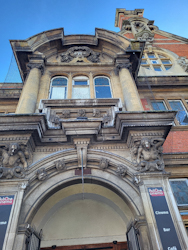
JUST IN CASE you do not know about it, there is a wonderful independent cinema in West London’s Acton. Called ActOne, it is housed in what was once Acton’s public library. Built between 1898 and 1900, it was one of a series of public libraries financed by the philanthropist Passmore Edwards. Incidentally, the Bush Theatre in Shepherds Bush is also housed in a former Passmore Edwards library.

ActOne has two screens, both with comfortable seating and good sound systems. The public spaces in the library include a bar and a large room with shelves filled with books about cinema. All in all, ActOne is a lovely place to enjoy films.

Enticed by espresso from a Portuguese cafe

THERE IS A DENTAL practice in Golborne Road (North Kensington). One afternoon in late 1994, I went to meet its then owner, Mr M, with a view to working there. It so happened that he remembered me from his days as a pre-clinical dental student at University College London. At that time, I was a PhD student and once a week I taught (tutored) physiology to the pre-clinical dental students. I believe that I learned more about the subject than my students while I was teaching them.

Because both of us had studied in the Physiology Department and later at the College’s Dental School, we knew a great deal in common and had much to chat about. While we were talking, Mr M offered me a coffee. He ordered this from the café next door to the surgery. It was some of the best espresso coffee I had tasted for a long time. We reminisced for a couple of hours during which we had one or two more of the superb cups of espresso coffee. He offered me the job, and I accepted. I worked in the practice during the next five years, and then left for another one. Later, Mr M sold the practice, which is now owned by another dentist and is still in business.

The café next door to the practice, Lisboa Patisserie, is also still in business, and the quality of the coffee served there has never been less than excellent. This popular Portuguese establishment also serves a wide range of Portuguese baked products, both sweet and savoury. Although it is now about 25 years since I last worked at the surgery, my wife and I visit the Lisboa Patisserie on average at least once a fortnight.

Yesterday, 29 March 2025, I was standing across the road from the surgery and the café when I noticed the magnificent blossom on a tree standing close to them. Seeing this, brought back memories of how delicious espresso coffee helped to entice me to accept a job at Mr M’s dental practice.

Two men each with a beer mug in their right hands

I FIRST BECAME AWARE of Birra Moretti when I visited the city of Udine in northeast Italy in the late 1960s. This brewery was founded in Udine in1859, Its logo includes a man in a hat, holding a glass tankard of beer in his right hand.

Today, I visited a pub near Hatfield in Hertfordshire. Within the gents’ toilet, I noticed a sticker attached to a cistern. At first sight, it looks like the Birra Moretti logo, After a moment, I saw that it is a parody of the logo issued by a football (soccer) club in Stevenage, Hertfordshire. Where the original logo is topped with the words ‘Birra Moretti’, the parodied version has the name ‘Steve Evans’.

And who, you might be wondering, is Steve Evans? Between 2022 and 2024, he was the manager of Stevenage Football Club. During his time in this role, the team won 57 out of 120 matches.

Three generations of artists in one family

SIR WILLIAM ROTHENSTEIN (1872-1945) was born of German-Jewish parents in the Yorkshire city of Bradford.  His father was involved in Bradford’s textile business. Trained at the Slade School of Art (part of London’s UCL), William became a well-known painter and cultural figure. Between 1920 and 1935, he was director of the Royal College of Art. Rabindranath Tagore dedicated his work “Gitanjali” to William. One of William’s sons, Michael Rothenstein (1908-1993), who was born in Hampstead, became a noted printmaker. He married Betty Mona Desmond Ayers (née FitzGerald; 1915-2017), who was known as ‘Duffy Ayres’. She was an English portrait painter.

Michael and Duffy had two children, one of whom is Anne Rothenstein (born 1949). She is a self-taught artist, who lives and works in London. Until 12 April 2025, there is an exhibition of her paintings at the Stephen Friedman Gallery in London’s Cork Street. Her attractive paintings, which seem deceptively simple when compared with those made by her grandfather William, depict portraits, interiors, and landscapes. However, they are far from simple. They are subtle and sometimes dreamlike. And as the gallery’s handout noted, her portrayal of perspective is unusual: the landscapes seem flattened. The paintings on display are oddly compelling and this along with their somewhat muted colouring, enhanced my enjoyment of Anne’s art.

As soon as we entered the gallery and I saw the artist’s name, I wondered whether she is related to the famous Sir William Rothenstein. When the gallery assistant informed us that she is from the same family, I was excited. Already, I knew of William’s connections with Hampstead and that he hosted Tagore, when the great Bengali visited London, but I had no idea that both his son and his granddaughter were artists (although far less well-known than him).