Through the tongue

During my three and a half decades working as a dentist, I have been assisted by numerous ladies varying in age from sixteen to over seventy years. ‘Carly’ was one of them. When she joined me in a practice west of London, it was the first time she had worked in a dental practice. She was a quick learner, but far from discreet.
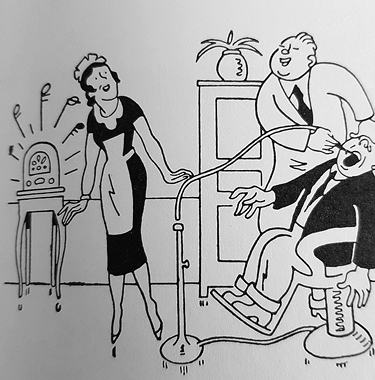
CARLY

When we had a new patient, we recorded the person’s details on the outside of a record card. One day, a smart-looking woman sat down in my dental chair, a new patient, and I asked her for her personal details: name, date of birth, address, and so on. Carly entered the information on the record card. When we had finished, Carly asked the patient:

“Are you M.R.S. or M.I.S.S?”

The lady replied:

“Miss.”

Quick as a flash, Carly said:

“I can’t see why you ain’t married. You ain’t ugly or anythink.”

The lady took this quite well. She could see that Carly meant no harm.

One Monday morning, Carly arrived and said to me:

“Ere, look at this”

She stuck out her tongue, which had a shiny silver-coloured metal stud pierced through it. I was lost for words for a moment, and then asked her if it was uncomfortable.

“No, it ain’t,” she replied, “It makes eating spaghetti difficult, though. It gets caught up on it.”

All morning, whenever a patient sat in my dental chair, she would tap the patient’s shoulder, and then say: “Wht d’ya think?” before sticking her tongue out to display her stud to the person in the chair. Most of the patients were either politely complimentary of just smiled. By now, my regular patients had got used to Carly and her friendly but cheeky manners.

Another day, Carly arrived at work. Very excitedly, she told me:

“You’ll never guess how much I paid for a large pack of prawns at Tesco’s.”

“Four pounds?” I guessed.

“No, just a quid.”

“That’s a good bargain,” I said.

“What me and me boyfriend do,” Carly explained, “is we swap the labels on the packets in the chiller so that we get the special offer prices instead.”

“Be careful,” I advised.

On yet another occasion, Carly arrived at work looking distressed. I asked her what was wrong.

“I crashed me boyfriend’s car.”

“But you haven’t got a license have you, Carly?”

“No, but I was drunk. I got in his car and drove it backwards into a lamppost.”

I am sure that the boyfriend was not pleased because throughout the day Carly was rung up by him on her mobile ‘phone. She would go out into the corridor, but because she was screaming at her chap so loudly, everyone could hear her.

During one appointment, I was beginning to scale (remove the dental tartar or calculus) a lady’s teeth. After a few minutes, while I changed instruments the lady, a well-dressed woman with airs and graces, asked me:

“Excuse me, Mr Yamey, but what exactly are you doing to my teeth?”

Before I could answer, Carly replied quickly:

“E’s cleaning the crap off yer teeth.”

The patient seemed quite happy with this simple summary.

Despite Carly’s occasional rather undignified comments, she was an excellent assistant. Patients appreciated her unpretentious, friendly, open approach and the fact that she was rarely silent. After a few months, when she had gained some experience, Carly left our practice to take up a better paid position in another dental practice. Some weeks after she had been working there, she dropped into our surgery to say ‘hallo’. I asked her how she was getting on in her new job. She replied:

“It’s ok, but they have told me not to open my mouth during the day.”

Picture source: “Der Zahnarzt in der Karikatur” by E Hinrich (1963)

Back to BASIC

computer

During the last two years (1968-69) at my secondary school, Highgate School in north London, we were taught about computing. The teacher in charge was one of the pioneers of the computer programming language called BASIC (an acronym for Beginner’s All-purpose Symbolic Instruction Code). The first version of BASIC, which was considerably simpler to use than FORTRAN or COBOL, was released in 1964. So, our teacher was advanced in introducing it to us. We learned about creating flow diagrams and then converting them into BASIC.

When I learnt BASIC back in the late sixties, the only computers available were huge main-frame machines that occupied large rooms. PCs and lap-tops were not yet available, or hardly even imagined. The school did not possess a main-frame computer. But, it did possess a keyboard attached to a telephone line. By dialling a number, the keyboard could be connected to a remote computer. It was not possible to type directly into the computer. First the programme that we concocted had to be typed on the keyboard, which converted the programme into a series of holes on a long ribbon of paper. When the programme had been transferred into the punched holes, the remoter computer was dialled, and then the long strip had to be fed into a slot on the keyboard console. Then, the author of the programme had to hold his breath. For, it would be some time before the computer sent back a message that was typed by the console onto its paper-feed. More often than not, the message would convey the sad news that the programme had an error. Then, it was back to the ‘drawing board’ to determine where we had gone wrong.

When the programme was correct, the results were exciting. Some people used the computer to do statistical work, or to generate answers to mathematical problems. I discovered how to make the computer write random poetry. I submitted some of what I produced to the school’s magazine, but it was turned down.

Several of my fellow pupils and I became obsessed with programming. We could not get enough of experimenting with programming. The console was kept locked in a wooden cabinet, which could only be opened by our teacher. Somehow or other one of us managed to get a copy of the key, and, more importantly noticed the number that our teacher dialled to access the computer. From then onwards, we had far greater access to the machine.

The IBM company lent the school a prototype of a table top computer. This could only be programmed using machine language, which is the coding that underlies languages such as BASIC, FORTRAN, and COBOL. Using machine language is real programming, and quite difficult. It was to difficult for me to master even at a very simple level.

When I went for my interview at the Physiology Department at University College London (‘UCL’), the other candidates and I were shown the room containing a large computer, which the Department possessed. The staff were very proud of these advance machines that were able to process experimental data in “real time”. Information from the measuring instruments employed in the experiments was converted into numerical data that could then be processed statistically by the computer, and then displayed to the experimenters while the experiment was proceeding.

A week or two after my interview at UCL, I went for another interview, this time at the Physiolgy Department of Chelsea College (now long since closed). After I had been several questions by the Prof and some of his colleagues, they allowed me to ask any questions I had. Having been impressed by what I had seen at UCL, I asked:

“Do you use computers in your department here at Chelsea?”

“Of course, we do, all the time” answered the Prof immediately.

After a short pause, one of his colleagues said:

“Well … actually… we don’t have any computers in this college.”

Then the Prof said something, which I found rather pathetic:

“I can understand that your first choice is UCL. However, we would be happy to offer you a place in our department providing you will promise to accept our offer if UCL does not give you one.”

Fortunately, UCL did offer me a place on their course.

I gained admission to UCL, my first choice amongst the six universities to which I applied. During our first year, we had to take a course in physics. Once a week, we spent an afternoon in the laboratory carrying out practical work. One day, we were asked to write computer programmes to solve a chosen problem. I was the only person (in our class of fifty students), who could complete the task. No one else had a clue as to how to do it. They had attended good secondary schools all over the country, but only mine had offered teaching in computer science.

After that class in the physics laboratory in 1970, I did not touch a computer until about 1997. We bought a PC, because my wife needed one for her studies. When she was not using it, I experimented with it. It operated with one of the Windows programmes. I was flummoxed. It seemed quite different to what I experienced in the late sixties. How was I going to programme it? After a short while, I realised that things had moved on a long way since I learnt BASIC.


Image source: www.quora.com

Pull it out…

After qualifying at University College Hospital Dental School in early 1982, I practised dentistry for another thirty-five and a half years. I never owned my own practice but worked in those owned by other people. I worked in a total of five practices. With exception of one practice, where I worked for less than eight months, I enjoyed the conditions of the rest. None of my ‘bosses’ (i.e. the practice owners) appeared to mind how much or how little I earned for them and how much time I took off for travelling. I am grateful to them for their tolerant attitudes towards my laid-back approach to work.

My first boss, ‘J’, provided gave me a smooth introduction to the trials and tribulations of general dental practice. He was always ready to give me advice if I needed it, but gently encouraged me to take control of my decision making so that I became in charge of what I was doing.

During the first few months of being in practice, I often encountered difficulties when extracting teeth. Maybe, at that time I had insufficient experience to know when an extraction was likely to be too difficult for me to perform. Maybe, some teeth are just very hard to extract. This is the case.

If I got stuck midway through an extraction, I would ask my dental nurse to summon J. When J, who was very skilled at extracting teeth, arrived, he would work on the tooth up to a certain point. Then he would say to me that I should finish the job. He could have easily completed the extraction himself, but he wanted me to do it so that my patient would not lose confidence in me. I feel that this was extremely kind of him and will always be grateful for his sensitive approach. Later in the day, when there were no patients about, he used to take me aside and explain what he had done to loosen the tooth. Thus, I learned how to improve my technique.

As the years passed, my ability to perform extractions, even difficult ones, increased. Often, I would extract teeth that my colleagues would have referred to specialists. Although some of my other dental skills improved over the years, It is sad to relate that what I became best at was removing teeth rather than saving them!

PS: dentists never PULL out teeth; they use various techniques to widen the tooth socket and to split the collagen fibres that hold the tooth in the socket.

Picture source: “Der Zahnarzt in der Karikatur” by E Heinrich (1963)

The lady in blue

What makes for a great work of art? Well, people differ on the answer to this question. Seeing one special painting in the Galleria Regionale della Sicilia in Palermo (Sicily) helped me formulate my answer.

ARTGREAT 1

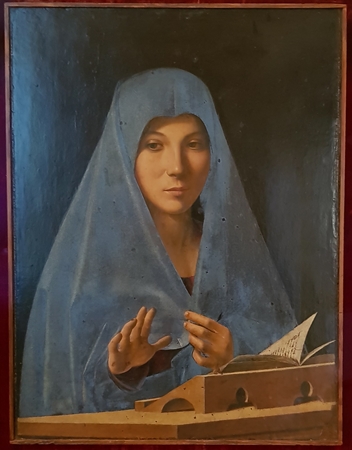
The painting that literally caught my eye and grabbed my full attention is “The Virgin Annunciate”. It was painted sometime between 1474 and ’77 by the Sicilian artist Antonello da Messina (c. 1430-79). It depicts a woman in a blue veil seated at a small wooden desk on which there is an open book. The fingers of her right hand spread forwards towards the viewer. Her left hand holds her veil closed. She appears to be gazing towards her right.  Simple, really, if described like this, but it is not.

The painting grabbed my attention long before my brain had time to analyse what was reaching my eyes’ retinas. It was an intense visceral attraction to the image that made me stop and look at it carefully, an attraction that few other works of art have had for me.

When I had recovered from the initial pleasurable shock of seeing such beauty, I began to notice its subject matter, and with the help of an explanatory note next to the painting, I learnt some of the artist’s deeper intentions.

ARTGREAT 1a

For example, there is a sharp crease in the cloth of the veil  just above the mid-point of the lady’s forehead. This tells the informed viewer that the Virgin is wearing a special treasured, rarely worn, veil that is usually kept neatly folded in a closet or wardrobe. No doubt, art historians would be able to point out many other meaningful details that the artist has depicted. Despite these aspects of symbolic meaning, despite its subject matter and context, this picture is primarily an object of enormous beauty and graciousness that appeals greatly to something in the deep recesses of my subconscious.

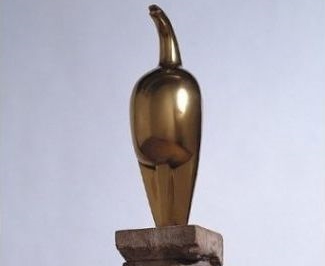
For me, a work of art must first seize the seat, the very source of my emotions in a positive way. If it can do that, then whether or not the artist has imbued it with layers of meaning, the work is in my view a great one. Lest you think that it is only the works of long dead masters that fall into my definition of ‘great art’, let me refer to someone who created more recently, Constantin Brâncuși (1856-1957). Some of his sculptures depict birds or humans as simple, almost abstract, forms, almost devoid of detail. These works evoke the same deep sensations of visceral attraction as the painting by Da Messina, yet they could hardly be more different in all respects from that.

ARTGREAT 2 bookdepository do com

A work by Brancusi [Source: bookdepository.com]

I am unable to formulate why the Da Messina and Brancusi works chime (and even some extremely abstract works such as those by Modriaan or Sean Scully) with my deepest emotional chords, when others, undoubtedly masterful in many ways like the works of Caravaggio and Barbara Hepworth, do not. I suppose this is what folk call ‘taste’. And, tastes differ greatly.

ARTGREAT 3

Sean Scully

For me, a great work of art must first appeal to me emotionally, viscerally if you like, rather than intellectually. If I can only begin to appreciate a work of art after it has been explained, as is the case with much so-called ‘conceptual art’, then, for me, it is not ‘great art’.

The author and his book…

What is inside Adam Yamey’s new book about Gujarat?

yamey's avatarGUJARAT, DAMAN, and DIU

ADAM GUJU BOOK

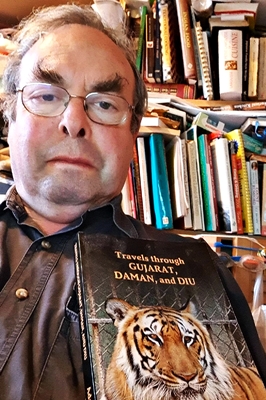
“Travels through Gujarat, Daman, and Diu” by Adam Yamey is a personal introduction to a part of western India far less well-known than its neighbour Rajasthan.

First, a bit about the author:

Adam Yamey is the author of several books, including: Albania on my Mind, From Albania to Sicily, Exodus to Africa, Rediscovering Albania, Aliwal, City on the Hooghly, Buried in Bangalore, Bangalore Revealed, and A Boer in Bangalore.

Born in 1952 in London, son of South African parents, he attended Highgate School, and then University College London. After a doctorate in mammalian physiology, he became an undergraduate once more and qualified as a dental surgeon. After 35 years in general dental practice in Kent and London, he retired in September 2017.

Amongst his many achievements, he has been Chairman of both the Maidstone Recorded Music Club and the Medway Association…

View original post 367 more words