Ethiopian coffee under the railway tracks

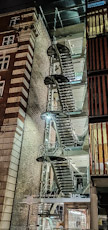
IT WAS FROM ETHIOPIA that historians believe coffee beans were first exported to Yemen, where they were roasted and processed into what we would now recognise as a coffee drink. The earliest recorded use of coffee beans for brewing the drink was in 15th century Yemen. However, soon the drink spread to other parts of the Middle East, North Africa, Turkey, and Persia. By 1600, it had reached Europe. Today, the 13th of April 2023, we were strolling along Shepherds Bush Market, which runs alongside the elevated railway tracks along which trains of the Hammersmith & City and Circle Lines run. The tracks run high above the market supported by brickwork arches. Some of these arches have been used to house shops and in one case an interesting café, which opened in 2020, just before the first of the covid19 lockdowns.

The café is called Delina and is run by Ethiopians. Beautifully decorated with Ethiopian textiles and other artworks, this place offers Ethiopian fare including coffee from Ethiopia. Customers can have their coffee prepared in various common ways such as, for example, Americano, espresso, and latte. I asked whether I could try coffee the way it is drunk in Ethiopia and was given the choice of coffee flavoured with cardamom or with ginger. I opted for the latter because once, many years ago, I had drunk coffee with ginger (and other spices) in a tiny coffee shop next to a mosque in Fort Kochi (Kerala, India), and liked it.

The lady working behind the bar first collected a ‘jebena’, which is ceramic container with a cylindrical base, a handle, and a long neck with a pouring spout. She washed it out and then placed it on a glowing charcoal to both dry it and heat it. Meanwhile, she prepared some coffee in the espresso machine, and filled a small jug with it. To this she added some ginger powder and stirred the mixture well. Carefully, she poured the ginger coffee into the heated ceramic container. Then, she loaded a small tray with the following: the ceramic container and a woven stand to support it upright; a tiny coffee cup with no handle; a bowl of sugar; and a small circular holder containing lumps of smoking incense. She explained that in Ethiopia it was believed that drinking coffee whilst being bathed in incense fumes enhanced the enjoyment of the beverage. There was enough coffee in the jug to refill the tiny cup or bowl about five times.

In Ethiopia, the coffee is usually first roasted in front of those who are about to enjoy it, ground with a pestle and mortar, and then brewed with water in the jebena being heated on charcoal. Then, it is poured into the tiny cups through a filter made with fine filaments. Although Delina has an electrically heated pan for roasting coffee beans, I imagine that roasting a fresh batch for one customer was considered too much work. I can imagine that when the place has a group of Ethiopian customers, shortcuts cannot be taken and the beans are freshly roasted for them.

As for the coffee laced with ginger, it was enjoyable. I could not taste the ginger, but I could feel it in my throat as I swallowed it. Years ago in Fort Kochi, we had been told that it was believed that ginger coffee was beneficial for the throat. Would I go to Delina again? Yes, I would. Despite the trains rumbling overhead every few minutes, the place has a delightful and visually satisfying ambience, and friendly staff. It also serves Ethiopian food, which we have yet to sample.

A versatile contemporary artist

YESTERDAY, WE ADMIRED paintings created by the Great Masters of European art, which hang on the walls of the rooms of 18th century Kenwood House in north London. Today, the 12th of April 2023, we enjoyed artworks of a completely different nature within the almost spartan spaces of the White Cube Gallery in Bermondsey Street. Currently, three artists’ works are on display. Three areas in the gallery are dedicated to one of them – Marguerite Humeau. She was born in 1986 in France, and received her MA from the Royal College of Art in London – the city in which she now lives and works.

Humeau creates works in a wide variety of materials. She also makes video art, one example of which was on show in the smallest of the three spaces. A larger room contained panels made with one or more ceramic tiles. The glazed surfaces of these tiles are not flat but contain hand-sculpted three-dimensional features including textural variations and curvy striations, which protrude from the flattish background surface.

The largest room of the show must be seen to believed. Entering is like setting foot on an alien planet inhabited by weird organic shapes that suggested to me plants, fungi, and insects, but all of them greatly magnified. These shapes are sculptures created by Humeau. Some of them were emitting musical sounds. I found the sculptures both intriguing because of their allusions to biological structures and also quite satisfying visually. As to what led to their creation, the gallery’s website (https://whitecube.com/artists/artist/Marguerite_Humeau) explained:
“The artist was inspired by eusocial insects such as ants, termites and bees, whose complex cooperative societies enable them to build huge structures and to cultivate other organisms in symbiotic relationships. Reflecting on the ants shepherding their aphids and the termites tending their fungus gardens, Humeau found an equivalent in the place yeast has assumed in human societies, as the essential ingredient of bread and beer around which our human collective has gathered. Contemplating the probability of our imminent, self-inflicted extinction as a species, Humeau sees insect societies as both the inheritors of our ravaged environment, and a prompt to consider how interdependence and cooperation might offer a means to avert our fate.”
Fair enough; but even if the works are portents of a gloomy future, my spirits were uplifted by seeing them. The exhibition continues until the 14th of May 2023. If you plan to visit it, save a bit of time for the interesting and attractive, abstract paintings and sculptures by Samuel Ross (born 1991 in London), which are on show in another of the gallery’s spaces.

The thing that amazes me is that even though the paintings by the Great Masters, who painted many centuries ago and which we saw 24 hours ago at Kenwood are immensely satisfying visually, seeing the artworks by Marguerite Humeau today was an equally enjoyable experience. I wonder what it is that happens in the brain to produce the same amount of enjoyment from seeing such widely differing artistic creations.

Caught in the act midair

TO CAPTURE A DETAILED IMAGE of a hawk attacking a bird in mid-air using photography would require a decent camera with a good lens and a high shutter speed. Yet, in about 1832 – long before cameras with high shutter speeds existed – the painter Edward Landseer (1802-1873) depicted a hawk attacking another bird high above the ground. He did not use photography. He created his picture on canvas with his paintbrushes and oil paints. His painting, “Hawking in the Olden Time”, hand in north London’s Kenwood House where I saw it today, the 11th of April 2023.

Clearly, Landseer’s image is a painting, but it contains as much detail as a reasonably good photograph. It must have taken him very much longer to execute than the fraction of a second that the event – the attack, which he captured on canvas, lasted in real life. Was his visual memory so good that he was able to hold a detailed memory of that instant in his head whilst he painted it? Although I doubt it, that possibility cannot be ruled out.

As I stood in front of the picture, pondering about it, another theory entered my head. During the nineteenth century, the art of taxidermy had reached a high degree of development. For example, the British ornithologist John Hancock (1808-1890) was an accomplished taxidermist. One of his works, “The Struggle with the Quarry”, which is in the Hancock Museum (in Newcastle upon Tyne) consists of one stuffed bird attacking another, and at first glance makes one think of Landseer’s painting. Although this was created after Landseer made his painting, the art of taxidermy had already begun to be perfected by taxidermists such as Louis Dufresne (1752-1832). So, when I was standing in front of the painting at Kenwood and thinking that Landseer might well have used a work of taxidermy as a model for his picture, I might not have been mistaken.

Kenwood House contains one of London’s best collections of old master paintings outside the city’s major public art galleries. Each time I visit it, I discover something that I had not noticed before. I am sure that I had seen the painting by Landseer, but it was not until today that I gave it more than a passing glance. Today, while walking around the house with some friends who had never been there before, we stopped in front of the painting of mid-air carnage and wondered how this image had been created before modern photography had been invented. Maybe, what I have written provides the answer.

The golden guinea

IT USED TO BE THE CASE that, amongst other things, fancy goods and professional services were priced in Guineas, rather than Pounds Sterling. A Guinea was worth twenty-one shillings. That was, before decimalisation, one Pound and one Shilling (£1.05 after monetary decimalisation occurred on the 15th of February in 1971). Although I was fully aware of the nature and value of one Guinea, I had never given its name a thought until 2023, when we went to an exhibition in the Bank of England’s fascinating museum. The exhibition was about the Bank and its various diverse connections with the slave trade.

One exhibit was dedicated to the Guinea. The first Guinea coin was minted in 1663. Its name derived from the West African Guinea Coast, which was an important centre for the British export of African slaves. It was also a place to obtain gold that had been mined by local Akan miners working in the forests of what is now Ghana, but was the British colony called “The Gold Coast”. Some of this gold used to be obtained by the Royal African Company and transported to London.

So much for the origin of the name of the unit of currency. And now for something I knew already, but have always found fascinating. My father had a book in his study – “The Golden Trade of the Moors” by EW Bovill (published in 1961). In this interesting, scholarly book the author described an important trade between the ‘Moors’ of North Africa and the miners in what is now Ghana and nearby parts of tropical Africa. The North Africans mined salt (NaCl) from beneath the surface of the Sahara Desert. At the same time, Africans were digging up gold in the tropical forest of West Africa. However, there was a severe lack of available salt in the places where the gold was being harvested. Long before the British became involved with Africa, North Africans used to transport salt southward across the desert to the tropical forests where gold was being produced. So valuable was the salt to the gold miners and their families that the only thing that they would accept in exchange for gold was the salt carried from North Africa. Salt, an essential for life, was literally worth at least its weight in gold.

Sadly, after Europeans began their involvement with Africa, gold was not the only valuable commodity that could be obtained from there. For several centuries, another major export was human beings: slaves to work in lands across the Atlantic from Africa. The exhibition at the Bank reveals that many of its personnel were involved in the slave trade, but not all. Some were active in the movement to abolish the slave trade. It is a well designed exhibition and most interesting.

Revealing the soul. Alice Neel.

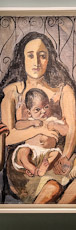
DESCRIBED AS THE FIRST living artist to have had a retrospective exhibition in the Soviet Union, the American painter Alice Neel (1900-1984), there is a superb exhibition of her art at the Barbican Centre in the City of London until the 21st of May 2023. Alice, who was born in a small town in Pennsylvania, led a colourful life – and by this, I am not referring only to her paintings. Politically, she was leftward leaning. In 1935, she joined the US Communist Party and remained a member throughout the McCarthy era and after it. She participated actively in anti-fascist activity before WW2. Some of the portraits she painted were of Marxists and members of the US Communist Party. Maybe, it was this political activity that got her, her family, and her paintings invited to Moscow in 1981. She was a Communist but objected to the bureaucracy associated with the Party. In late life, when she was asked about her political views, she replied that she was “an anarchic humanist.”

During the Great Depression that hit the USA in 1929, President Franklin Delaney Roosevelt initiated the New Deal programme to deal with the unemployment crisis. In 1933, as part of this the Public Works Art Project was set up, and Alice joined it immediately. She was paid US $26.88 per week to produce a painting every six weeks. Her works done for this organisation and its successor, the Federal Art Project of the Works Progress Association, depicted urban scenes of adversity and social injustices. These paintings were her own brand of Socialist realism. I liked what was on display.

Alice remained a figurative artist throughout her life and throughout the period when most of her fellow American artists were moving away from the figurative and increasingly towards the abstract. The highlights of the exhibition are her portraits, some of them of subjects who have removed their clothing. In all of her portraits, she gets beneath her subjects’ clothing or external appearance and portrays not what a conventional portraitist depicts, but the personalities of her subjects as she understood them. The results were not always liked by her subjects, but the viewer can get much more of an idea of what the people would have been like had we been lucky enough to meet them. Like the Victorian photographer Julia Margaret Cameron (1815-1879), Alice’s portraits are not a slavish reproductions of nature but a wonderful attempt to portray what lies beneath the surface – the subject’s soul and character. She once said:


“As for people who want flattering pictures of themselves, even if I wanted to do them, I wouldn’t know what flattery is. To me, as Keats said, beauty is truth, truth beauty … I paint to reveal the struggle, tragedy, and joy of life.”

Included at the Barbican’s exhibition, there is a documentary film about Alice made by Nancy Baer. Alice was filmed in various situations, and comes across as a delightful person. Some of the scenes in the documentary show her at work on a portrait. What impressed me when watching these scenes in her studio was her ability to create straight from life unwaveringly. She looked at her subject and without faltering painted elements of the portrait that did not need adjusting. Her eye-brain-hand coordination looked to be superb.

Returning to the Moscow exhibition, the “Morning Star” newspaper (https://morningstaronline.co.uk/article/c/rebel-cause), which praised the exhibition, pointed out:


“…a wall text incorrectly refers to Neel’s 1981 Moscow exhibition as being by the “first living artist to have a retrospective in the Soviet Union,” whereas many artists including Yuri Petrov-Vodkin, Alexander Deyneka, Pablo Picasso and Fernand Leger had exhibited there from the 1930s onwards.”


They may well be right, but whether the artists mentioned were showing a few of their works rather than a retrospective covering their whole output until the date of the exhibition, is a question I cannot answer. In any case, it was no mean achievement to have been both invited to exhibit in Moscow during the Cold War and to have been elected to the American Academy and Institute of Arts and Letters (in 1976).

Once again, I must admit my ignorance: Alice Neel was an artist who was new to me. However, I am pleased that she is now on my radar. I can strongly recommend visiting the exhibition at the Barbican for an exciting visual feast.

Tokenhouse Yard

ST MARGARET LOTHBURY CHURCH stands on Lothbury, facing the north side of the Bank of England. It is, so the rector told us, the only one of the churches designed after the Great Fire of London (1666) by Christopher Wren, which did not suffer damage during WW2. It contains some beautifully crafted wooden features including a choir screen originally erected in the Church of All Hallows the Great (demolished 1894) in about 1683. In a side chapel, my wife spotted a gravestone that aroused our interest.

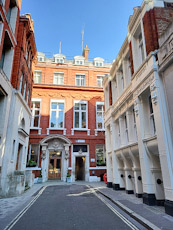
The black grave stone is to commemorate the Barnes family. The name at the top of the carved inscription is “James Barnes Jnr” of Tokenhouse Yard, who died in 1830. Other members of the family, who died later than him are listed below his name. What interested us was James’s address. Tokenhouse Yard, which is just under 100 yards in length, still exists and runs in a northerly direction beginning a few feet away from the west end of St Margaret’s church.

Tokenhouse Yard was laid out by the economist Sir William Petty (1623-1687) during the reign of King Charles I on land which had been occupied by the house and garden of the Earl of Arundel. Petty was, in addition to being an economist, a physician, physicist, philosopher, and one of the first members of the Royal Society. According to an online history of London (www.british-history.ac.uk/old-new-london/vol1/pp513-515) the Yard:


“… derived its name from an old house which was once the office for the delivery of farthing pocketpieces, or tokens, issued for several centuries by many London tradesmen. Copper coinage, with very few exceptions, was unauthorised in England till 1672.”


Daniel Defoe (c1660-1731), who was a child when the Great Plague broke out in London in 1665, later wrote that he remembered terrible sounds and scenes in the then densely populated, and probably somewhat squalid Tokenhouse Yard, many of whose inhabitants were infected. As it was during the worst days of our recent covid19 pandemic, back in 1665 there was nobody out in Tokenhouse Yard. He wrote:


“Passing through Tokenhouse Yard, in Lothbury, of a sudden a casement violently opened just over my head, and a woman gave three frightful screeches, and then cried, ‘Oh! death, death, death!’ in a most inimitable tone, which struck me with horror, and a chilliness in my very blood. There was nobody to be seen in the whole street, neither did any other window open, for people had no curiosity now in any case, nor could anybody help one another. Just in Bell Alley, on the right hand of the passage, there was a more terrible cry than that, though it was not so directed out at the window; but the whole family was in a terrible fright, and I could hear women and children run screaming about the rooms like distracted; when a garret window opened, and somebody from a window on the other side the alley called and asked, ‘What is the matter?’ upon which, from the first window it was answered, ‘Ay, ay, quite dead and cold!’ This person was a merchant, and a deputy-alderman, and very rich.”

Today, few, if any, people live in Tokenhouse Yard. It is now lined with office buildings, some quite elegant. At the north end of the Yard, there is a large decorative terracotta coloured Victorian edifice – number 12, named Token House. This was built for Huth’s Bank in 1872 to the designs of EA Gruning, a German immigrant. The bank was founded by another German – Frederick Huth (1777-1864). Today, the building houses offices.

An archway in the façade of Token House is the entrance to a covered alleyway – effectively a tunnel – that leads to Telegraph Street. This is so-named because it was near the building housing the Electric and International Telegraph Company (founded in 1855). Of interest, if you happen to be in the area, there is a nice coffee house, Ravello, on this street.

The Fire of London destroyed many buildings in 1666. Although these were replaced by newer ones, many of which have been demolished since, the conflagration did not destroy the medieval street layout of pre-Fire London. Thus, today we can enjoy the quaint narrow streets of yesteryear even though many of them, including Tokenhouse Yard and Telegraph Street (formerly the eastern part of ‘Great Bell Alley’) are lined with buildings constructed after Queen Victoria ascended to the Throne. The archaic network of streets in the old City of London add charm to what otherwise would have become a far less interesting urban area.

Baker in the Bank

UNBELIEVABLY, THE ARCHITECT Herbert Baker (1862-1946) demolished a major work of one of England’s greatest architects – Sir John Soane (1753-1837). Imagine the outcry if Sir Richard Rodgers decided to demolish Christopher Wren’s St Pauls Cathedral to replace it with one of his own design. Well, in the 1920s, Baker demolished most of Soane’s Bank of England to replace it with a larger building – the present Bank – which he designed.

There is a small museum in the Bank of England. Some of its rooms have been designed to recreate the kind of interiors that would have existed in Soane’s Bank building. In one of the rooms of the museum, a circular space beneath a glazed dome, there is a framed portrait of Sir Herbert Baker. Baker, who helped design New Delhi, is well known for his architectural work in South Africa. After being commissioned by the imperialist Cecil Rhodes (1853-1902) to redesign Groote Schuur, his house on the slopes of Cape Town’s Table Mountain, he was asked to design many other structures in South Africa.

The portrait depicts Baker standing at a drawing table by a window through which a building in his typical neo-classical style can be seen. At the bottom left corner of the painting, there is a depiction of a framed painting of Cape Town’s Rhodes Memorial, which Baker designed in 1906. If you look carefully at this picture within a picture, an equestrian statue can be discerned. This statue, called “Physical Energy”, was sculpted by George Frederick Watts (1817-1904), who was briefly married to the actress Ellen Terry. The statue was cast in 1902, and placed at the Rhodes Memorial in Cape Town. In 1907, another bronze cast was made, and this stands on a stone plinth in Kensington Gardens almost midway on a line connecting the statue of young Queen Victoria in front of Kensington Palace with the Henry Moore sculpture on the east bank of The Long Water (part of the Serpentine).

When we saw the portrait of Baker, we were viewing an interesting exhibition that explores the Bank of England’s many and varied links with the slave trade. The caption relating to the portrait of Baker concentrated on the small image of the memorial to Rhodes. It correctly pointed out that Rhodes had been a Prime Minister of the Cape Colony, which became part of unified South Africa in 1910. It also mentions that Rhodes:
“…held racist beliefs that Africans were inferior.”
In 1912, the author GK Chesterton wrote of Rhodes that he:


“… had no principles whatever to give to the world. He had only a hasty but elaborate machinery for spreading the principles that he hadn’t got. What he called his ideals were the dregs of a Darwinism which had already grown not only stagnant, but poisonous … It was not his fault that he “figured out that God meant as much of the planet to be Anglo-Saxon as possible.” Many evolutionists much wiser had “figured out” things even more babyish. He was an honest and humble recipient of the plodding popular science of his time; he spread no ideas that any cockney clerk in Streatham could not have spread for him. But it was exactly because he had no ideas to spread that he invoked slaughter, violated justice, and ruined republics to spread them.”


Well, that is something for recipients of, and those applying for, Rhodes Scholarships to ponder over.

Getting back to the Bank that Baker designed, the museum is well worth visiting not only for its temporary exhibition about slavery but also for its permanent collection of exhibits, all of which have easily understood explanatory labelling.

Before we began carrying personal water supplies

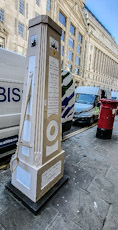
LONG BEFORE LONDONERS began the current fashion of carrying bottle of water wherever they go, the city’s inhabitants had to rely on water sources such as hand-operated street pumps. Although there are still a few functioning public drinking fountains in London, there are no usable pumps to be found. However, a few of them have been kept as historic monuments. One of these is located on the north pavement of Cornhill, a few yards east of the Royal Exchange building.

The pump, which is now kept looking like new – except that it no longer works – was set-up in 1799. On one of its four sides, the manufacturers, Phillips & Hopwood (“Engine Makers”), have included the information that the pump was paid for by the Bank of England, the East India Company, Fire Offices (i.e., insurance companies), and the “bankers and traders of the Ward of Cornhill”. The inscription on this side of the pump also mentions that the it was erected above a well that had been discovered and enlarged.

On another side of the pump, that facing south, there is a brief history of the well. It was first dug before 1282 when Henry Wallis (aka Henry le Walleis; died 1302), thrice Mayor of London, built a “House of Correction” on the spot. This was a prison for “night walkers” and was known as “The Tun”. Stow writing his “Survey of London” in 1598, noted that the prison was built of stone and (preserving Stow’s spelling) we learn:
“In the yeare 1298. certaine principall Citizens of London, brake vp this prison called the Tunne, and tooke out certain prisoners for the which they were sharply punished by long imprisonment, & great fines, as in another place I haue shewed.
In the yeare 1401. this prison house called the Tunne was made a Cesterne for sweete water conueyed by pipes of Leade frõ the towne of Tyborne, and was from thence forth called the conduite vpon Cornhill: Conduite vpõ Cornhill.Then was the wall planked ouer, and a strong prison made of Timber, called a Cage, with a payre of stockes set vpon it, on the top of which Cage was placed a Pillory for the punishment of Bakers offending in the Assise of Breade: for Millers stealeing of Corne at the Mill: and for baudes Cage, stockes and pillorie vpon Cornhill.and scolds &c.”

By the time the pump was set-up, the prison had long since gone (? demolished). How and why the well was rediscovered, I cannot say, but it was, and its water became accessible by using the pump. The top of the pump serves as an advertisement. At the top of each of the four sides of the pump, there are symbols, which people would have recognised as being the trademarks of four insurance companies in existence at the time that it was established. Back in the 18th and early 19th centuries, firefighting services were provided by the insurance companies. The trademarks of insurance companies were placed on buildings so that firefighters of each insurance company could recognise which houses had paid for policies that made them eligible to be saved by the firemen.

Today, firefighting is no longer provided by insurance companies, and water is no longer available from public pumps. So, it is not surprising to see many people wandering around London with their own supplies of drinking water – in plastic bottles and other containers. What does surprise me is that when I was younger, in the 1960s and 1970s, one hardly ever saw people carrying their own drinking water. Now, it is quite common to see people sipping from their personal water carriers. Have people become thirstier recently, or what is it that makes them feel that they should never be without a portable supply of potable water?

The hole truth

AFTER AN INTERESTING visit to the Bank of England’s museum, we headed north east to Brick Lane. Our destination was Beigel Bake at number 159. Not to be confused with its near neighbour, Beigel Shop, the far superior Beigel Bake, which is open 24 hours a day, was established in 1974. Although now a separate business from the Beigel Shop, the two places were originally the same business, as is recorded in an online article (https://londonist.com/london/food/things-you-probably-didn-t-know-about-beigel-bake):
“Although widely seen as rivals, the two shops were originally owned by the same family. Brothers Asher and Sammy Cohen started off working for another brother at The Beigel Shop next door, but eventually branched out to 159 Brick Lane in 1976. When the brothers aren’t putting in a shift, Nathan Cohen, one of two sons can be seen overseeing the sale and production of the 2,000-3,000 beigels baked in-house every day.”
I am uncertain whether the brothers are still with us or whether Nathan still oversees the place. In any case, Beigel Bake is well worth a visit. We did so today, the 4th of April 2023.

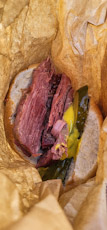
A few weeks earlier, we ate salt beef (Reuben)sandwiches at Selfridge’s Brass Rail eatery, which I have described elsewhere (https://adam-yamey-writes.com/2023/03/25/the-brass-rail/). We went to Brick Lane both because we were hungry and, also because we wanted to compare the salt beef on offer there with that we ate at Selfridges. After waiting in a long, but fast-moving queue, we were served our beigels, stuffed full of warm salt beef, some mustard, and slices of pickled gherkin.

Beigel Bake salt beef in a beigel (bagel)

As the Beigel Bake does not offer any seating, one has to eat the generously filled beigels elsewhere. At the Brass Rail, you can sit at a comfortable table, where a waiter brings the salt beef sandwich to you. The salt beef served at Beigel Bake is much tastier than that at the Brass Rail. Unlike the latter, Beigel Bake does not put sauerkraut and cheese into the sandwich. Without those ingredients, the salt beef tastes far superior to when they are present. In addition, the beigel suits the salt beef much better than the rather soft bread used at the Brass Rail. In brief, to my taste the Beigel Bake offering is far superior in all respects to that of the Brass Rail.

As mentioned, at the Brass Rail you can sit and eat your sandwich comfortably. However, currently the sandwich costs £14.95 to take-away (more if you eat-in). In contrast, a salt beef beigel with pickle and mustard, currently costs £6.00 at Beigel Bake. What you get at the Brass Rail is definitely not worth £8.95 more that at the less pretentious Beigel Bake, and it seemed like there was more beef in the latter’s offering than in the former.

A word of advice: do not bother with the nearby Beigel Shop even if there is a long queue at Beigel Bake – it is well worth the wait.