

THE WRITER CHARLOTTE Bronte (1816-1855) and her sister Emily lived in Brussels from 1842 to 1844. Charlotte’s novel “Villette” (published in 1853) is based on her stay in Belgium’s capital city. In the novel, a young female character, Lucy Snowe, visited a gallery in the city, and noticed a painting that had been set aside to be viewed by connoisseurs. It was described in the story as follows:
“It represented a woman, considerably larger, I thought, than the life. I calculated that this lady, put into a scale of magnitude, suitable for the reception of a commodity of bulk, would infallibly turn from fourteen to sixteen stone. She was, indeed, extremely well fed: very much butcher’s meat—to say nothing of bread, vegetables, and liquids—must she have consumed to attain that breadth and height, that wealth of muscle, that affluence of flesh. She lay half-reclined on a couch: why, it would be difficult to say; broad daylight blazed round her; she appeared in hearty health, strong enough to do the work of two plain cooks; she could not plead a weak spine; she ought to have been standing, or at least sitting bolt upright. She, had no business to lounge away the noon on a sofa. She ought likewise to have worn decent garments; a gown covering her properly, which was not the case: out of abundance of material—seven-and-twenty yards, I should say, of drapery—she managed to make inefficient raiment. … On referring to the catalogue, I found that this notable production bore the name ‘Cleopatra.’”

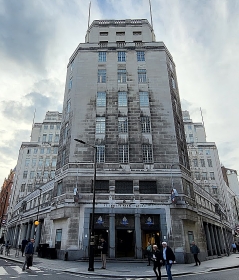
Today, 29 October 2025, we looked at a small exhibition in London’s Bury Street. Presented by a Turkish gallery, Guler & Guler, the show was called “Silks & Sultanas: Courtly Fabrics and Depictions of Women in the Ottoman World”. Mr Cem Güler kindly showed us around his small, but superb exhibition. One of the larger paintings, which depicts a reclining lady, is called “The Almeh” (i.e., The Sultan’s favourite), and was painted by Eduoard de Biefve (1808-1882), a Belgian. It was painted in 1842, the year that the Bronte girls arrived in Brussels. Mr Guler explained that this was the painting that Charlotte described in “Villette”. The description in the extract reproduced above is a good description of what we saw today, but the author added a few details that are not present in the painting.
In December 2023, the painting was auctioned by Sotheby’s in Dallas (USA). The auction house’s website remarked of this painting:
“The present painting met with a tumultuous reception in 1842 largely because of its title. The Arab term Almeh designates a class of educated women who sang and recited poems from behind a screen or from another room during parties or private entertainments. However, the term’s meaning became distorted and for many at that time it was associated with exhibitionist dancers whose suggestive dances had a sexual connotation. L’Almeh by Bièfve is deliberately provocative: languorously reclining on a couch, the woman looks directly at the viewer and points a finger at the mattress. It is hardly surprising that the painting met with such reactions.”
And in “Villette”, after being caught looking at the painting, the young English lady viewing it is told off by Monsieur Paul Emanuel, who clearly thought it an unsuitable picture to be seen by a young lady. And Lucy Snowe did not approve of it, as is related in the following from artdaily.com:
“We may think of our historic and leading creative minds as endlessly progressive, but in 1842, the indelible Charlotte Brontë came face to face with a controversial new painting, a true succès de scandale that by all evidence disturbed and irritated her so badly that she wrote at length about it in her final — and some say her best — novel, Villette. Brontë’s fictional proxy, the main character Lucy Snowe, stares at the painting (and its seductive subject) and thinks: ‘…this picture, I say, seemed to consider itself the queen of the collection. She lay half-reclined on a couch: why, it would be difficult to say … She had no business to lounge away the noon on a sofa. She ought likewise to have worn decent garments; a gown covering her properly, which was not the case … Then, for the wretched untidiness surrounding her, there could be no excuse … it was on the whole an enormous piece of claptrap’.”
We had entered the small gallery to see the exhibition because I wanted to see whether there were any paintings of women dressed in traditional Albanian folk costumes (Albania was part of the Ottoman empire until 1912). There were none, but, instead, I came face to face with a painting that had caught the attention of Charlotte Bronte soon after it was painted.




 yamey
yamey 