
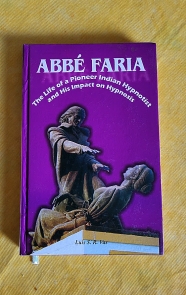
HERE IS A BOOK that I bought some years ago when visiting the city of Panjim in Goa, the formerly Portuguese colony, now a state of India. Written by Luis SR Vas, it is a biography of Abbé Faria, who was born in Portuguese Goa in 1756, and died in Paris (France) in 1819. There is a statue commemorating him in the centre of Panjim. A picture of this monument adorns the front cover of the book, and depicts Faria hypnotising a woman. I have seen the sculpture, and I photographed it 2018.
Faria spent most of his life away from the Indian subcontinent, in Italy, Portugal and France. Born Jose Custodio de Faria, he became a priest, and was, for a time, highly regarded in ecclesiastical and royal circles. Living in turbulent times, life did not go smoothly for him. For example in 1797, he was arrested in Marseilles, and imprisoned in the now famous Chateau d’If, Luis Vas wrote that it was Faria, who was in the mind of the author Alexandre Dumas when he included a character named Faria in his novel “The Count of Monte Cristo” (first published in 1844).
The Abbé’s chief claim to fame is that he was a pioneer of what we now call hypnosis, but he called ‘lucid sleep’. He spent many years perfecting this now well-recognised method of modifying behaviour and its use in the armoury of medical science. However, during his life, although admired by many, he was disdained and criticised by others. He discovered that subjects could only be hypnotised if they were willing to be susceptible. This was in contrast to his rival, Anton Mesmer, who believed that states of hypnosis were achieved by altering the subject’s magnetic field: animal magnetism. Faria was one of the first to question Mesmer’s theory. Faria died a poor man, but it was only many decades later that reputable scientists realised that what he had done was sound, rather than quackery.
The book by Vas is not only biographical, but also full of the history of the times through which Faria lived, and of the various countries where he worked and resided. The book ends with a brief summary of the course of the history of hypnosis after Faria’s death. Probably difficult to obtain outside of Panjim, where it was published, the book provided a fascinating insight into a subject, hypnosis, about which I have rarely considered in the past.

