
THE BRITISH PAINTER Hurvin Anderson was born in Birmingham (UK) in 1965. His mother and father came to Britain from Jamaica before he was born. As a child, he carried a sketchbook with him wherever he went. He studied art first at Wimbledon College of Art, and then later at the Royal College of Art. Until 26 August 2026, there is an exhibition of his works (mainly paintings) at Tate Britain in London.
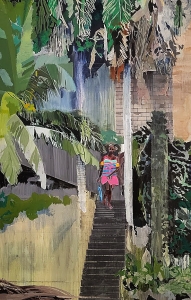
Although Hurvin was not brought up in the Caribbean, he learned a lot about the place by listening to his parents talking about the places they had left. The first room of the exhibition contains paintings he made after seeing his parents’ and their friends’ photographs. They are not copies of the photographs but they depict his impressions of what can be seen in them.
Other rooms contain paintings which he made in the Caribbean while undertaking an artist’s residency in Port of Spain in Trinidad & Tobago. In some of these pictures, he explored the complex relationships between slavery, the Caribbean’s colonial past, and modern social situations. In some of the paintings, he places his subject matter behind a painted barrier, for example a grid or fence, to emphasise the fact that often in the Carribean, some people (black or poor) were excluded from pla es where others (white or wealthy) were admitted. Although many of Hurvin’s paintings contain messages or comments about life in the Caribbean, his emphasis is on the aesthetic, rather than the politics.
One of the many pictures that caught my attention was called “Between Port Radix and Moruga II”. According to its exhibition label, it depicts a Hindu mandir (temple) in Trinidad. It shows a low building in front of which many pennants, each on its own pole, are fluttering in the wind. Tridad has a south Asian community. One of its best-known personalities was the writer VS Naipaul (1932-2018).
Near the end of the show, there is a gallery that contains four paintings that Hurvin created specially for the Tate’s exhibition. These, like all the others on show, are beautifully composed and skilfully executed. Hurvin’s portrayals of both people and nature make a visit to the exhibition extremely enjoyable.

