A COMMANDER OF THE BRITISH EMPIRE AND THE ARTISTIC INTERPRETATION OF COLONISATION

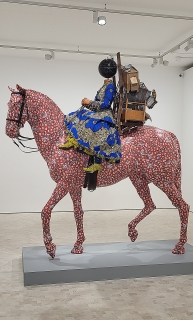
THE ARTIST YINKA SHONIBARE was awarded the prestigious CBE in 2019. In case you do not know what these three letters stand for, it is ‘Commander of the British Empire’ – not that Britain has much of, if any, empire left to boast of. For much of its long existence, places in the British Empire witnessed many injustices and inhumanities. This was especially true before the abolition of the slave trade in the early 19th century. Yinka Shonibare, who was born in London in 1962 and brought up between that city and Lagos in Nigeria, uses his artistic skills to explore Britain’s lengthy history of imperialism imaginatively and creatively. Even without knowing that he does this, his art works are in themselves visually exciting and fascinating to the viewer. The pieces on display until the 1st of September 2024 at the Serpentine South gallery in Kensington Gardens are well worth seeing both for their inherent beauty and for the way that Shonibare expresses his interpretation of Britain’s colonial past and its legacy.

For more information about the exhibition, please visit: www.serpentinegalleries.org/whats-on/yinka-shonibare-cbe-suspended-states/

An artistic British Nigerian in Mayfair

WHEN WE ARE IN LONDON, we make regular visits to the commercial art galleries, many of which are to be found in and around Mayfair. Not only can one get to see some of the most recent works of contemporary artists, but also those that will eventually end up in private collections that are usually inaccessible to the general public. Today, the 12th of October 2023, we were walking along Cork Street, heading towards the Waddington Custot Gallery when we passed a gallery, the Stephen Friedman, which we had never entered before. Through its window, we saw works by an artist, whose oeuvre we enjoy, and entered.

Much of the exhibition at Stephen Friedman is dedicated to creations of the British Nigerian artist Yinka Shonibare. He was born in London in 1962. His Nigerian parents took him to Lagos in Nigeria when he was 3 years old, and he lived there until he was 17. A year later, he developed transverse myelitis, which left him paralysed on one side of his body. Despite this, he went on to study fine art at the Byam Shaw art school, and then later at Goldsmith College (part of the University of London). Because of his disability, Yinka directs a team of assistants to create his artworks (sculptures, photographs, fabrics, and much more). He has become a widely exhibited and highly acclaimed artist.

Yinka’s works are visually engaging and highly imaginative. They are also full of meaning. He uses his creations to:

“… question the validity of contemporary cultural and national identities within the context of globalisation. Through examining race, class and the construction of cultural identity, his works comment on the tangled interrelationship between Africa and Europe, and their respective economic and political histories.” (see https://yinkashonibare.com/biography/)

Although one can easily enjoy the aesthetics of his creations without understanding the artist’s messages contained within them, a good knowledge of colonial and post-colonial history will enhance the viewer’s experiences of them.

The exhibition is on until the 11th of November 2023. In addition to Yinka’s works, he has curated a small, but fascinating, collection of artworks by several artists from the African diaspora.

Visiting an exhibition of outdoor sculptures in a London park

I ALWAYS ENJOY seeing sculptures displayed in the open-air. Until the 29th of October (2023) the annual outdoor Frieze Sculpture exhibition is being held in the south-east corner of London’s Regents Park. As with all the Frieze Sculpture exhibitions I have seen, this one is no exception – it displays a ‘mixed bag’ of artworks. Although many of this year’s exhibits are colourful, creative, and often playful, few of them are exceptional.

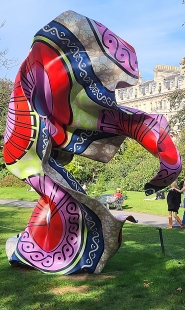
Two works struck me as standing out from the crowd. One of them, created in 2023 by Yinka Shonibare, is a folded work called “Material (SG) IV” (see photograph). This shape of this work resembles a flickering flame frozen in time. Covered in colourful patterns, the artist wanted to depict a piece of printed fabric, such as a sail, blowing in the breeze.  According to the Frieze Sculpture 2023 website, this artist:

“… creates work that explores issues of race and class through the media of sculpture, painting, photography, film, pictorial quilts and public works.”

The website explained that in the work in Regents Park:

“The fabric was originally inspired by Indonesian designs, mass-produced by the Dutch and eventually sold to colonies in West Africa. In the 1960s the material became a signifier of African identity and independence and, in Shonibare’s hands, the ‘perfect metaphor for multi-layered identities’.”

Even though it is interesting to know what was in the artist’s mind when he created the sculpture, it is a visually fascinating and satisfying piece in its own right.

The other work that particularly attracted me was created in 1976 by the artist Louise Nevelson (1899-1988). Born in a city now in Ukraine, she emigrated to the USA in the early 20th century. It was in the States that she studied art, and then created most of her artworks. Painted black, and called “Model for Celebration II”, it is a tall abstract piece, which was:

“… Inspired by the cubist innovations of Pablo Picasso and Henri Matisse, Nevelson reimagines painterly cubism as a sculptural opportunity.” (see https://viewer.mapme.com/frieze-sculpture-2023/location/ca758a4f-1328-48d2-a3cf-6c6b65edf794).

Unlike the other works on display in the park, Nevelson’s work has stood the test of time. So, maybe it was unfair of the curator to include such a work amongst the works of so many newcomers to the ‘art scene’. However, I was pleased to see it, as it is one of the only exhibits that I felt had profundity rather than the immediate and often short-lasting aesthetic appeal of many of the other exhibits.