
Some tiny doors at the Windsor Castle in London’s Kensington

THREE YEARS AGO, I published a book about west London past and present. In it, I made a brief mention of a pub, the Windsor Castle, which is near to Notting Hill Gate. This is what I wrote in the book:

At the western end of Peel Street, there is another pub, The Windsor Castle. Unlike the Peel Arms, this is a working establishment, now popular with the locals, most of whom are definitely not poorly paid labourers. The hostelry was originally built in about 1826, and then remodelled in 1933. The pub contains much of its original late Georgian building fabric and is a Grade II listed place.”

A tiny door

Although the pub is a mere 5 minutes’ walk away from our home, where I have been living for more than three decades, I only entered it for the first time today, the 24th of August 2025. On entering, we were given a warm welcome by the pub’s manager before we sat at a table in the shade of a tall tree that overlooks the hostelry’s enclosed garden.

Within the pub, the furnishings look quite old. A notice on the wall draws the attention of visitors to some very low doorways in the wooden screens that divide the interior into separate rooms. The notice relates that in the seventeenth, eighteenth, and nineteenth centuries, families ran pubs. The children of the landlord and landlady used to work in the pubs, delivering food and drinks. They would enter and exit the areas where the customers were enjoying food and drinks through the tiny doors such as still can be seen at the Windsor Castle, closing the doors behind them. The pub’s patrons were not allowed to use these little doors. They had to stay in the sections of the pub that were reserved for their social status: the public bar, the private bar, the sherry bar, and so on.

Just as I had never entered the Windsor Castle before, I had never seen these tiny doorways in any of many pubs I have visited.

My book “BEYOND MARYLEBONE AND MAYFAIR: EXPLORING WEST LONDON” is available from Amazon: https://www.amazon.co.uk/BEYOND-MARYLEBONE-MAYFAIR-EXPLORING-LONDON/dp/B0B7CR679W/
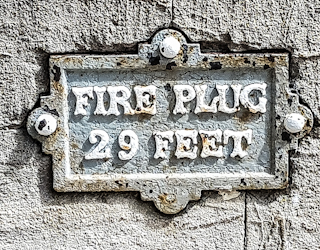
Fire plug


The first time I encountered the term ‘fire plug’ was when I was researching the life of my great grandfather Franz Ginsberg, who died in 1936. As an 18 year old, he went from his home in the German Empire to the South African town of King Williams Town in 1880.  By 1885, he had established a factory for making matches. Such factories are full of raw materials that are prone to catching fire. As his business grew, so did his need for a reliable water supply for dealing with fires. 

Water in the Eastern Cape was expensive in the late 19th century. Franz had to apply to the town council for permission to increase the supply of water to his factory. He also needed permission to install more fire plugs. In my published biography of my great grandfather, I wrote:

“Almost a decade later, in 1898, Franz and his brother-in-law Mr Siegfried Salomon (who married Franz’s sister Ida and was a Town Councillor for a while) both applied to the Town Council to have ‘fireplugs’  placed on their premises. This was allowed on condition that the applicants paid the expense of placing them there; and that they would be liable to other charges including a fine of £25 if they used the water from these for any purpose other than the extinction of fire.”

Recently, I visited Windsor Castle, where I saw several signs such as is shown in the illustration to this blog article. They indicate the locations of fire plugs in the castle. Had I not seen the term ‘fire plug’ before while writing about my ancestor, I might not have noticed these small old-fashioned signs.

So, what, you might be wondering, is or was a fire plug? The modern term for them is ‘fire hydrant’. The fire plugs, which were precursors of fire hydrants were simply holes made in the water mains pipe, which were blocked with a plug. The plug could be removed when water was required to extinguish fires.

I suspect that you are by now asking yourself if Franz ever had to make use of the plugs he had requested. Well, he did occasionally:

In February 1893, the Cape Mercury newspaper published a long article about Franz’s match factory. It begins with a spark of humour:

In December last an unusual illumination made a “King” industry more widely known than before. A fire broke out in, and consumed the drying shed at Messrs. Ginsberg & Co.’s Lucifer Match Factory, which is situated in Victoria Street. The loss was not great, but the advertisement was extensive – and cheap – for it was gratuitous.’”


If you want to know more about my ancestor who went to South Africa in search of prosperity and later became a senator in that country, please read:

Soap to Senate: A German Jew at the dawn of apartheid

by Adam Yamey.

It is available from: lulu.com, Amazon, bookdepository.com  and Kindle