Superb sculptures at a gallery in South London

HE WAS BORN in Chicago (Illinois) in 1935 and as a child was often taken by his mother to public galleries in the city. Maybe at least partly because of this Richard Hunt, who died in December 2023, became an artist. In 1953, he was awarded a scholarship to study at School of the Art Institute of Chicago. It was there that his interest in working with metal began and that he became acquainted with the work of the leading modernist artists of the 20th century. He taugh himself welding, and many of his fascinating sculptures that are on display at the White Cube Gallery in Bermondsey (until 29 June 2025) can be seen, beautifully displayed.

Many of the sculptures consist of bits of waste metal that Hunt salvaged, modified, polished, and welded together. Other sculptures are made of cast metal. Many of Hunt’s works are abstract, but suggest to the viewer that they might also depict transformations of organic forms. Each of the sculptures is intriguing and original. The influences of other artists might be subtly evident in some of them, but they are not at all obvious. The gallery’s website noted:

“Hunt developed a sculptural language that was both deeply personal and richly associative, drawing on a broad array of influences: the forms and rhythms of the natural world; the mythic narratives of Greek and Roman antiquity; his cultural heritage and global travels; the formal vocabulary of European modernism and the legacy of African American civil rights leaders who shaped his time.”

 As one looks at the works on display, many of the things in the quote above become apparent.

Although some of the works at White Cube are quite small, Hunt has produced many huge works – too large to be within the White Cube – that are displayed in public places. I thought that Hunt’s sculptures were wonderful, and was surprided that until visiting this show I had not been aware of his work.  The show at the White Cube was quite a wonderful eye-opener for me and I can strongly recommend seeing it.

Two sculptors: one famous and one forgotten

DURING THE 1950S and the first half of the 1960s, my mother, Helen Yamey, created sculptures in the sculpture workshops of St Martins School of Art, which was then located on Charing Cross Road. Although my mother was not a student at St Martins, she worked alongside one of the school’s teachers of sculpture, the noted sculptor Anthony Caro (1924-2013). Caro became famous for his metal sculptures that consist of pieces of metal either welded or bolted together. While my mother was making sculptures at St Martins, she like other sculptors including Phillip King, Tim Scott, and William Tucker, was undoubtedly influenced by, and learned from, Caro’s work. She learned welding and created several abstract sculptures that consist of pieces of steel welded together. Unlike Caro, who achieved great fame, my mother, who was unambitious and only created sculpture to fulfil a creative urge, my mother and her sculptures became forgotten.

Today, 8 March 2025, we visited the Annely Juda Fine Art Gallery in central London to see a small exhibition of sculptures by Anthony Caro. Unlike many of Caro’s works, the metal sculptures on display, are not enormous. They are small enough to be fitted comfortably into one’s living room or a small garden. Indeed, one of the sculptures, in my opinion the most attractive, has the title “Table Piece CCCXLI”. It was constructed in oxidised steel. The five Caro pieces in the exhibition display a variety of compositional style, and together demonstrate the artist’s versatility. They were all made between 1970 and 1990. My mother left St Martins before this period, sometime in the mid-1960s. I know that she maintained an interest in Caro’s output, but. Sadly, I cannot recall what she thought of its quality.

The exhibition at Annely Juda continues until 15 March 2025. You can read about my mother’s life in art and her time at St Martins in my book “Remembering Helen: My Mother the Artist” [ available from Amazon, e.g.: https://www.amazon.co.uk/REMEMBERING-HELEN-MY-MOTHER-ARTIST/dp/B0DKCZ7J7X/ ]

An email from the USA about a sculpture made of metal

A COUPLE OF DAYS ago (in March 2024), I received an email from the widow of an American (USA) anthropologist with whom my father collaborated many years ago (in connection with the economic aspects of peasant society). She wrote that she had read one of my blog articles about my mother’s career as a sculptor, and wanted to let me know that she and her husband had bought one of them while my mother was alive (she died in 1980).

I asked the lady whether she could send me pictures of the piece they had purchased. She did. The piece is abstract, and made of pieces of steel welded together. At first sight, you might mistake it for a work by Anthony Caro (1924-2013). This similarity might well have arisen because my mother and Caro worked together in the sculpture studios of London’s St Martin’s School of Art.

I was pleased to receive the two photographs of the work because I remember that steel and metal working were my mother’s favourite materials for creating sculptures. After she left St Martin’s, she had a studio in a garage in Golders Green, but did not have access to welding equipment and other tools needed for making steel sculptures. Instead, she created large abstract works from heavy chunks of timber, but this did not satisfy her nearly as much as working with metal. Gradually, she lost enthusiasm for sculpting, which I felt was a great shame.

I am very grateful having received the photographs, and seeing them prompted me to write this short piece.

Soho and a straight horizon

WALKING ALONG CHARING CROSS ROAD in central London recently, a memory of my childhood sprung into mind. When I was about eight years old, I was told off by my art teacher at school because the horizon on my painting was not straight enough for her. She told me that I should have used a ruler. When I related this incident to my mother, she was quite annoyed because, in her opinion, it did not matter whether a horizon was drawn ruler straight or not. I hoped that she would not complain to the school about her feelings about the ineptitude of the art teacher. I do not recall that she bothered to do so.

My mother was an artist, whose works became increasingly abstract as she grew older. Before WW2, she trained to become a commercial artist at the Michaelis School of Fine Art in Cape Town (South Africa). Her earliest works, which I have never seen, were hand-painted posters, advertisements for the latest films (movies). In 1948, she followed my father from Cape Town to London, where he had taken up an academic post at the London School of Economics. They married in 1948 and, according to my father, Mom took painting classes with the now famous Stanley Spencer (1891-1959). Interestingly, I never heard my mother mentioning these classes.

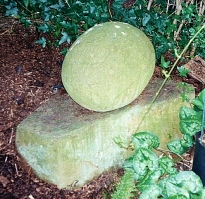
Stone sculpture by Adam Yamey’s mother

I was born in 1952, and it was around then that my mother began creating sculpture. One of her earliest sculptures was in terracotta and its subject matter was a mother, seated, holding a child, maybe me. During the late 1950s and early part of the 1960s, my mother worked in the sculpture workshops at St Martin’s School of Art, which was then located on Charing Cross Road. The Sculpture Department was then under the directorship of Frank Martin (1914-2004), whom my mother referred to as ‘Mr Martin’ when talking to us at home.  It was there that she worked alongside sculptors, who have since become quite famous. These included Menashe Kadishman (1932-2015), Buky Schwarz (1932-2009), Philip King (1934-2021), and Antony Caro (1924-2013). The latter two helped her learn how to weld and create sculptures in metal, a medium she preferred. It was probably at St Martins that my mother met the sculptor Elizabeth Frink (1930-1993), who also taught in the Sculpture Department. She and Mom became close friends. ‘Liz Frink’, as she was known in our family, was a regular visitor to our home in northwest London.

My mother used to work at St Martins several days a week. She used to do a lot of the family’s food shopping nearby in Soho’s Old Compton Street. Vegetables were bought from a French greengrocer, and meat from a Belgian butcher called Benoit Bulcke. This butcher, according to Mom, knew how to cut meat correctly, unlike most English butchers. As a young child, I accepted that this was the case if Mom said so. The butcher and the greengrocer no longer exist. However, three other stores she frequented are still in business: The Algerian Coffee Store; Camisa; and Lina Stores. My mother was an early disciple of the cookery writer, Elizabeth David (1913-1922), and her encouragement of the preparation of French and Mediterranean dishes. The proximity of St Martins to Old Compton Street was convenient for my mother, as the shops along it provided many ingredients, which were hard to find elsewhere in London in the 1950s and early 1960s.