
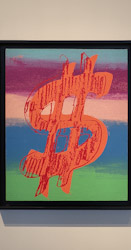
ONCE AGAIN, THE MK Gallery at Milton Keynes has put on a superb exhibition. Until 29 June 2025, there is a show of artworks by the artist and film maker Andy Warhol (1928-1987), who was born in the USA. Best known for his multiple portraits of figures such as Marilyn Monroe and Mao Tse Tung and Pop Art images, there is much more than this on display at the MK.
The first room of the show contains work that Warhol created in the 1950s and early 1960s. Like artists such as Picasso and Hockney, whose creative lives began with works that were not as experimental and novel as their later works, Warhol’s earlier, less revolutionary, images show that he was a competent draughtsman capable of producing highly acceptable ‘straightforward’ compositions. It was interesting to see his earlier works because they are rarely displayed in public galleries. And it is always nice to see how an artist who is best known for his or her more extraordinary creations began his or her creative output.

The exhibition includes many of Warhol’s Pop Art images including those of Marilyn and Mao, but also there are several of his portraits of other figures. These include the artist Basquiat, the politician Barry Goldwater, Marcel Duchamp, Joseph Beuys, Muhammad Ali, and Liz Taylor. What I found interesting was that amongst the portraits on display, there were a few of the British artistic couple Gilbert and George. As the exhibition booklet related:
“The British artistic duo Gilbert and George , like Warhol, explored the interplay between personal and public identity, often blurring the lines between performance and art.”
Warhol’s portraits of this couple reflect their own graphic artistic style.
Other images on display relate to the Cold War and to the electric chair. The images on display in the show include drawings, prints, posters, and photographs (often adjusted to create interesting artistic effects). There are also exhibits relating to Warhol’s prolific output of films. He made about 600 of them. It would have been interesting to have been able to see extracts from some of them.
In brief, this is an exhibition that is worth travelling to. Apart from being beautifully displayed alongside helpful information panels, it is worthy of a visit to be able to enjoy seeing this artist’s rarely seen early works.
 yamey
yamey 