
Is nothing sacred?

A LONG WALL on the south bank of the River Thames faces the Houses of Parliament. It is literally covered with hearts painted in red. Each heart is supposed to commemorate one of the more than 220,000 people who died of covid19 in Britain. Families and friends of the victims can write the names of their lost ones on the hearts on this wall – the National Covid Memorial Wall. For those who work in the Houses of Parliament and those who walk past it, this heart covered wall is a chilling and moving reminder of a terrible period during the recent history of Britain as well as the rest of the world.

A group of volunteers:

“… repaint faded hearts, re-write dedications that are being absorbed into the Wall, remove graffiti, and look after the Wall to ensure that those lost to Covid19 in the UK are remembered as people, not as a statistics.” (www.nationalcovidmemorialwall.org/)

Recently, we watched some of these generous people, some of them mounted on ladders, working with their paint brushes. As we walked alongside the wall, reading some of the names of people who were killed by the covid virus, we noted that not all of the inscriptions were dedicated to remembering the dead. Some of them, it is sad to relate, were tasteless graffiti and statements such as “X loves Y”. It is these thoughtless additions to a wall of sorrow that the dedicated volunteers work to eradicate. Seeing these irreverent and irrelevant ‘blots’ on the wall made me think “is nothing sacred?”
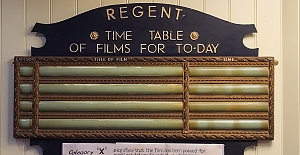
Regent: a cinema regenerated in a small town in Dorset

OVER THE YEARS, many cinemas that were opened in the first half of the 20th century have either been closed or converted to be used for other purposes. A substantial number of them were built in the Art Deco style, which flourished in the 1920s and ‘30s. Some cinemas, such as the Ionic and the ABC in Golders Green and the Odeon in Temple Fortune, have been demolished. Others became bingo halls or meeting places for religious groups. The Coronet in Notting Hill Gate began life as a theatre, then became a cinema, and is now a theatre again. During a recent visit to Christchurch in Dorset, I saw a cinema, designed in the Art Deco style, which is still in business.

The Regent Cinema stands on Christchurch’s High Street. It is in pristine condition – a fine example of Art Deco architecture and internal design – it looks as if it has been built recently. Opened on Boxing Day 1931, it continued showing films until it closed in July 1973. After that, like so many other cinemas, it was operated by the Mecca company as a bingo hall and social club. This functioned until it closed in 1982. Late that year, the building was purchased by Christchurch Borough Council.

The local authority together with over 100 volunteers restored the Regent to its original Art Deco glory. In June 1983, the Regent Centre with its cinema were opened for use. Since then, the restoration of the cinema has continued and technological improvements have been made (e.g., digital cinema has been introduced). Very recently (in 2021) further work has been done to recreate the original cinema (e.g., the cinema’s seats, carpet and colour schemes, have been restored to their original appearance, and 35 mm projection has returned). Given all this loving care the cinema has received, it is no wonder that it looks like new. Now, it is mainly run by keen volunteers.  It is very heartening to discover a cinema that has survived closure and repurposing and lived to return to being used for the purpose it was originally designed. On the Sunday morning that we visited it, we were unable to enter the auditorium because it was filled with children enjoying the screening of a film. However, the ticket office contains a good set of photographs of the restored cinema’s interior.