
Threatened by Heathrow Airport

THE PARISH CHURCH of Harmondsworth is about 1.7 miles northwest of Heathrow Airport’s Terminal 1, yet it feels as if it were much further from it, maybe in the heart of the countryside. What was once a small village in rural Middlesex has now been engulfed by London’s westward spread. However, the old village green retains a certain rustic charm.
The name of the place derives from the name of a person, ‘Hermode’ or ‘Harmond’ and the Anglo-Saxon word ‘worth’ meaning a farm or enclosure. Set in what was once fertile farmland that provided corn and green crops for the London markets, it is now a mainly residential area. Writing in 1876 in his “Handbook to the Environs of London”, James Thorne remarked:

“The village of Harmondsworth is small and not remarkable …”

Writing 146 years later, I must disagree. The place is remarkable for retaining some of its rural atmosphere. The village green is surrounded by a row of picturesque old cottages, a slightly newer-looking village store (Gable Stores), and two pubs (The Crown and The Five Bells [formerly ‘The Sun’]), and the entrance to the churchyard of the parish church of St Mary.

The vicar of St Mary kindly unlocked the church for us. According to a history of the church by Douglas M Rust, it is probably located near the site of a pagan place of worship on one of the quintarial lines defined by Roman surveyors’ landmarks. The archaeologist Montagu Sharpe, writing in volume 33 of the “English Historical Review”, published in 1918, observed:

“Two curious discoveries came to light after the quintarial cross-lines had been drawn, making each pagus appear like a gigantic chequer-board. The first was, that 47 out of 56 mother churches of parishes in Middlesex were situated upon one or other of these lines, the apparent explanation being that Romano-British chapels (compita) adjoined the principal rural ways, which were designed to follow the quintarial lines. In the next age these little edifices were adopted by missionaries for Christian worship, following the astute and well-known direction of Pope Gregory to utilize the pagan sacra where the people had been accustomed to assemble. If so, then such sites have been associated with public worship, first pagan, then Christian, for nearly 2,000 years.”

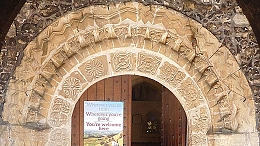
Be that as it may, the present parish church in Harmondsworth was constructed from the 12th century onwards, much of it before the 16th century. In the 18th century, a cupola was added to the bell tower. In the following century, repairs and restoration was undertaken. The south entrance has a decorated carved stone Norman archway. The carved capitals of the pillars on the south side of the nave are 12th century. The westernmost pillars on the north side of the nave are 13th century, whereas the four pillars to the east of these are 16th century. The chancel, which is supported by the newer pillars was constructed later than the nave. Where the newer part was joined to the older, there is a discontinuity in the stonework of the arch that joins the nave to the chancel: the two halves of the arch do not match each other. The pointed arches along the north side of the nave are Perpendicular gothic in style, whereas those north of the chancel are a Tudor design.

The tower of the flint covered church used to be the tallest building in Harmondsworth until the control tower at nearby Heathrow Airport was constructed, Douglas Dark mentioned of the church:

“Little did the early builders realise that their church was later to become the parish church of the manor where many visitors to Britain first arrive.”

A few yards northwest of the church, there is another treat awaiting visitors to Harmondsworth. This is the Harmondsworth Barn, which was constructed 1425-27 on land bought in 1391 by William of Wykeham (c 1320-1404), Bishop of Winchester, to endow Winchester College. It is now maintained by English Heritage, from whose website I gleaned the following information:

“Used mainly to store cereal crops before threshing, it remained in agricultural use until the 1970s. At 58 metres (192 ft) long and 11.4 metres (37 ft 6 in) wide, the barn is one of the largest ever known to have been built in the British Isles, and the largest intact medieval timber-framed barn in England.”

The barn’s main purpose was to store locally grown cereals (e.g., wheat, barley, and oats) and was still in use during the 1970s. Its interior is a fine example of well-preserved mediaeval carpentry. The barn is located on the eastern edge of what was once Manor Farm, through which a stream of the River Colne flowed. The erstwhile farm covered the probable site of a long-since demolished Benedictine Priory.

James Thorne noted that the barn had once been ‘L’ shaped, rather than rectangular as it is today. The part of it that had made it shaped like an ‘L’ was taken away and relocated elsewhere. To quote Thorne:

“This wing was taken down about the same time as the Manor House and rebuilt at Heath Row, 1 ½ miles S.E. of Harmondsworth church. This, which is known as the Tithe Barn, exactly resembles the Manor Barn in structure, except the walls are of brick…”

Well, ‘Heath Row’ is now ‘Heathrow’ and this fragment removed from the barn at Harmondsworth no longer exists. I located it on a map surveyed in 1862. It then stood on a road or lane that ran south from the Bath Road to Perry Oaks Farm on the western edge of Heathrow village. This land is now covered by the airport terminals (1,2, and 3).

Harmondsworth village has a few other old buildings apart from those already mentioned. One of them is Harmondsworth Hall, which Wendy Tibbits described in her blog (www.wendytibbitts.info) as follows:

“This grand-sounding building was built in the early 1700s, but still has elements of a fire-damaged Tudor building which was on this site. The central chimney and a fireplace are remnants of the former hous. … In 1910 this house was the first house in Harmondsworth to have its own electricity supply.”

Both Ms Tibbits and the vicar of the parish church fear for the future of Harmondsworth should plans to extend Heathrow Airport are carried out. Most of the old village will be demolished, leaving the church and the barn. Ms Tibbits noted:

“If the London Airport Expansion plans go ahead eleven listed buildings in Longford, and twelve in Harmondsworth will be demolished, along with hundreds of other homes. Only Harmondsworth medieval Great Barn and its Norman church will survive the destruction, but who will want to visit them when they will be meters from the airport’s perimeter fence?”

Although extending the airport might benefit the country, it would be sad to lose yet more of Britain’s heritage.

The abolitionist’s country home: Wilberforce in north London

THE RIDGEWAY IN MILL HILL, with spectacular views over north London and the nearby countryside from each side of it, is a pleasant place to wander. St Pauls Church is a simple Gothic revival edifice. It stands across the road from the famous Mill Hill School (established in 1807) and one of a line of three war memorials separated from each other by a few yards. The church has a plaque attached to it that informs the viewer that it was built by the anti-slave trade activist and politician William Wilberforce (1759-1833), consecrated in 1833, and became a parish church in 1926.

While we were looking at the plaque, a man (a cleric) arrived by car, unlocked the church, and invited us inside. We asked him about Wilberforce and his connections with Mill Hill. He told us that the great abolitionist had lived in Mill Hill and was for a short while the neighbour of his friend Sir Stamford Raffles (1781-1826), who is best known for his ‘founding’ of Singapore. Our new acquaintance explained that Raffles’ widow, his second wife, was buried in the churchyard of St Pauls (Mill Hill), but not the great man himself. Raffles, who was an abolitionist, was disliked by Theodor Williams, the Vicar of the parish of Hendon in which Mill Hill lay, who was sympathetic to slavery because his family had profited from slavery in Jamaica. Williams insisted that Raffles be buried outside the parish church rather than within it. Until 1914, the whereabouts of Raffle’s remains were unknown until they were stumbled upon by accident in a vault whilst the ground was being dug up to build an extension to the church. In contrast, his one-time neighbour, Wilberforce was interred in Westminster Abbey.

As an aside, but one which is important for me who has an interest in double-headed eagles, the Raffles coat-of-arms includes one of these imaginary creatures.

Returning to Wilberforce and Raffles, our informant told us that they were neighbours at Highwood Park (on Highwood Hill), 1100 yards northwest of St Pauls. William Hague, politician, and author of a biography of William Wilberforce (first published in 2008), wrote that the abolitionist moved into his new home in Mill Hill on the 16th of June 1826. Wilberforce wrote:

“I shall be a little zemindar, one hundred and forty acres of land, cottages of my own, etc.”

By ‘zemindar’, he was referring to ‘zamindar’, the Hindustani word meaning ‘landowner’. Wilberforce’s neighbour, Raffles, was already installed at Highwood Park when the abolitionist moved next door. Raffles wrote of his home there (quoted in “Handbook to the Environs of London” by James Thorne [publ. 1876]):

“A happy retirement … a house small but compact … Wilberforce takes possession tomorrow of the next-door house so that we be next-door neighbours and divided the hill between us.”

Sadly, Raffles died on the 5th of July 1826, shortly after his friend Wilberforce moved on to Highwood Hill.

Before moving to Mill Hill, Wilberforce had lived for some time in Kensington Gore, which runs along the south side of Kensington Gardens. His home from 1808 to 1821 was Gore House, built in the 1750s and set in three acres of grounds. It had interiors designed by Robert Adam, but sadly it was demolished and eventually replaced by the Royal Albert Hall, which occupies the site of the house and its grounds. Writing in the 1880s, Edward Walford quoted Wilberforce as having written of Gore House:

“We are just one mile from the turnpike at Hyde Park Corner, having about three acres of pleasure-ground around our house, or rather behind it, and several old trees, walnut and mulberry, of thick foliage. I can sit and read under their shade with as much admiration of the beauties of nature as if I were down in Yorkshire, or anywhere else 200 miles from the great city.”

Highwood Hill on the edge of London would have provided the ageing Wilberforce with what he had enjoyed at Gore House but without being so close to the heart of London.

Prior to moving into Mill Hill, Wilberforce had lived in Marden Hall in Surrey and at ‘The Chestnuts’ on Honeycroft Hill in Uxbridge. Unfortunate circumstances led to Wilberforce having to leave Mill Hill prematurely. These included financial difficulties arising from falling income from his land in Yorkshire and losses incurred by his son William. By the end of 1830, Wilberforce and his wife decided that they had to move out of their home on Highfield Hill. They moved to Brighstone on the Isle of Wight, and then later to East Farleigh in Kent.

Wilberforce felt that there was one disadvantage of Mill Hill when he moved there in 1826. The problem was that the nearest church, the parish church at Hendon, was three miles away. William Hague explains what happened next. Here is a summary of what he wrote. In Spring 1828, Wilberforce spent two months in London during which he approached the Church Commissioners regarding establishing a new church near his home in Mill Hill. At first, his plans for the church were welcomed by Theodor Williams, the Vicar of Hendon, who was, as already noted, unfriendly to the anti-slavery movement. However, once the construction of the chapel, the present St Pauls on the Ridgeway, began, Williams reacted vigorously against the idea.  Hague is not certain what caused this change of heart on Williams’ part. One reason might have been that there was an Act of Parliament that allowed the founder of a new church to select and appoint its vicar. Another was that Williams was known not to like the Evangelicals, which included Wilberforce and other promoters of the abolition of slavery.

Despite the difficulties raised by the Vicar of Hendon, the chapel was built, but remained a chapel rather than a parish church until 1926. We liked the simple architecture of the spacious church, but this view was not shared by the architectural historian Nikolaus Pevsner and his co-author Bridget Cherry, who wrote:

“A typical cheap church of its date in the Commissioners’ style…”

The church contains some attractive stained-glass windows. That above the high altar at the eastern edge of the church is a copy, in painted glass, of “Dead Christ and Three Marys” by Annibale Carracci (1557-1602). It was created by Charles Muss (1779-1824) and WG Hodgson and dated 1809. Muss was an enamel painter to King George IV. Three other remarkable windows were created more recently (www.stpaulschurchmillhill.co.uk/jubilee-window.php). One of them, illustrated above, depicts chains and alludes to Wilberforce and slavery; another commemorates the Middlesex Regiment, which used to have some barracks in Mill Hill; and the third celebrates the Diamond Jubilee of Queen Elizabeth II.

We drove to Highwood Hill to see what, if anything, is left of the houses occupied by Raffles and his neighbour Wilberforce. Highwood House, built soon after 1817 and much altered since, was hidden from view behind dense vegetation and by a building close to the road. Just east of this across the narrow Nan Clarks Lane, there is a decaying wooden signboard to which a metal commemorative plaque is affixed, which faces the main road, Highwood Hill (the A5109). The plaque bears the words:

“Site of Hendon Park residence of William Wilberforce from 1826 to 1831.”

Behind the sign, there is a newish wooden fence, the boundary of a small estate of large residential houses. Hendon park was:

“… a substantial brick building in 1756 … was rebuilt and stuccoed in the early 19th century … it had fallen into neglect by 1951 and had been replaced by three houses and Crown Close by 1961 …” (www.british-history.ac.uk/vch/middx/vol5/pp21-23).

We left Mill Hill, having learnt much about two men, whose connection with the place we were previously unaware. There is far more to Mill Hill than this and I hope to write about other aspects of this lovely part of London in the future.