
The house in the desert and a fighter for the independence of India

A NARROW ROAD LEADS away from the town of Mandvi (in Kachchh, a part of Gujarat) into an arid sandy area close to the seacoast. Scrubby bushes populate most of this flat terrain. After a few miles, a red building can be seen on the horizon. As you approach it, you can see that it resembles no other in the surrounding area, or, for that manner, in any other part of India. However, if you are a Londoner, it would seem familiar, although quite incongruous.
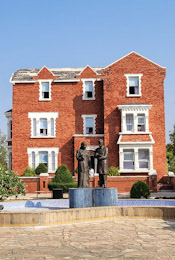
Replica of India House near Mandvi, Kachchh

The house in the desert is an accurate replica of a typical Victorian house, such as can be found in North London. In fact, it is a full-size copy of number 65 Cromwell Avenue in London’s Highgate area. The reproduction near Mandvi was built as part of a complex to commemorate Shyamji Krishnavarma (1857-1930), who was born in the centre of Mandvi.

Krishnavarma, who became a barrister and worked in various Princely States, moved to London, where he lived until about 1907. He moved to Paris, and then to Geneva, where he and his wife lived until they died.

In London, Krishnavarma lived opposite Highgate Woods. He invested wisely, and became interested in the works of English men, who had their doubts about Britain’s domination of India. He became an opponent of British rule in the Indian subcontinent. At first, his interest was mainly intellectual. However, in 1905, following the partition of Bengal, he became an activist.

One of his several activities was to purchase number 65 Cromwell Avenue. He had it adapted to become a ‘home away from home’ for Indians studying in London – they frequently had to endure the racist attitudes of English people. He named the building ‘India House’ (which should not be confused with the present Indian High Commission in London).

Apart from providing Indian food, some accommodation, and some leisure facilities, India House also hosted meetings that discussed the injustice of British rule in India. Soon, India House attracted the attention of the British police. This was because India House was becoming a nucleus or hotbed of anti-British activism. For example, some of the people who frequented the House experimented with bomb making and smuggling firearms to freedom fighters in India.

Krishnavarma left London in 1907, when he feared that he might be arrested. India House continued to be active until mid-1909 when one of its visitors assassinated an important colonial official.

Krishnavarma wrote in his will that after he was cremated, his ashes should be returned to India only after it had become independent of the British.

In the early part of this cemetery, the Chief Minister of Gujarat, then Narendra Modi, decided to bring Krishnavarma’s ashes to India – to Mandvi. Some years later, a complex to commemorate Krishnavarma was built outside Mandvi. Part if this is the replica of Highate’s former India House. The ashes of Krishnavarma and his wife are stored in urns on display in a building next to the replica.

If this story interests you and you want to know much more about India House, its replica, Krishnavarma and his fellow freedom fighters, including the currently influential VD Savarkar, you should read my, dare I say it, very informative book. I have produced two versions of it. One, the latest edition is “Indian Freedom Fighters in London 1905-1910), and is available here: https://www.amazon.co.uk/gp/aw/d/0244270716/ . The other “Ideas, Bombs, and Bullets”, which can only be delivered to addresses in India in available here: https://store.pothi.com/book/adam-yamey-ideas-bombs-and-bullets/.

Hall of fame

CAXTON blog

Caxton Hall is close to major London landmarks such as Westminster Abbey, the Houses of Parliament, St James Park, and Buckingham Palace. Yet, it is hidden away in Caxton Street, not only from the casual visitor but also from the attention of contemporary London life. However, this has not always been the case.

Built as Westminster’s Town Hall in 1878-82, it was designed by the architects W Lee and FJ Smith. Its architectural style has been described as an “Ambitious but coarse essay in Francois I style”.[1] It is distinctive looking building that attracts the eye.

The Town Hall contained two large public spaces known as the Great and York Halls[2]. Prior to the 1930s, these halls were used for a variety of gatherings including political meetings. Between 1933 and 1979, Caxton Hall became a registry office where weddings (often of celebrities) were held.

In 1900, the first Pan African Conference was held in Caxton Hall. From February 1906, it was the venue for meetings of The Women’s Social and Political Union, which was founded in 1903 by Emmeline Pankhurst, a fighter for women’s suffrage. Being close to the Houses of Parliament, Caxton Hall was a convenient place for the women to gather before their regular marches to the home of Parliament.

On the 1st of July 1909, Sir William Hutt Curzon Wyllie was shot dead at the Imperial Institute in South Kensington by an Indian nationalist, Madan Lal Dhinghra, from the Punjab. On the 5th of July[3], four days after the assassination, many Indians gathered at Caxton Hall to condemn the actions of Madan Lal Dhingra. Although most of those attending supported the motion “ that those present at the meeting and all the communities of Indians both in India and Great Britain express horror and condemnation of the murders of Curzon Wyllie …”, there was at least one person who opposed it as this extract from my book “Ideas, Bombs, and Bullets” describes:

“When the Chairman announced that the resolution had been passed unanimously, Veer Savarkar, who was in the audience, shouted:

No, not all!

Thereupon, mayhem broke out. People were filled with fear as many of them knew Veer’s connections with revolution and bomb-making . Many shouted that he should be thrown out and a few chairs were brandished angrily. A Mr Edward Palmer[4], of mixed British and Indian ancestry, took it upon himself to:

“… plant a truly British blow between the eyes of Savarkar who had raised a chair to fell me… ”

Tirumal Acharya, who helped to defend Veer from further attacks by Palmer, first thrashed Palmer and then began helping his friend get away from the hall .  Before this, VVS Aiyar had threatened Palmer with a gun, but Veer winked at him to restrain him . A few days later, Virendranath Chattopadhyaya, who was unable to attend the meeting, wrote to the London Times, saying that if he had been present, he would have supported Veer’s objection even at the risk of being thrown out . He added that although he objected to the resolution and believed in the right to express one’s own opinion, he did not consider that assassination and anarchism was the right way to achieve the independence of his country.”

For those who do not know, Veer Savarkar (VD Savarkar: 1883-1966) has assumed great importance in today’s India. He was a prolific writer, an Indian nationalist and freedom fighter, and helped formulate the concept/philosophy of Hindutva, which is part of the foundation of Hindu Nationalism.

Although Savarkar did not remain in the UK for much longer after this meeting, seeing Caxton House, now converted to luxury dwellings, and knowing its connections with those people I have researched in some detail sends a shiver down my spine.

“IDEAS, BOMBS, and BULLETS”

by Adam YAMEY

is available from:

Amazon, bookdepository.com, lulu.com, and Kindle

Notes to the text of the blog:

[1] https://historicengland.org.uk/listing/the-list/list-entry/1357266

[2] https://en.wikipedia.org/wiki/Caxton_Hall

[3] Much detail from Times (London) 6 July 1909

[4] Edward Palmer was of mixed Indian and British descent. Maybe, it was he who founded Veeraswamy’s Restaurant in London in the 1920s (see: https://erenow.net/biographies/white-mughals-love-and-betrayal-in-eighteenth-century-india/1.php, and https://www.historic-uk.com/CultureUK/The-British-Curry/, both accessed 15 June 2019)